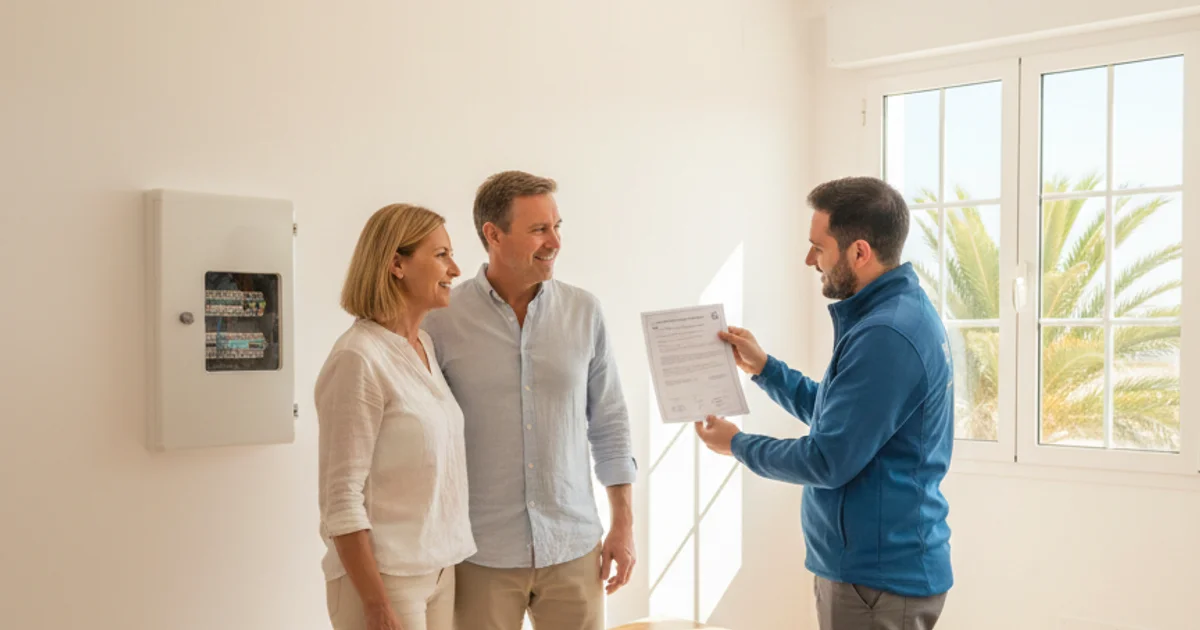
If you've recently moved to Spain or bought property here, you've probably heard the term boletín eléctrico thrown around. Estate agents mention it, your gestor asks about it, and the electricity company wants one before they'll do anything.
Spanish bureaucracy can feel overwhelming when you're navigating it in a second language. This guide will explain everything you need to know about the electrical certificate system in plain English - consider it your go-to resource for understanding this essential document.
Whether you're buying, selling, renting, or renovating property on the Costa del Sol, at some point you'll need to understand the boletín. Let's demystify it.
What is a boletín eléctrico?
The boletín eléctrico - officially called the Certificado de Instalación Eléctrica (CIE) - is an official certificate confirming that your property's electrical installation meets Spanish safety standards.
These safety standards are defined by the REBT (Reglamento Electrotécnico de Baja Tensión) - Spain's electrical regulations, similar to the UK's BS 7671 wiring regulations.
If you're from the UK, think of it as similar to an EICR (Electrical Installation Condition Report), but with important differences: in Spain, this certificate has legal implications and is required by electricity companies to set up or transfer your supply.
Key facts about the boletín eléctrico:
- Valid for 20 years from the date of issue
- Must be issued by an instalador autorizado (authorised electrician) registered with the Junta de Andalucía
- Gets registered with the regional government's industry department
- Required by electricity companies (Endesa, Iberdrola, etc.) for supply connections and transfers
When do you need a boletín eléctrico?
Here's when you'll encounter the certificate requirement in Spain:
Buying a property
When you purchase a property, you'll need the boletín to transfer the electricity supply into your name. The electricity company won't do the transfer without a valid certificate if the installation is over 20 years old or has been modified.
Selling a property
While not legally required to complete the sale at the notary, your buyer will need the certificate to get the electricity in their name. Smart sellers get this sorted before listing to avoid delays.
Renting out your property
If you're letting out your property, tenants setting up their own electricity account will need a valid certificate. This is especially important if you're applying for a tourist rental licence - you'll need your paperwork in order.
After major renovations
If you've done significant electrical work - adding circuits, moving the consumer unit, or upgrading the installation - you'll need a new certificate to reflect the changes.
Increasing your contracted power
Want to upgrade from 4.6kW to 6.9kW to run air conditioning or an electric car charger? The electricity company will likely request a certificate to confirm your installation can handle the increased load.
Reconnecting disconnected electricity
If the property has been given de baja (supply disconnected) for an extended period, reconnecting requires a fresh certificate.
New electrical installations
Any brand new electrical installation - whether in a new build or a complete rewire - requires certification before connection.
What happens during the inspection?
Knowing what to expect makes the process less stressful. Here's how a typical inspection works:
The authorised electrician visits your property. The inspection usually takes 30-60 minutes depending on the size of your home. They'll check:
- The consumer unit (cuadro eléctrico) - checking breakers, RCDs (diferenciales), and overall condition
- Circuit testing - testing each circuit throughout the property
- Sockets and light fittings - checking they're properly installed and safe
- Earthing (toma de tierra) - verifying the earth connection exists and works correctly
- Cable condition - checking for any visible damage or undersized wiring
If everything passes: The certificate is issued the same day or within 24-48 hours. It gets registered electronically with the Junta de Andalucía.
If issues are found: The electrician will explain exactly what needs fixing before a certificate can be issued.
What if my property fails the inspection?
Don't panic - this happens more often than you might think, and it's completely fixable.
Many older Costa del Sol properties, especially those built in the 1970s, 80s, and 90s, don't meet current standards. Electrical regulations have changed significantly since then, and what was acceptable 40 years ago isn't today.
Common issues we find in Málaga properties:
- Missing earth wire (toma de tierra) - Very common in older buildings. The two-pin sockets from decades past had no earth connection.
- Outdated consumer unit - Old ceramic fuse boxes or panels without proper RCD (diferencial) protection.
- Undersized cables - Wiring that was fine for 1980s appliances can't handle modern loads.
- No RCD protection - Modern regulations require these life-saving devices that trip when they detect a fault.
- Degraded insulation - Older cables may have brittle or damaged insulation.
The good news? The electrician will explain exactly what needs fixing. You'll get a clear quote before any work begins. Most repairs can be completed within a few days to a week.
Once the repairs are done, a re-inspection is carried out, and your certificate is issued. It's better to discover and fix these issues now than have an electrical problem later.
How much does a boletín eléctrico cost in Málaga?
Here are realistic costs for the Málaga area in 2026:
- Inspection + certificate (no repairs needed): €100 - €200
- Consumer unit replacement: €300 - €700 additional
- Adding earthing: €200 - €500 depending on complexity
- Full rewire (older apartment): €2,000 - €5,000+
The inspection fee typically includes the certificate registration with the authorities. Always ask for a detailed quote before approving any repair work.
If your property is relatively modern (built after 2000) and hasn't been modified, you'll likely just pay the basic inspection fee.
How to get a boletín eléctrico: step by step
Here's the simple process:
- Contact an authorised electrician (instalador autorizado) - make sure they're registered with the Junta de Andalucía
- Schedule the inspection visit - we can often arrange this within a few days
- The electrician inspects your installation - this takes 30-60 minutes
- If passed: Certificate is issued and registered (same day or within 48 hours)
- If repairs needed: Get a quote, approve the work, repairs are completed, then re-inspection
- You receive your official certificate - keep it safe with your property documents
- Use it for utility transfer, property sale, rental setup, etc.
The whole process - if no repairs are needed - can be completed in a single visit.
Practical tips for expats
Here's advice we share with the expats we work with across the Costa del Sol:
- Keep your boletín with your property documents - alongside your escritura (title deed), receipts, and other important papers
- Note the expiry date - it's valid for 20 years, so set a reminder
- If buying property, ask for the boletín before completing - don't leave it to chance
- If your property is older, budget for potential updates - it's common and not a disaster
- An authorised electrician can help with utility paperwork - we regularly help clients navigate Endesa, Iberdrola forms and requirements
- Never use unregistered "handymen" for electrical work - they can't issue legal certificates, and the work may not be safe
Glossary: Spanish electrical terms in English
Keep this handy when dealing with paperwork or speaking to Spanish contractors:
| Spanish term | English equivalent |
|---|---|
| Boletín eléctrico / CIE | Electrical certificate |
| Cuadro eléctrico / Cuadro de distribución | Consumer unit / Fuse box |
| Diferencial | RCD (Residual Current Device) |
| Magnetotérmico | MCB (Miniature Circuit Breaker) |
| Toma de tierra | Earthing / Earth connection |
| REBT | Spanish electrical regulations |
| Instalador autorizado | Authorised electrician |
| Junta de Andalucía | Regional government of Andalusia |
| Alta / Dar de alta | Connect / Set up (electricity supply) |
| Baja / Dar de baja | Disconnect / Cancel (electricity supply) |
Frequently asked questions
What is a boletín eléctrico and why do I need one?
A boletín eléctrico (officially Certificado de Instalación Eléctrica or CIE) is an official Spanish electrical certificate confirming your installation meets safety standards. You need it to connect or transfer electricity supply, after renovations, when increasing power, or when selling/renting property.
How long does a boletín eléctrico last in Spain?
A boletín eléctrico is valid for 20 years from the date of issue. After this period, you'll need a new inspection and certificate if you want to make changes to your electricity supply or contract.
Can I transfer electricity without a boletín eléctrico?
Generally no. Spanish electricity companies (Endesa, Iberdrola, etc.) require a valid boletín to transfer the supply into a new name, especially if the installation is over 20 years old or there have been changes to the electrical system.
How much does an electrical certificate cost in Málaga?
The inspection and certificate typically costs €100-€200 if no repairs are needed. If the installation requires updates (common in older properties), repairs can add €300-€700+ depending on the work required. See our electrical certificate service page for details.
What happens if my electrical installation fails the inspection?
Don't worry - this is common, especially in older Costa del Sol properties. The electrician will explain exactly what needs fixing. Common issues like outdated consumer units or missing earthing can usually be repaired within a few days, then a re-inspection is done and the certificate issued.
Need help with your boletín eléctrico?
At VLR Instalaciones, we work regularly with expats and estate agents across the Costa del Sol. We understand that navigating Spanish bureaucracy in a second language is frustrating - that's why we're happy to explain everything in English and guide you through the process.
We cover Marbella, Fuengirola, Benalmádena, and all of Málaga province. With over 20 years of experience and 300+ five-star reviews, we've helped thousands of property owners get their electrical certificates sorted.
What we offer:
- Fast turnaround - often same-week appointments
- Clear explanations in English
- Transparent pricing with no surprises
- Help with utility company paperwork if needed
- Repairs and upgrades if your installation needs work
Visit our electrical certificate (boletín eléctrico) page for more information, or give us a call. We're here to help make this process as painless as possible.