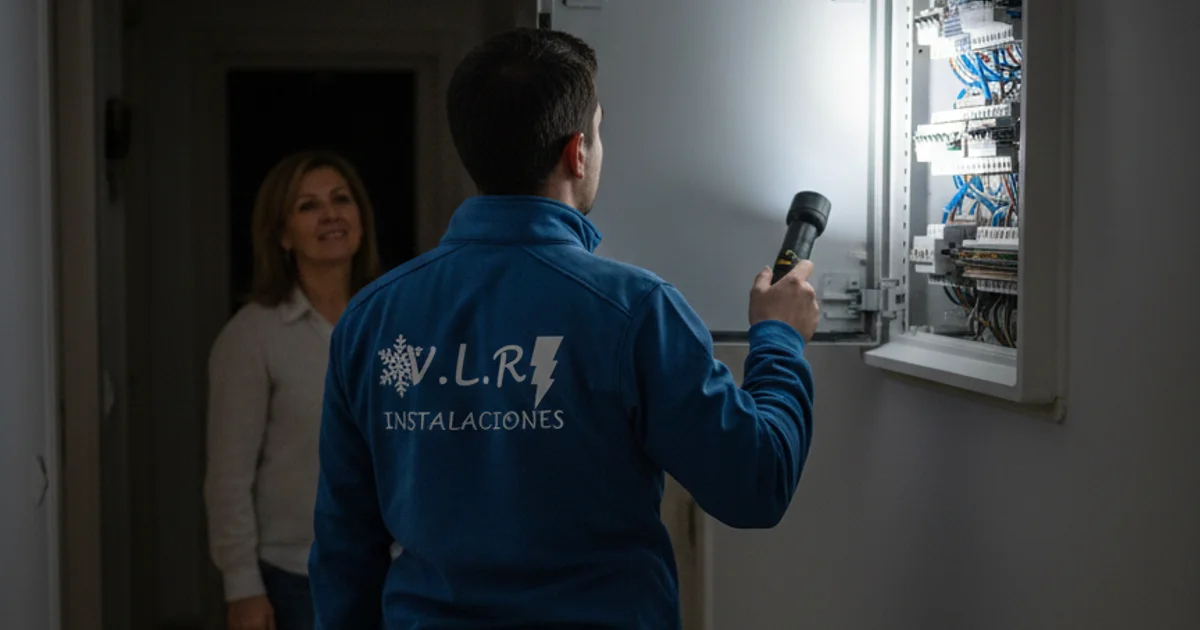
You're in the dark. The switch keeps tripping every time you flip it back up. And you're not entirely sure what anything is called in Spanish. Sound familiar?
If you're reading this at 3am on your phone, don't panic. This is one of the most common electrical problems in Spanish properties, especially older ones on the Costa del Sol. And yes, it can be fixed.
Quick terminology to get us started: that switch that keeps tripping is called a "diferencial" in Spanish - it's the RCD (Residual Current Device). This guide will help you understand what's happening and what you can do about it.
What is an RCD and why does it trip?
The RCD (called "diferencial" or "interruptor diferencial" in Spain) is a safety device that protects you from electric shock. It constantly monitors the electrical current flowing through your circuits.
If it detects that current is "leaking" somewhere it shouldn't be - like through a faulty appliance or damaged wire - it instantly cuts the power. This happens in milliseconds, before the electricity can harm you.
So when your RCD trips, it's actually doing its job: protecting you. The frustrating part is figuring out what's causing it.
If it keeps tripping, something is wrong. Don't just keep resetting it - that's like ignoring a smoke alarm.
Common causes of RCD tripping in Spanish properties
1. Faulty appliance
This is the most common cause. When an appliance develops an internal fault, it can leak current to earth, triggering the RCD.
The usual suspects:
- Washing machine - especially older ones or those with moisture damage
- Dishwasher - water and electricity is always a risky combination
- Water heater (termo) - the heating element degrades over time
- Fridge or freezer - particularly the compressor
- Oven or hob - high temperatures stress components
Anything that combines water with electricity, or uses heating elements, is more likely to develop faults.
2. Humidity and damp
This is extremely common on the Costa del Sol. The coastal air, rain after long dry periods, and condensation can all affect your electrics.
Problem areas include:
- Outdoor sockets on terraces and in gardens
- Exterior lights
- Pool equipment - pumps, filters, lighting
- Old junction boxes without proper sealing
- Wiring inside walls with damp problems
If your RCD trips after heavy rain or during humid weather, this is likely the cause.
3. Old or faulty RCD
RCDs have a lifespan of 10-15 years. Over time, they can become oversensitive (tripping when there's no real fault) or, worse, stop working altogether.
Your RCD has a test button - you should press it monthly to check it's working. If you've never done this, you're not alone, but it's worth starting now.
Many Spanish properties have old electrical installations that haven't been updated in decades.
4. Old or damaged wiring
Many Costa del Sol properties were built in the 1970s, 80s, and 90s. The wiring from that era:
- May not have proper earth connections
- Has degraded insulation
- Can have loose or corroded connections
- Often doesn't meet current safety standards
These problems can cause intermittent current leakage that trips the RCD.
5. After storms or power cuts
Power surges during storms can damage appliances, which then cause RCD trips. Heavy rain can also introduce moisture into outdoor electrical fittings.
6. Overloaded circuit
Important note: Overloads (too many appliances on one circuit) usually trip the MCB (magnetotérmico in Spanish), not the RCD. They're different protections:
- RCD (diferencial): protects against current leakage (electric shock)
- MCB (magnetotérmico): protects against overloads and short circuits
If only your RCD is tripping, the problem is usually a current leak, not an overload.
Safe troubleshooting steps you can try
Before calling an electrician, you can try to identify the problem yourself. Here's how to do it safely:
Step 1: Don't keep flipping the switch
If the RCD trips every time you reset it, there's a reason. Repeatedly resetting it won't help and could be dangerous. Stop and investigate.
Step 2: Find your consumer unit
In Spanish homes, the cuadro eléctrico (consumer unit/fuse box) is usually near the front door, in a hallway cupboard, or in a utility area. Look for a metal or plastic box with switches inside.
Step 3: Identify the switches
You'll see two types:
- RCD (diferencial) - the larger switch, usually has a "T" or "Test" button
- MCBs (magnetotérmicos) - the smaller switches, one for each circuit
Step 4: Isolate the problem circuit
- Switch OFF all the MCBs (small switches)
- Reset the RCD (flip it back up)
- Turn the MCBs back on one at a time
- When the RCD trips, you've found the problem circuit
Step 5: Find the faulty appliance
Once you know which circuit has the problem, unplug the appliances on that circuit one by one. When the RCD stops tripping, you've found the culprit.
Step 6: Check for obvious issues
Look for:
- Burn marks on sockets or plugs
- Burning smell
- Damaged or frayed cables
- Water or moisture near electrical fittings
STOP AND CALL AN ELECTRICIAN IF:
- The RCD trips instantly every time you reset it
- You smell burning
- You see sparks or scorch marks
- You're not comfortable doing these checks (that's completely fine!)
When to call an electrician
You need professional help if:
- The RCD won't stay on no matter what
- You've unplugged everything and it still trips
- There's a burning smell or visible damage
- The problem started after rain, a storm, or DIY work
- Your consumer unit looks very old (ceramic fuses, no test button)
- It keeps happening randomly with no clear pattern
- You're not sure what to do (that's absolutely fine - better safe than sorry)
What the electrician will do
Here's what to expect when the professional arrives:
- Test all circuits with professional equipment
- Measure insulation resistance to find leaks
- Identify the exact fault location
- Explain the problem in terms you understand
- Give you repair options with costs
- If needed, upgrade old components in the consumer unit
- Issue a new boletín eléctrico if the installation is updated
Preventing future problems
Some tips to avoid RCD trips:
- Press the test button monthly - check your RCD actually works
- Service appliances regularly - especially washing machines and water heaters over 10 years old
- After storms - check outdoor electrical areas
- If buying or renting - ask about the age of the electrical installation
- Consider upgrading - if your property is 30+ years old
- Don't overload extension leads - common in older Spanish flats with few sockets
Useful Spanish vocabulary
Keep this handy when speaking to Spanish tradespeople or your landlord:
| Spanish | English |
|---|---|
| Diferencial | RCD |
| Magnetotérmico | MCB / Circuit breaker |
| Cuadro eléctrico | Consumer unit / Fuse box |
| Enchufe | Socket / Plug |
| No hay luz | The power is out |
| Salta el diferencial | The RCD keeps tripping |
| Electricista de urgencias | Emergency electrician |
Frequently asked questions
Why does my RCD keep tripping at night in Spain?
This usually happens because appliances run overnight - dishwashers, washing machines on delay timers, or the water heater heating up. It can also be due to humidity changes. Check which appliances are running when it happens.
Can humidity cause the RCD to trip?
Yes, this is very common on the Costa del Sol. Coastal humidity, rain after dry spells, and condensation can affect outdoor sockets, terrace lights, and pool equipment. After heavy rain, RCD trips are particularly common.
How often should I replace the RCD?
RCDs typically last 10-15 years. Press the test button monthly to check it's working. If your RCD is very old, has no test button, or keeps tripping for no apparent reason, it's time to replace it.
What's the difference between the RCD and MCB?
The RCD (diferencial) protects against current leakage (electric shock). The MCB (magnetotérmico) protects against overloads and short circuits. They're different, complementary protections.
Is it dangerous if the RCD keeps tripping?
The RCD trips to protect you, so it's doing its job. But if it keeps tripping, there's an underlying problem that needs fixing. Don't ignore it or keep resetting it without investigating.
Need help right now?
If you're reading this in the dark at 3am, we understand. Our 24-hour emergency electrician service is available right now.
We've been solving electrical problems across Málaga province for over 20 years. We work regularly with expats and are happy to explain everything in English.
We cover Marbella, Fuengirola, Benalmádena, and all surrounding areas.
Also available: electrical repairs for less urgent problems. If your installation is old, we can assess whether you need an upgrade.
Call us now - that's what we're here for.