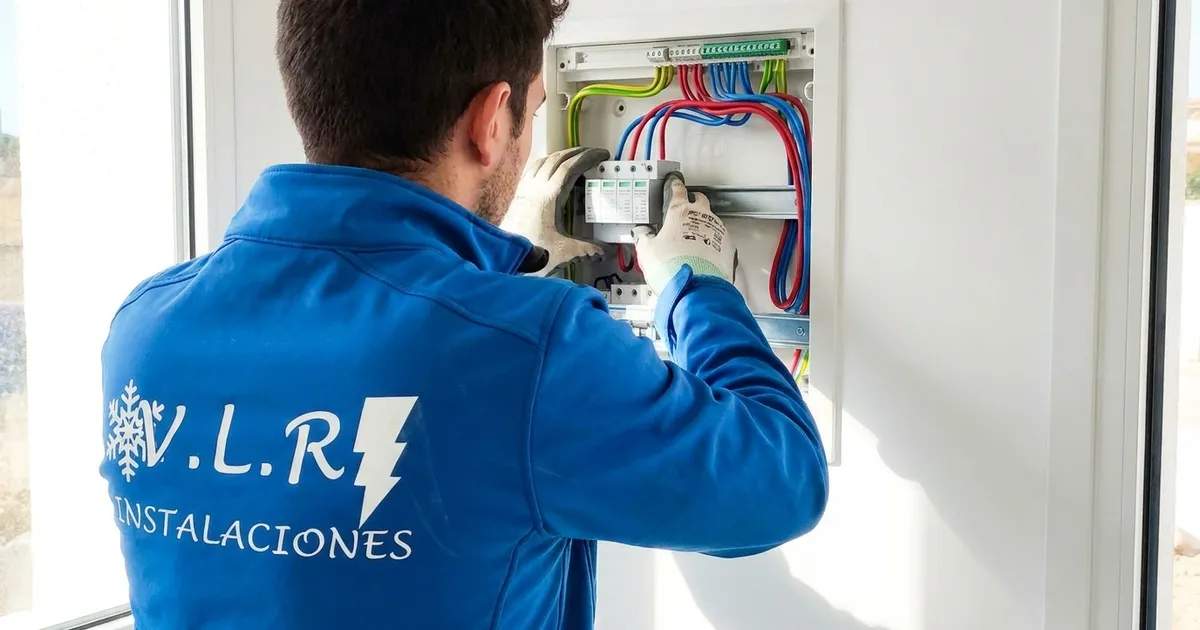
If an appliance has blown or your router has died after a storm, it was probably caused by a power surge. With the REBT (Spain's Low Voltage Electrical Regulations) under revision, surge protection is about to change from a recommendation into a legal requirement. Here's what that actually means and whether it affects you yet.
What is a power surge?
A surge (sobretensión) is a sudden rise in voltage above the normal levels of the mains supply. It can last microseconds (a transient surge, caused by lightning or switching operations on the grid) or persist for longer, as a temporary overvoltage, for example due to a fault in the distribution network.
In both cases the outcome can be the same: damaged appliances, ruined electronics, or in the worst case a fire risk in the consumer unit (cuadro eléctrico, your fuse board).
What the REBT says about surge protection
The obligation sits in the revision of ITC-BT-17, with the technical characteristics defined in ITC-BT-23. It is set to make protection against temporary and transient overvoltages mandatory in new installations, without the prior risk assessment that is required today.
It's worth being precise: as of today, the final text of the new REBT has not yet been published in the BOE (Spain's Official Gazette). The regulation in force is still Royal Decree 842/2002. What exists is an advanced draft, under European public consultation, with publication expected but no confirmed date. Even so, the direction of travel is clear, and many new installations are already being carried out with this protection ahead of the rules.
The three types of protector (SPD)
- SPD Type 1 (coarse protection): for direct lightning strikes, in buildings with a lightning rod or within 50 m of one. It goes at the origin of the installation, upstream of the meter. It stops the bulk of the lightning current but lets through a fair amount of voltage, so it is always completed with a type 2.
- SPD Type 2 (medium/high protection): the usual choice in homes. Fitted inside the main distribution board, it diverts virtually all of the current with a good protection level. Combined type 1 + type 2 devices exist.
- SPD Type 3 (fine protection): fitted close to especially sensitive equipment (electronics, home automation, battery chargers). Never used on its own: it complements a type 2.
There is a practical detail that explains why a type 3 is sometimes needed even with a type 2 already in the board: a surge is a high-frequency phenomenon and it builds back up with cable distance. Beyond roughly 10 metres from the board it rises appreciably, and by about 30 metres it can double. If your sensitive equipment sits a long way from the board, the protector in the board no longer covers it as well.
Lightning aside, there is a second family of transient surges that often gets forgotten: switching surges. They come from switching operations on the distributor's network or in your own installation (protective devices opening, automatic reclosing, motors starting, capacitor banks, welding equipment). They carry far less energy than a lightning strike, but they are much more frequent.
When will it affect you?
According to the draft, the requirement will apply to:
- All new electrical installations.
- In existing installations, when a new circuit for generation (solar panels, batteries) or for EV charging is added, as set out in their respective technical instructions. For solar, specific protection for the DC side is also expected.
This needs stating precisely, because the opposite is repeated constantly: in an installation that already exists, a modification or extension does not on its own trigger the obligation. Only adding one of those two circuits does, generation or EV charging. Extending the consumer unit for air conditioning or home automation does not oblige you to fit surge protection.
Not mandatory is not the same as not worthwhile, and we explain why below. But if someone tells you the law forces you to fit it because you changed any old circuit, that is not the case.
If your installation is not touched, there is no obligation to adapt it either, unless a serious risk is identified.
Is it worth installing even though it isn't mandatory yet?
In Málaga, autumn storms and voltage spikes on the grid aren't uncommon, especially inland and in homes with older installations. A type 2 surge protector in the consumer unit is a small investment compared with the cost of replacing a television, a computer or a damaged home-automation system.
It's particularly worthwhile if you have, or are planning to install, solar panels, an EV charger, or smart-home systems: these are precisely the installations most vulnerable to this kind of damage.
How much does it cost to install a surge protector?
The price depends on the type of device and the complexity of your consumer unit. As a rough guide, a type 2 SPD fitted in a home typically starts at around €120-150, though the final price depends on your installation. For a quote tailored to your case, it's best to have an authorised installer inspect your consumer unit.
Frequently asked questions
Is surge protection mandatory right now?
Not yet. The REBT currently in force (Royal Decree 842/2002) does not require it across the board. The obligation is part of the REBT revision, which has not yet been published in the BOE.
What happens if I install an EV charger now?
For the charger circuit itself, ITC-BT-52 already requires protection against temporary and transient overvoltages today, so it is not optional. Under the new REBT, this upgrade will also trigger the requirement for the rest of the installation. Ask for the charger quote to include it: it is the cheapest moment to add it.
We quote it together with the charge point.
Will any surge protector do?
No. The device must match the type of installation, the location of the consumer unit and the risk level (for example, whether the building has a lightning rod). An authorised installer can tell you which type you need.
My installation is old, do I have to update it now?
Not immediately, unless it presents a serious risk. The obligation is only triggered by adding a new generation or EV-charging circuit. That said, if you are opening up the consumer unit for a renovation anyway, that is the natural and cheapest moment to add this protection.
Does surge protection cover damage from a power cut?
Not exactly. It protects against voltage spikes, not against supply outages. These are different phenomena and require different solutions.
If you'd like to know whether your consumer unit has the right protection, or you're thinking about installing an EV charger or solar panels, VLR Instalaciones can inspect it and advise you with no obligation. You can read more about our surge protection service.