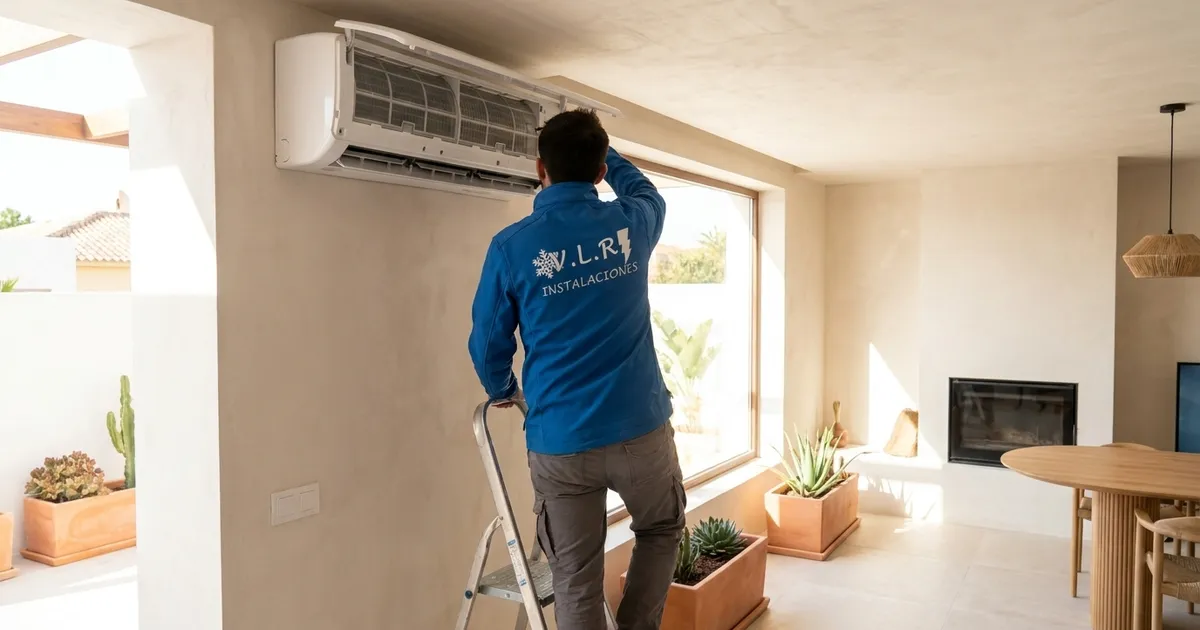
Is air conditioning expensive to run in Spain? It is the question everyone asks when the first summer bill lands on the Costa del Sol. And it is a different question from what it costs to install: here we are talking about the cost of having it running, which is the one that really adds up when the hot season lasts for months.
The good news is that the consumption can be estimated from just a few figures, and a good part of it is in your hands. Let us look at what it depends on, how to work it out with real numbers, and what changes the bill without giving up on staying cool.
What the consumption depends on
What an air conditioner costs does not come from a single number. It is five factors that multiply together:
- The unit's power: the more cooling capacity, the more electricity it can draw. But a unit that is too small for the room also uses a lot, because it never stops.
- Efficiency: the energy label and, above all, whether it is a modern inverter or an old on/off unit. It makes a huge difference.
- Hours of use: a couple of hours at night is not the same as running it from morning to night.
- The temperature difference: the more cooling you ask for relative to the outside temperature, the harder the compressor works.
- The room: insulation, orientation, amount of glazing and whether there is direct sun. A living room with the blind up at six in the evening is an energy sink.
How to work out the consumption, step by step
You can estimate it simply. What a unit uses is its electrical power (in kilowatts) multiplied by the hours it runs and by the price per kWh you pay.
The first figure has a catch: the cooling capacity the unit advertises (say, 3.5 kW of cooling) is not what it draws from the grid. Thanks to efficiency, an inverter split for a living room typically pulls around 0.8-1.2 kW of electrical power while the compressor is working - and it does not run flat out: once it reaches temperature, it modulates and drops right down.
With that, a realistic example: a living room with a modern split running about 6-8 hours a day in high summer uses on the order of 4-8 kWh a day. Multiplied by the price you pay per kWh and by the days of the season, that works out as an increase of tens of euros a month under heavy use, not hundreds, as long as the unit is the right size and well maintained. And this is where the tariff comes in: that same kWh costs more or less depending on the hour, something we go into in how time-of-use pricing works.
Inverter versus on/off
If your unit is a fair few years old, it is probably one of those that switches the compressor on and off at full power over and over. A modern inverter, by contrast, modulates: it speeds up to cool and then holds itself at a low output, avoiding those spikes. For occasional use the difference is small, but on the coast, with long seasons and many hours, an inverter uses considerably less and usually pays back the change in a few summers.
Why the cost of staying cool weighs so much in Málaga
Inland, air conditioning is used for a few weeks; on the Costa del Sol, for months on end. That is why the running cost matters more here than the installation cost: the unit may be the same, but the accumulated hours are not. Add to that the older town-centre flats with little insulation and a lot of sun-facing wall, where the unit is fighting the building itself.
Consumption that jumps from one summer to the next without any change in your habits usually signals something: clogged filters, low gas, or a unit that is past its best. Before resigning yourself to the bill, it is worth ruling that out; we cover it in why the AC runs but does not cool.
How to pay less for the same cooling
Set the temperature and do not force it. Around 25-26 °C is comfortable and the consumption is reasonable. Dropping to 20 °C does not cool any faster, it just makes the unit run longer.
Lean on the cheaper hours. Cooling the house in the late evening, once out of the peak price band, or using the timer so it is not left on needlessly, changes the total. It is the same logic as cutting your electricity bill in summer.
Maintain the unit. Clean filters and a clear outdoor unit are money: a dirty unit uses more to give the same cooling.
Look at the alternatives if you are replacing it. For anyone cooling a lot, a heat pump versus air conditioning or self-consumption with solar panels - which generate exactly during the hottest, priciest hours - can change the equation over the medium term.
Frequently asked questions
How much does air conditioning cost to run per month in Spain?
It depends on the unit, the hours and the price you pay per kWh, but as an order of magnitude: a modern inverter split for a living room draws around 0.8-1.2 kW while the compressor is working, and not continuously. Over an intensive Costa del Sol summer (several hours a day for weeks) that usually adds tens of euros a month to the bill, not hundreds, provided the unit is the right size and well maintained.
What determines how much air conditioning uses?
Five things: the unit's cooling capacity and its efficiency (energy label and inverter versus old on/off technology), how many hours you run it, the temperature you set against the outside temperature, and how well insulated and oriented the room is. The same unit can use twice as much in a room with afternoon sun and the blind up as in a well-shaded one.
Does a portable or window unit use more than a split?
Yes, almost always. Portable and window units tend to be less efficient, and a portable one blows already-cooled room air out through its hose, which pulls warm air in from outside to replace it. For sustained use, a properly fitted fixed split cools more and uses less for every degree it brings the room down.
What temperature should I set it to use less?
Around 25-26 °C is the sensible point in summer: every extra degree you drop pushes up consumption without adding much comfort. Setting it to 20 °C does not cool the room any faster, it just makes the unit run longer and use more. Pairing a sensible temperature with ceiling fans lets you stay comfortable with the AC working less hard.
Is it worth replacing an old unit with an inverter?
If you run the unit for many hours, usually yes. An old on/off unit switches the compressor on and off at full power, while a modern inverter modulates and holds the temperature using considerably less. With the long, heavy-use season on the coast, the difference in consumption can pay back the change in a few summers.
Want your AC to use only what it should?
At VLR Instalaciones we have over 20 years of electrical and air-conditioning work in Málaga and the province, as electricians authorised by the Junta de Andalucía. We check that your unit is the right size, with its own circuit and protection, that your contracted power keeps up, and that you are not paying over the odds for a unit that performs poorly. Get in touch for a no-obligation assessment.