Understanding the electrics in your Spanish home does not mean becoming an electrician. Once you know what each part does - the voltage, the sockets, the consumer unit, the contracted power, the earthing and the boletín - you are no longer lost when the power trips, when you buy a property, or when someone talks about "raising the power" or "issuing a boletín".
This is the guide we wish every newcomer to Málaga had, especially those arriving from a country with a different system. We will go part by part, in order, and in plain English.
1. Voltage and plugs
Mains electricity in Spain is 230 volts at 50 Hz, the European standard. The socket is type F, known as Schuko: two round pins, with two metal earth contacts on the sides.
If you have come from another European country, your appliances just work. If you have come from the UK, the key point is this: British appliances run at this voltage, so you need a plug adapter, not a voltage transformer. What you should not do is leave adapters permanently plugged into high-power appliances like a washing machine or a water heater - for those, change the plug or the socket properly.
2. The consumer unit: the heart of the installation
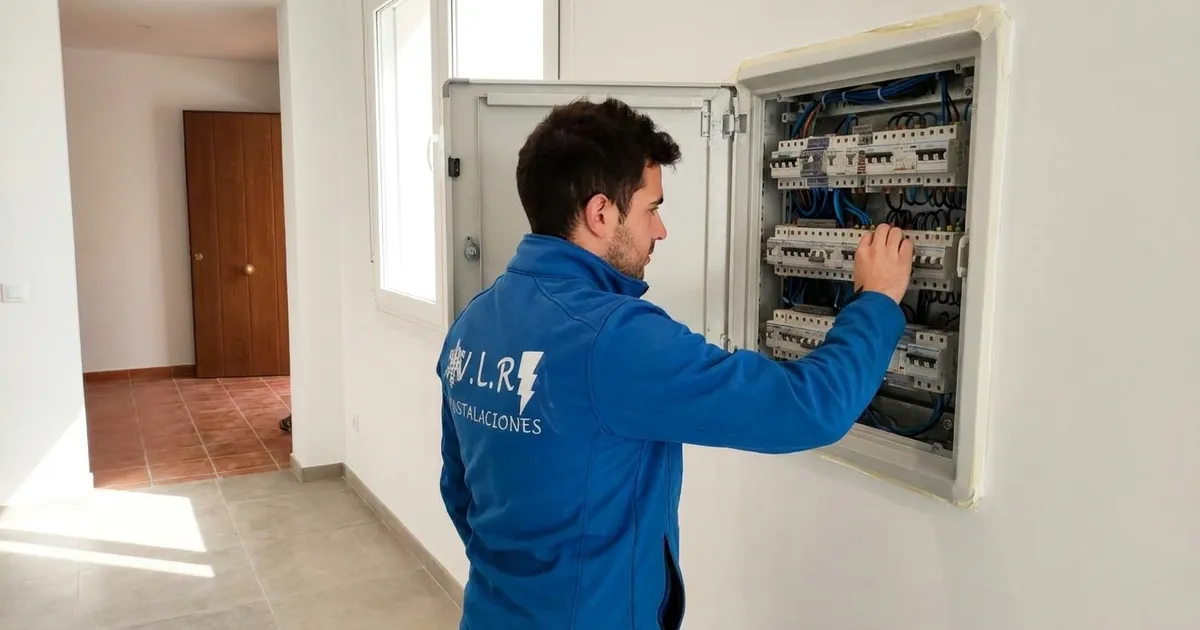
The cuadro eléctrico (consumer unit or fuse board) is the box of switches usually by the front door or in the hallway. It is the control centre for the whole home, and it is worth recognising its parts, because these are what trip when something goes wrong:
- The main switch (IGA): cuts the whole home at once. This is the one you flip to leave the property dead.
- The diferencial (RCD): the one that protects people. It trips on a current leak - for example if an appliance faults or water gets in. It is a larger switch, often with a test button.
- The magnetotérmicos (MCBs): the small switches, one per circuit (kitchen, sockets, lights, AC…). They trip when that circuit is overloaded.
Knowing which is which saves you calls and stress. We go through each in your Spanish consumer unit explained, and if it is the RCD that keeps tripping, in why your RCD keeps tripping.
3. Contracted power: why the lights go out
This is the concept that confuses newcomers most. In Spain you do not just contract "electricity": you contract a power level (potencia contratada), measured in kilowatts (kW), which is the most you can draw at once. Exceed it - oven, ceramic hob, air conditioning and water heater all going together - and the power trips, even though nothing is actually faulty.
So the first thing we ask when someone says "the power goes out when I cook" is how much power they have contracted. Sometimes the answer is to raise it, but not always: it costs money every month, and often it is enough not to overlap the hungry appliances. We cover it in contracted power explained and, for the air-conditioning case specifically, in why your AC trips the electricity.
4. The tariff: why the hour matters
As well as the power, you pay for the energy you use, and since 2021 that energy does not cost the same at every hour. The day is split into bands (peak, standard and off-peak) and the same wash costs less overnight or at the weekend than at teatime. Understanding this is the simplest way to cut the bill without giving anything up; it is all in how Spanish time-of-use pricing works.
5. Earthing: the invisible protection
Toma de tierra (earthing) is a wire connecting the installation to the ground, diverting any current leak before it can give you a shock. Together with the RCD, it is what protects people. The trouble is that in many older Málaga properties (especially in the town centre) it is missing or in poor condition, and you cannot see it at a glance.
Signs something is wrong: two-pin sockets with no side contacts, or a tingle when you touch the fridge or washing machine. If that rings a bell, do not leave it: see how to check whether your home has earthing. It is a quick, cheap check for an electrician.
6. The boletín eléctrico: the key document
The boletín eléctrico, officially the Certificado de Instalación Eléctrica (CIE), is the paper certifying that your installation meets the regulations. An authorised electrician issues it, and you will need it at three moments: to connect the electricity supply in a new property or one that has been without a contract for a while, to increase the power beyond certain limits, and often when selling or letting.
Do not confuse it with the energy performance certificate - that is a different thing. And mind who signs it: only an installer authorised by the Junta de Andalucía can issue one. If you are buying, this is squarely on your checklist: we pull it together in buying an old property: the electrical checklist.
What to check when you move in
Find the consumer unit and test the RCD. It should have a test button (T or Test); press it and it must trip. If it does not, it is not protecting you, and that is urgent.
Confirm there is earthing. Especially in older flats. It is the difference between a fright and an accident.
Check the power you have contracted and whether it suits how you live. A home with AC, a ceramic hob and induction needs more than one from thirty years ago. If you are bringing an electric car, plan the charger at the same time: with load management it often avoids a bigger contract (see EV charger installation).
Be wary of a burning smell or sockets that get warm. That is not normal and does not wait: what to do is in a burning smell from a socket or the board.
What you can do yourself, and what you can't
Changing a bulb, a light fitting or a surface socket is within reach of anyone careful, with the power off. But anything touching the consumer unit, a new circuit, the earthing, or that needs a boletín must be done by an authorised electrician. This is not red tape: without an authorised installer there is no valid certificate, and without it the supplier will not connect the supply or raise the power. It is also exactly where a mistake in the protection is costly. How to check the person coming to your home is authorised is in how to check an electrician is registered.
Why it pays to be clear about this in Málaga
On the Costa del Sol, town-centre flats with decades-old wiring sit alongside new all-electric homes and holiday properties that stand empty for months. That mixed housing stock means we see it all: boards with no RCD, non-existent earthing, inherited power levels that no longer fit, and appliances hung off circuits never designed for them. Understanding the basics lets you spot the problem before it becomes a fault - or a risk.
Frequently asked questions
What voltage do Spanish homes use?
Mains electricity in Spain is 230 volts at 50 Hz, with the type F (Schuko) socket - two round pins and two earth contacts on the sides. It is the European standard, so appliances bought in the EU work with no adapter. UK appliances run at this voltage but need a plug adapter, not a voltage transformer.
Why does the power cut out when I switch on several appliances at once?
It is almost always the contracted power (potencia contratada): every home has a limit in kilowatts it can draw at the same time, and going over it trips the main switch. Oven, hob and air conditioning together is the classic combination. The fix is not always to raise the power - sometimes it is just not overlapping the heavy appliances, and sometimes the installation needs checking.
What is the boletín eléctrico and when do I need it?
The boletín eléctrico, officially the Certificado de Instalación Eléctrica (CIE), is the certificate an authorised electrician issues to confirm the installation meets the regulations. You need it to connect a new supply or reconnect one that lapsed, to increase your power, and often when selling or letting. It is not the same as the energy performance certificate.
How do I know if my home has earthing?
Earthing (toma de tierra) is the protection that diverts a current leak and prevents shocks. In older properties it can be missing or faulty. Warning signs: two-pin sockets with no side earth contacts, or getting a tingle from appliances. The only way to be sure is to measure it, and it is a quick check for an electrician.
Can I do electrical work in my home myself?
Changing a bulb or a light fitting, yes. But anything touching the consumer unit, a new circuit, the earthing, or requiring a boletín must be done by an electrician authorised by the regional government. It is not just about safety: without an authorised installer there is no valid certificate, and without it the supplier will not connect the supply or increase the power.
Would you like us to check your installation?
At VLR Instalaciones we have over 20 years of electrical work in Málaga and the province, as electricians authorised by the Junta de Andalucía. If you have just moved in or are not quite sure about your installation, we carry out a full check - consumer unit, protections, earthing and power - and explain in plain terms what you have and what is worth doing. Get in touch for a no-obligation assessment.