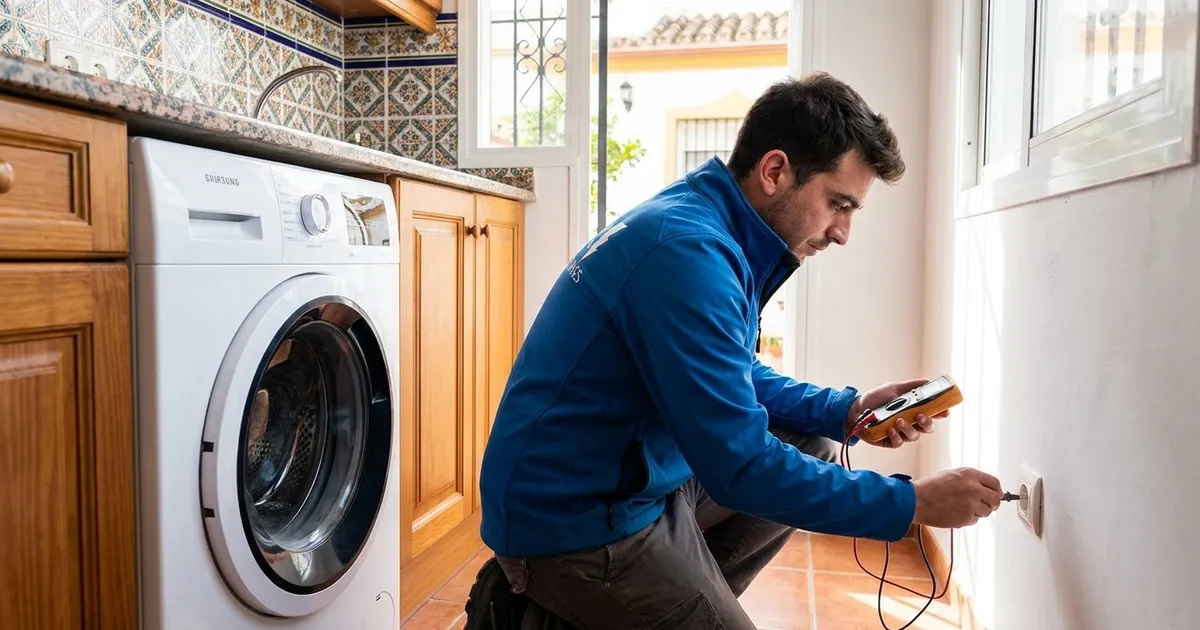
You touch the washing machine and feel a tingle. Or the fridge, or the oven, or the kitchen tap while the dishwasher is running. Plenty of people live with it for months, assuming it is just something that appliance does. It is not: a shock from an appliance always indicates a fault.
Here is what is happening underneath, why the important question is not how much it hurts but whether the RCD trips, and what to do today. This is one of the few electrical symptoms where waiting to see if it happens again is the wrong instinct.
What is actually going on
Inside an appliance, current should flow around a closed path. When insulation degrades - damp, a chafed cable, an ageing motor - some of that current escapes to the metal casing.
The casing then sits at a voltage, waiting for a path to earth. If you touch it, especially barefoot or with wet hands, that path is you. That is the shock.
In a correct installation you should never feel it, because there are two defences: the earthing, which offers that leakage a much easier path than your body, and the diferencial (RCD), which detects the leak and disconnects before it becomes dangerous.
The question that really matters: does the RCD trip?
This splits the situation in two, and they are not equally serious.
If the RCD trips
Annoying, but it is the system working. There is a leak and protection is disconnecting. The appliance causing it is the culprit, and finding it is straightforward - we cover that in why your RCD keeps tripping.
If you feel a shock and the RCD does NOT trip
This is the serious one. It means there is a leak and protection is not acting. The usual reasons:
- There is no earth connection. Common in older properties that have never been rewired. Without one, leakage has nowhere to go and the casing stays live.
- The earth exists but does not work. A conductor cut during a refurbishment, a degraded earth rod, or a socket where the third conductor was never connected.
- The RCD has failed. They are mechanical devices and they age. One that has gone twenty years without being tested may no longer trip at all.
- The leak is small. Enough for you to feel, still under the trip threshold. That is a developing fault and it will grow.
Press the test button
RCDs have a button marked T. Pressing it should trip the device and cut the power immediately. It is the only simple way to confirm it is still alive, and it is worth doing a couple of times a year.
If pressing it does nothing, that RCD is not protecting you. This is not a job to postpone: it is the device everything else depends on when a leak develops.
What to do right now
Unplug the appliance. If you cannot reach the plug safely - it is behind the unit, you would have to lean on the casing - switch that circuit off at the consumer unit first, then unplug it.
Do not keep using it "carefully". With gloves, with a cloth, touching only the buttons. The problem is not how you touch it: there is voltage where there should not be, and the conditions change the moment water is involved.
Be especially careful in kitchens and bathrooms. Damp floors, bare feet, taps and metal pipework. That is where a mild shock stops being mild.
If the shock comes from a tap or pipe rather than an appliance, call without waiting. That suggests leakage has reached the plumbing, which affects the whole property rather than one machine.
Why this comes up so often in older Málaga properties
In the centre and the older barrios we see many installations that predate earthing being required in homes. Plenty have had new sockets added over the years, but the earth conductor never existed: the socket has the pins, and nothing is connected behind them.
It looks entirely convincing until the day an appliance develops a leak. If your property is of that era and has never been renewed, it is worth checking before a shock tells you - we cover it in how to tell whether your home has earthing.
Damp does the rest. Near the coast and on ground floors, ambient humidity degrades insulation over time, and that is exactly where leaks begin.
What an electrician will do
Check whether an earth exists and whether it has real continuity through to the sockets; measure its value; verify the RCD trips within the time it should; and trace which appliance or circuit the leakage comes from.
These are measurements rather than guesses, and they establish whether what needs replacing is an appliance, an RCD, or whether the property is missing earthing altogether. That last case is usually resolved as part of a rewire.
Frequently asked questions
Why do I get a shock when I touch an appliance?
Because some current is escaping to the appliance's casing instead of flowing where it should. When you touch it, your body offers that current a path to earth, and you feel the tingle. It always indicates a fault: either the appliance has an internal leak, or the installation is not diverting that leak the way it should.
I feel a shock but the RCD does not trip. What does that mean?
That is the more worrying of the two situations. It means protection is not operating when it should: there may be no earth connection, the diferencial (RCD) may have failed, or the leakage may be too small to trip it yet large enough to feel. Do not dismiss it because the sensation is mild.
Is a small shock actually dangerous?
The tingle itself may be mild, but what causes it is not. The same leakage you barely notice today can be far more serious with wet hands, barefoot on a damp floor, or while touching a tap or pipe at the same time. Treat it as a warning, not as a quirk of the appliance.
Could my property have no earth connection?
In older properties it is fairly common, particularly where the installation has never been renewed. Without an earth, leakage has nowhere to go and the appliance casing stays live until somebody touches it. It can be tested, and if it is missing, it is one of the most worthwhile things to put right in a home.
What should I do right now?
Unplug that appliance and stop using it. If you cannot reach the plug safely, switch off the relevant circuit at the consumer unit first. Do not keep using it carefully or with gloves: the problem is not how you touch it, it is that there is voltage where there should not be.
Felt a shock at home?
VLR Instalaciones has spent more than 20 years across Málaga and the province, as electricians authorised by the Junta de Andalucía. We measure the earthing, confirm the RCD genuinely trips, and trace where the leakage is coming from. It is a quick check and one of the most reassuring there is. Call us - we cover 24-hour emergencies.