Earthing (toma de tierra) is the part of an electrical installation nobody thinks about until something goes wrong. You cannot see it, it does not show up on your bill and it does nothing visible day to day. But it is what turns a faulty appliance into a tripped switch rather than an electric shock.
A fair number of properties in Málaga do not have it, or only have it in part, and older buildings bought by overseas owners are well represented in that group. This guide covers how to check for yourself with what is already in the house, why an RCD is not a substitute, and what your options are if it turns out to be missing.
What earthing does, and why it matters
Earthing is a safety path. It connects the metal parts of your appliances to the ground through a cable (the yellow and green one) and a buried rod or mesh. If an appliance develops a leak, that current runs down the safety path instead of sitting there waiting for somebody to touch the casing.
That is also why earthing and the diferencial (RCD) belong together. Earthing gives the leak somewhere to go; the RCD notices it going and cuts the supply. Without earthing, the RCD loses its best chance of detecting the fault early, and the path the current takes can end up being a person.
How to check whether your home has earthing
1. Look at the sockets, but do not trust them
A modern socket has an earth contact: two metal strips at the sides (Schuko type) or a pin. If your sockets are the old round type with no side contacts at all, that is a fairly clear sign there is no earthing in that area. But beware the reverse: having sockets with earth contacts does not prove an earth cable is connected behind them. This is very common in properties renovated in stages.
2. Look inside the consumer unit
Open the cover of the consumer unit (cuadro eléctrico) and look for yellow and green cable. A terminal block with several yellow-green cables arriving at it is a good sign. If the unit is old, has porcelain fuses, or shows no cable of that colour at all, there is probably no earthing installation.
3. Check the electrical certificate
If you hold the boletín eléctrico (the Certificado de Instalación Eléctrica), the earthing installation is recorded on it. That is the quickest and most reliable route, assuming the document exists and is current. In properties that have never been renovated there is often no certificate at all, which tells you something in itself.
4. The check that actually counts: measurement
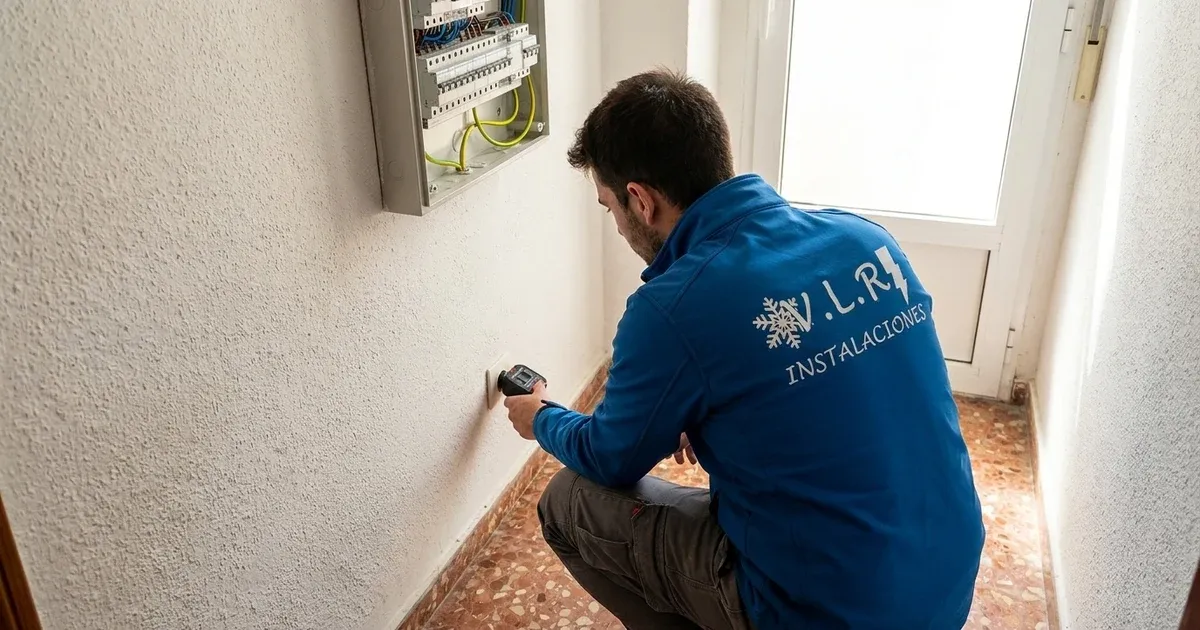
The plug-in socket testers sold in any hardware shop will tell you whether there is earth continuity at that point, and they are a useful first clue. What they will not tell you is whether the earth is good. That means measuring the resistance with an earth tester and confirming it falls within the values the REBT requires, and it has to be done by a licensed electrician.
Signs your earthing is missing or not working
Without measuring anything, these situations point to an earthing problem:
- You feel a slight tingle when you touch the washing machine, fridge, oven or hob. This is never normal, and it is the clearest warning sign of the lot.
- The RCD trips for no obvious reason, particularly in damp weather or when one specific appliance is used. We cover this in why your RCD keeps tripping.
- The sockets are old and round, with no side contacts, in part or all of the property.
- The installation has never been renovated and the building is decades old.
- Old and new sockets sit side by side: usually a sign they were swapped during other building work without running earth cable to them.
How this plays out in Málaga
Much of the housing stock in central Málaga and in the districts that grew through the 1960s and 1970s was built when earthing was not what it is today. Many of those properties have been upgraded in stages: a new consumer unit here, some walls opened up there, new sockets fitted, and the earthing never quite got done.
Being on the coast adds a second factor. Humidity and salt air are hard on older installations and on buried connections. An earthing system installed thirty years ago and never checked since may well have lost effectiveness, with nothing inside the property to indicate it.
And if you are buying, this is exactly the sort of thing that does not show up on a viewing. It is worth going through the full list in what to check when buying an older property before you commit.
What to do if you have no earthing
Do not ignore it, but do not panic either. It is a serious issue and a very fixable one. In the meantime, avoid using metal-cased appliances in damp areas (bathroom, kitchen, terrace) and never dismiss a tingle.
Get it measured properly first. Before anyone proposes work, you need to know what is actually there: whether the building has an earth, whether it reaches your property, and what condition it is in. That measurement shapes the whole solution and saves money on unnecessary work.
The usual fix is connecting to the building's earth. In most buildings that have a main earthing system, the answer is to connect your property via the meter cabinet. It is considerably less invasive than people expect.
If the building has none, it is a communal matter. The building's earthing system is a communal element, so it belongs on the agenda of the comunidad de propietarios. This is common in older blocks and is usually better solved collectively than flat by flat.
Use the opportunity to bring the rest up to date. If work is happening anyway, it is the moment to review the consumer unit and the RCDs. See electrical repairs and earthing systems.
Frequently asked questions
Does a three-pin socket mean the property has earthing?
Not necessarily, and this is the most common misunderstanding. A socket with an earth contact (the two metal strips at the sides of a Schuko socket, or a centre pin) only means it is ready for earthing. If there is no earth cable connected behind it, that contact goes nowhere. It happens a lot in properties renovated piecemeal: the sockets get replaced but the earth cable is never run to them.
Does an RCD replace earthing?
No. They are different things that work together. Earthing gives a leaking current a safe path to the ground; the RCD (diferencial) detects that leak and cuts the supply. Without earthing, the RCD loses its best chance of noticing in time, and the path the current takes may end up being a person. Neither one substitutes for the other.
Is earthing a legal requirement in a Spanish home?
For any new or renovated installation, yes: it is required by the REBT (Spain's low-voltage electrical regulation). Very old installations may stay as they are until they are altered, but as soon as you renovate, increase the contracted power or need an electrical certificate, the installation has to meet current regulations.
Can earthing be added to an old flat?
Almost always. In a building that has a main earthing system, your flat is connected to it via the meter cabinet. If the building has none, it is the comunidad de propietarios (residents' association) that needs to address it, because the earthing system is a communal element. Where neither route is viable, there are partial solutions an electrician should assess case by case.
How much does it cost to install earthing?
It depends a great deal on whether we connect to the building's existing earth or create a new one, the distance to the consumer unit, and whether cable has to be run through the property. That is why nobody can quote it blind: we inspect, measure and give you a fixed price with no obligation before any work starts.
Want to know whether your home is protected?
At VLR Instalaciones we have over 20 years of experience as electricians authorised by the Junta de Andalucía, covering the whole province of Málaga. We measure your earthing, tell you plainly what condition it is in and, if needed, install it and issue the corresponding certificate. Ask us for a no-obligation assessment and put the question to rest.