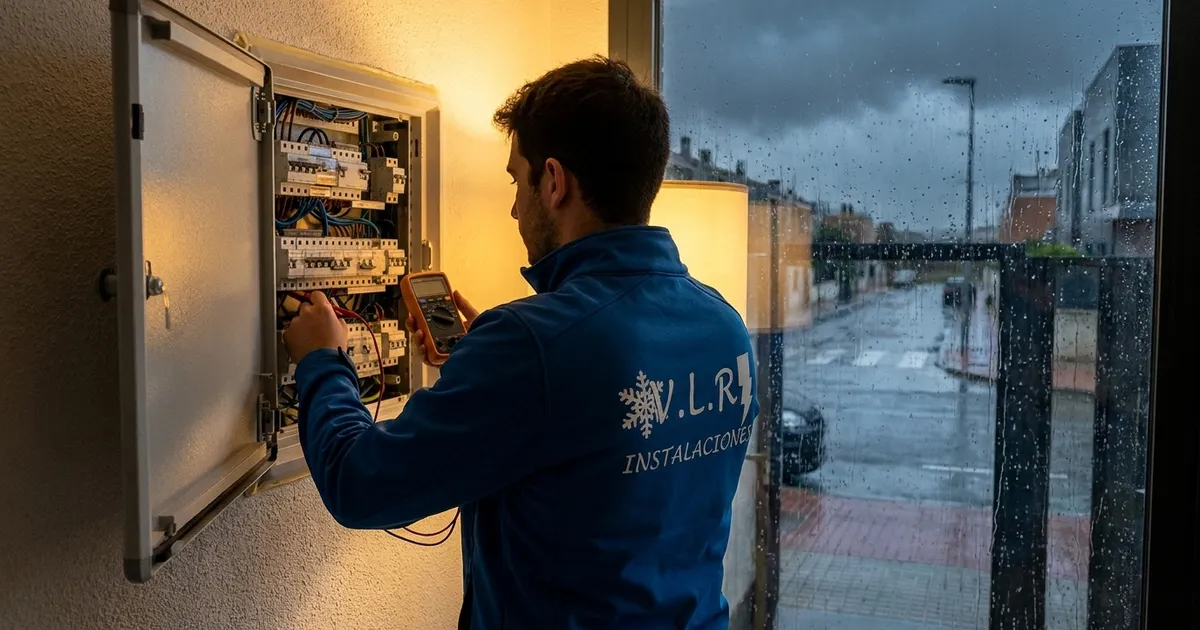
In Málaga the electrical risk is not in winter, it is in September and October. That is when the year's most violent storms arrive, the gota fría events that drop in an afternoon what has not fallen in five months, and take routers, televisions and appliance boards with them.
The striking part is that most of that equipment is not destroyed by lightning hitting the house. It is destroyed by something far less dramatic, far more common, and preventable for very little money. Here is what actually happens, what to do beforehand, what not to do during, and what to check afterwards.
What a storm actually does to your installation
1. Voltage surges arriving down the cable
By some distance the number one cause of damaged equipment. Lightning striking kilometres away induces a surge that travels along the network and enters your home through the socket. It does not need to strike nearby, the power does not need to go out, and you will not hear a thing. Hence the classic "the router is dead and nothing happened here". What a surge is and how it is dealt with is covered in surge protection.
2. Cuts and micro-cuts
Storms cause brief outages and reconnections. That abrupt off-and-on, repeated, is hardest on anything with a motor or electronics: fridges, air conditioning, pool pumps. Sometimes the damage does not show that day but weeks later.
3. Water where it should not be
This is the part people underestimate. Torrential rain finds leaks that ordinary rain does not: boards in patios and garages, outdoor junction boxes, garden lighting, the pool installation. Once water reaches the installation, the problem stops being an appliance and becomes the safety of the house.
4. A direct strike
Rare and serious. It is not what we usually see, but when it happens it is not solved by replacing an appliance: the whole installation needs checking before it is energised again.
Before it arrives: the short list
With a serious storm forecast, this is what genuinely changes the outcome:
- Unplug the expensive and the sensitive: television, computer, router, console. A disconnected appliance cannot receive anything down the cable. It is the most effective measure available and it is free.
- Check whether you have a surge protector in the board. A module with a small green window means you have one; red, or no module at all, is the conversation to have.
- Find the main breaker before you need it. Hunting for it in the dark with water coming in is the worst possible moment. If you cannot tell the switches apart, see what each switch in your consumer unit does.
- Check anything exposed to the weather: outdoor board covers, garden boxes, the garage and the pool installation. A seal dried out by summer is where October's water gets in.
- Photograph the board and keep receipts for the good equipment. If you end up claiming, those two things are worth more than any explanation.
- If it is a holiday let, leave the guest written instructions for a power cut. They do not know the property or where the board is. We cover this in electrical requirements for a holiday let.
During the storm: what not to do
Do not start unplugging mid-strike. The time to disconnect is beforehand. With the storm overhead, handling plugs and extension blocks is exactly what to avoid.
Do not keep resetting the RCD. If it trips and trips again, it is containing something real. Insisting only cancels the warning.
Do not touch the board with wet hands or while standing in water. Where water is involved the answer is not to get closer: isolate from wherever it is safe to do so, and call.
Afterwards: what to check
Once it has passed, five minutes of checking avoids later surprises. Confirm the power is back in every area, not just the one you are in. Press the RCD test button: it should drop instantly, and if it does not, it is sitting there without protecting you. Switch appliances back on one at a time rather than all at once, so you know which one is the problem if there is one. And pay attention to smells: if something smells of burning, that is a different conversation and it is in a burning smell from a socket or board.
If water reached the installation, do not improvise: the procedure is in electrical safety after flooding. And if you are unsure whether yours is urgent or can wait, that is exactly what what cannot wait and what can is for.
Insurance: how not to lose your cover
Many home policies cover electrical damage from lightning or surges, but limits and conditions vary considerably, so the only reliable answer is in your own. What helps in every case is the same: do not throw the damaged item away before it has been seen, take photographs, note the date and time of the storm, and obtain a report from a licensed installer describing the origin of the damage.
That report is the difference between "my telly broke" and a documented claim. And if the installation itself is undocumented, that conversation gets harder, which is one of the reasons we labour the paperwork in how to check an electrician is registered.
Why this is so particular to Málaga
The province has a very pronounced pattern: five or six months that are effectively dry, then from September, episodes of very intense rain concentrated into a few hours. That combination is the worst possible one for an installation, because summer dries out seals and covers, and the first serious storm finds every one of those gaps at once.
Add the closed-up property. Many coastal homes sit empty through winter or are opened only on the odd weekend, so an October leak can go unseen for weeks. And garages and basements, where much of a building's communal installation tends to live, are exactly where water collects.
Which is why September is the month to check, not October: after the first storm we are all flat out.
Practical recommendations
If you only do one thing, make it the surge protector. It is the only measure that works on its own, without you having to remember anything when a warning comes. It covers the most frequent case, which is the one that destroys your equipment.
Check everything outdoors in September. Covers, seals, garden boxes, garage and pool. It is a short inspection and it is the one that prevents October's emergencies.
Keep a battery torch somewhere you can find in the dark. A phone works, until it runs flat halfway through a long outage.
And do not re-energise anything that has got wet. Dry on the outside does not mean dry inside a box or an accessory.
Frequently asked questions
Does lightning have to strike nearby to damage something?
No, and it is the most widespread misunderstanding about storms. Most of the damaged equipment brought to us was never struck: a voltage surge reached it after travelling along the network from some distance away. That is why a router fails in a house where nothing struck and where the power never even went out.
Does a surge protector prevent everything?
It should not be sold that way. It greatly reduces the risk from the common cases, which are surges arriving along the network, and that is why it is worth having. What cannot be promised is total protection against a direct or very close strike. It is damage reduction rather than a shield, and anyone presenting it as an absolute guarantee is selling you something that does not exist.
Should I unplug everything during a storm?
Unplugging the expensive and sensitive items before it arrives is the single most effective measure there is, because a disconnected appliance cannot receive anything down the cable. Timing is the point: do it beforehand, not mid-storm. If it is already overhead, it is better not to be handling plugs and to wait it out.
Does home insurance cover lightning damage?
Many home policies do cover electrical damage from lightning or surges, but the terms and limits vary a great deal, so you have to check yours. What always helps: do not throw the damaged item away, take photographs, note the date and time of the storm, and get a report from a licensed installer describing the origin of the damage.
What do I do if water has got into the consumer unit?
Do not touch it, and switch off the main breaker only if you can reach it without getting wet or standing in water. Water and a consumer unit in the same place is one of the few situations that cannot wait until morning. If water has pooled and there are people inside it is an urgent call-out, and if anyone has felt a shock, ring 112 before anyone else.
Shall we check it before the next one?
At VLR Instalaciones we have over 20 years of experience as electricians authorised by the Junta de Andalucía, working across the whole province of Málaga. We check what is exposed to the weather, test the protective devices, fit surge protection, and where a storm has already done damage we find the origin and give you the report you need for your insurer. For what cannot wait, we cover emergencies 24 hours a day.