The kitchen has no power and the living room is perfectly fine. Or the sockets in one bedroom are dead while the rest of the house carries on as though nothing happened. When power goes off in only part of a property, the good news is that it is almost never the supply: it is one circuit protecting itself.
That narrows things down enormously. Here is what to check, in what order, what you can safely do yourself, and the point at which you should stop and call. If the whole property has gone dark, that is a different situation - see what to do in a power cut.
Why only one area
A properly designed installation does not run the whole house off one cable. It is split into independent circuits - lighting, general sockets, kitchen, washing machine, air conditioning - and each one runs from its own magnetotérmico (MCB) in the cuadro eléctrico (consumer unit).
That division is exactly what is working when you lose one area: the fault stayed contained where it happened instead of taking the whole property down. It is a good sign about your installation, not a bad one.
It is also why sockets can die while the lights stay on. They are on deliberately separate circuits.
Step 1: look at the consumer unit
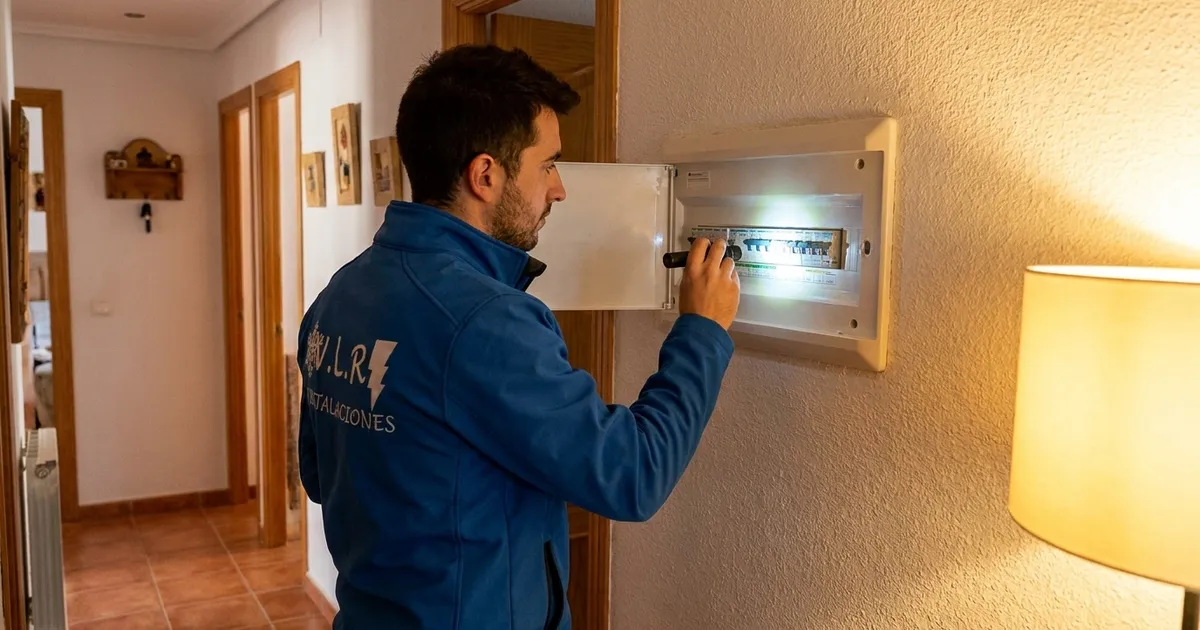
Open the board and find the switch sitting differently from the others - down, or halfway. That is the one that tripped, and it tells you which circuit failed.
If the circuits are labelled, you already know where to look. If they are not, which is typical in older installations, this is the moment you discover why labelling them is worth it. We cover that in what each switch in the consumer unit does.
If nothing has tripped and an area is still dead, the problem is not a protective device operating: that points to a loose connection or a failed accessory, and it will not be solved from the board.
Step 2: reset once, and only once
Push the tripped breaker fully down, then firmly back up. It may simply stay up: sometimes it was a one-off surge and it never happens again.
If it trips straight back, stop. Repeatedly re-arming a breaker onto a fault does not repair anything, and at worst it makes it worse, because every attempt re-applies voltage to whatever is failing. Two attempts tell you everything you need to know.
Step 3: find the culprit one plug at a time
This is the trick that solves most cases, and you can do it yourself:
- Unplug everything in the affected area. Everything, including chargers and extension leads.
- Reset the breaker. If it now stays up, the circuit is fine and the problem is one of the appliances.
- Plug items back one at a time, waiting a few seconds between each.
- Whatever trips it is the culprit. Leave it unplugged and do not use it again until it has been checked.
The usual suspects are appliances with a motor or a heating element - water heaters, irons, hairdryers, old fridges, pool pumps - and cheap extension leads that have spent years behind furniture.
When it trips with everything unplugged
If you have removed absolutely everything and it still trips, the fault is in the fixed installation: the wiring, a joint, or an accessory. At that point there is nothing further you can check without tools and training, and you should not try.
Leave that circuit switched off (the rest of the property can carry on perfectly well) and call. An isolated, open circuit is a safe state to wait in.
When it stops being able to wait
One dead area with no other symptoms is not an emergency and can wait until morning. These change that:
A burning smell. That smell does not appear by accident. Switch that circuit off and leave it off: see what to do about a burning smell.
A socket or switch that is hot, discoloured, or has marks around it.
Water involved. A leak, an overflowing washing machine or rain through a window changes the risk entirely. There is specific guidance in electrical checks after flooding.
Any tingle when touching an appliance, however slight.
The dead circuit feeds something critical: a full fridge, a freezer, medical equipment.
For the general rule on what runs and what waits, see what counts as a real electrical emergency.
What is usually behind it in Málaga properties
In older flats in the centre we meet the same story repeatedly: an installation designed for two or three appliances that has since had air conditioning, ceramic hobs and tumble dryers hung off it without any new circuits. The result is a socket circuit carrying far more than it was meant to, tripping whenever two large loads coincide.
There the problem is not the breaker that trips (it is doing its job) but the distribution. The fix is adding circuits, not fitting a larger protective device, which is precisely the worst thing anyone can do.
Frequently asked questions
Why has the power gone off in only part of the house?
Because what failed is a circuit, not the supply. Each area of the property runs from its own magnetotérmico (MCB) in the consumer unit, so when one trips, only what depends on it loses power. If the supply had failed, or the main RCD had tripped, the whole property would be dark.
I reset the breaker and it trips straight back. What now?
If it trips again immediately there is a genuine fault on that circuit and you should stop resetting it. Repeatedly re-arming a breaker onto a fault does not fix it and can make matters worse. Unplug everything in that area, try once more, and if it still trips with nothing connected, leave that circuit off and call an electrician.
The sockets are dead but the lights work. Is that normal?
As a symptom it is completely normal: in a correctly designed installation lighting and sockets are on separate circuits, precisely so that a fault on one does not leave the house in darkness. It tells you the problem is on the socket circuit rather than across the property.
Could a single appliance be causing it?
Very often it is. An appliance with an internal fault, a trapped cable or a worn-out extension lead is enough to take down the whole circuit. To find out, disconnect everything in that area, reset, then plug items back one at a time until it trips again. Whatever you plugged in last is the suspect.
Is this urgent or can it wait?
If only one area is affected, there is no burning smell and the rest of the property behaves normally, it can wait until a reasonable hour. It becomes urgent if there is a burning smell, heat or scorch marks on an accessory, if water is involved, or if the dead circuit feeds something critical such as a fridge or medical equipment.
Still no power in that area?
VLR Instalaciones has spent more than 20 years fixing faults across Málaga and the province, as electricians authorised by the Junta de Andalucía. We locate the exact point of the fault without opening up half the house, and tell you whether it is an appliance, an accessory or a circuit that has simply run out of capacity. Call us and we will take a look - we cover 24-hour emergencies.