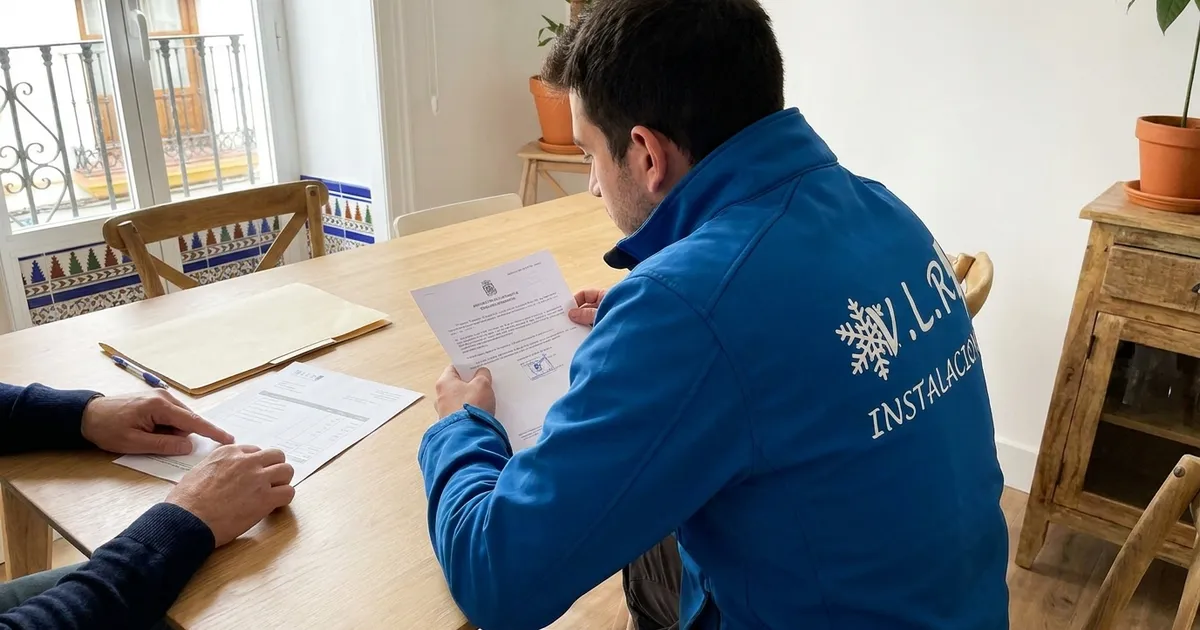
Every electrician says they are registered. We say it too, on this very website, on every page. The difference is that it is a claim you can check in five minutes, and almost nobody does, because nobody has explained how.
So that is what this article is about: what being registered actually means in Spain, how to verify it without taking anyone's word for it (including ours), what a quote needs to contain before you can compare it, and the warning signs that in our experience end in work that has to be redone.
What "instalador autorizado" actually means
It is not a title someone awards themselves: it is an administrative authorisation. A registered installation company (empresa instaladora habilitada) is entered on the official register, evidences the qualifications of its staff, and takes on obligations a private individual does not have, including holding public liability insurance.
From which follows the consequence that matters most in practice: only a registered company can issue the electrical installation certificate, the boletín, and it signs it with its own details. Somebody can be perfectly capable of doing the work and still be unable to certify it. Without a certificate you cannot arrange or increase your supply, so the installation sits in a kind of limbo. We cover the document itself under electrical certificate.
It is worth separating two things that get conflated: knowing how to do the work and being able to answer for it. There are plenty of capable people with no registration. The issue is not their technique, it is that if something goes wrong there is no document, no warranty, and nobody identifiable to pursue.
How to check it in five minutes
1. Ask for the registration number
Ask directly for the company's installer registration number. It is something a registered company must be able to evidence, so providing it costs them nothing. With that number and the registered name, the registration can be verified with the authorities. If the answer is vague or the subject changes, that is information in itself.
2. Check the tax details match
The registered business name and NIF you are given at the start should be the same ones that later appear on the invoice and the certificate. When the quote is signed by one name and the invoice arrives under another, or does not arrive at all, something does not add up.
3. Ask who will sign the certificate
If the job requires a certificate, ask before work starts who issues it. The correct answer is the company doing the work. A "we'll sort that out later" or "I can get you one through someone I know" is the clearest signal of all.
4. Insist on an invoice, with IVA
This is not only about tax: the invoice is what documents that a relationship exists between you and whoever did the work. Without one you have no warranty to invoke and no way to evidence who worked on your installation.
Warning signs
None of these proves anything on its own, but when two or three appear together the pattern is fairly reliable:
- Cash only, no invoice: the most common signal and the one that causes the most trouble later, because it leaves you nothing to fall back on.
- "You don't need a certificate" for work that does: sometimes ignorance, sometimes not, but the outcome is identical: an installation you cannot document.
- A one-line quote: a single global figure with no items cannot be compared with anything, and that is not accidental.
- Refusal to put in writing what happens if something turns up: electrical work means opening walls and boards, and surprises appear. A professional tells you in advance how those are handled.
- A price far below everyone else: nobody gives work away. If the price drops a long way, something has been left out, usually the good materials, the hours, or the paperwork.
- A mobile number and nothing else: no registered name, no address, no website. If there is a problem tomorrow, there is nobody to find.
- Pressure to decide on the spot: a genuine emergency needs fast action, but even then it is possible to say what will be done and what it will cost before starting.
What a proper quote contains
A quote is not a price, it is a description of what is going to happen in your home. It should make clear:
The items, one by one. What happens at each point, not a total. That is what lets you compare two offers and what prevents arguments mid-job.
Materials, with grades or brands. An accessory, a cable or an RCD span a very wide quality range. If it is not specified, you do not know what you are buying.
The registration work, if the job needs it. It should state explicitly whether the certificate and the filings are included or extra. This is the item that most often vanishes from cheap quotes.
Timescale, warranty, IVA and how long the offer stands. Four lines that cost nothing and define everything that can go wrong in the relationship.
And what happens if something unforeseen appears. The sentence that marks out someone who has done this many times: how additional work is priced and authorised before it is carried out. If you are gathering quotes, our guide to what rewiring costs shows which ranges are reasonable.
Why the cheap option costs more
This is not a platitude, it is three specific consequences, and all of them arrive late.
The first is documentary. Uncertified work surfaces at the worst possible moment: when selling, letting, or needing more power. We have seen it hold up transactions, and we cover it in selling without an electrical certificate.
The second is insurance. If there is an incident of electrical origin, an undocumented installation makes for an uncomfortable conversation with your insurer, and it is you having that conversation, not whoever did the work.
The third is simplest: redoing it costs more than doing it properly. When we are called in to correct badly executed work, there is nearly always undoing before there is doing, and that is paid for twice. If you are buying, the electrical checklist for an older property helps you spot it before you sign.
How this plays out in Málaga
Three circumstances here raise the risk of hiring blind. The first is urgency in high season: in July and August, with a full house and no power, the temptation to accept whoever answers first is enormous. Even in a hurry, asking for the registered name takes ten seconds.
The second is the overseas buyer. Many people buying on the coast do not know the Spanish paperwork and are unaware a certificate exists, so they do not miss it until they need it. That is precisely the profile most often left with an undocumented installation.
The third is owning at a distance: the holiday-let owner hiring from another country, without seeing the work and with no way to check who has been in the property. There, documentation is not bureaucracy, it is the only record of what was done. If that is you, see the electrical requirements for a holiday let.
And if you run a community, this multiplies: the owners' meeting needs comparable quotes to vote on, and a quote with no breakdown is not merely opaque, it cannot be approved on any sensible basis.
Practical recommendations
Always ask for the registration number, even in an emergency. It is the best effort-to-protection ratio in this entire guide.
Get three quotes with the same scope. Three prices for three different jobs are not comparable. Define what you want first, then price that.
Keep everything. Quote, invoice and certificate, digitally. It is the folder you will be grateful for when selling, letting or claiming, and the one almost nobody has.
Be wary of haggling over the phone. A price that drops because you pushed, without the scope changing, means either the first figure was inflated or the second will cut corners. Neither is a good sign.
And if something feels off, do not sign. A badly done installation is paid for over years. A day's delay in deciding costs nothing.
Frequently asked questions
Can any electrician issue an electrical certificate in Spain?
No. The electrical installation certificate can only be issued by a registered installation company entered on the official register, and it is signed by that company. Someone who knows how to do the work but is not registered can leave your installation working, but cannot certify it, and without a certificate you cannot arrange or increase your supply. That is the most important practical difference between the two.
How do I check a company is genuinely registered?
Ask for its installer registration number along with its registered business name and NIF (tax number), and check they match what later appears on the invoice and the certificate. Those details allow the registration to be verified with the authorities. A registered company hands them over without hesitation because it has to be able to evidence them; if you get evasion, you have your answer.
What do I actually risk if the work is done by someone unregistered?
Three things, none of which shows up on day one. The work cannot be certified, so the installation stays undocumented and that surfaces when you sell, let, or need more power. If there is an incident, your insurer may dispute cover on an undocumented installation. And if something has been done badly, you have neither a warranty nor an identifiable party to pursue.
What if work has already been done badly and without paperwork?
Start with an honest inspection of what is there, because not everything undocumented is badly executed and not all of it needs redoing. You establish what complies and what does not, correct what is necessary and document the whole. Keep whatever you have (messages, the quote, transfers): if there was payment there was a relationship, which helps both in pursuing it and in evidencing the starting condition afterwards.
Does a more expensive quote mean better work?
Not necessarily, and it is not the useful question. What matters is whether the quotes are comparable: same items, same materials, same registration work included. A high price with no breakdown does not buy peace of mind, and a very low one almost always means something has been left out, usually the good materials or the paperwork. Compare scope, not figures.
Check us too
At VLR Instalaciones we have over 20 years of experience as electricians authorised by the Junta de Andalucía, working across the whole province of Málaga. If you ask us for our registration number and tax details, we will give them to you: it is what we have just recommended you do with anyone, and it would make no sense to ask you not to do it with us. We provide an itemised quote at no obligation, with the registration work stated explicitly, and we issue the certificate for what we do. For emergencies, call us and we will tell you what we are going to do and what it costs before we start.