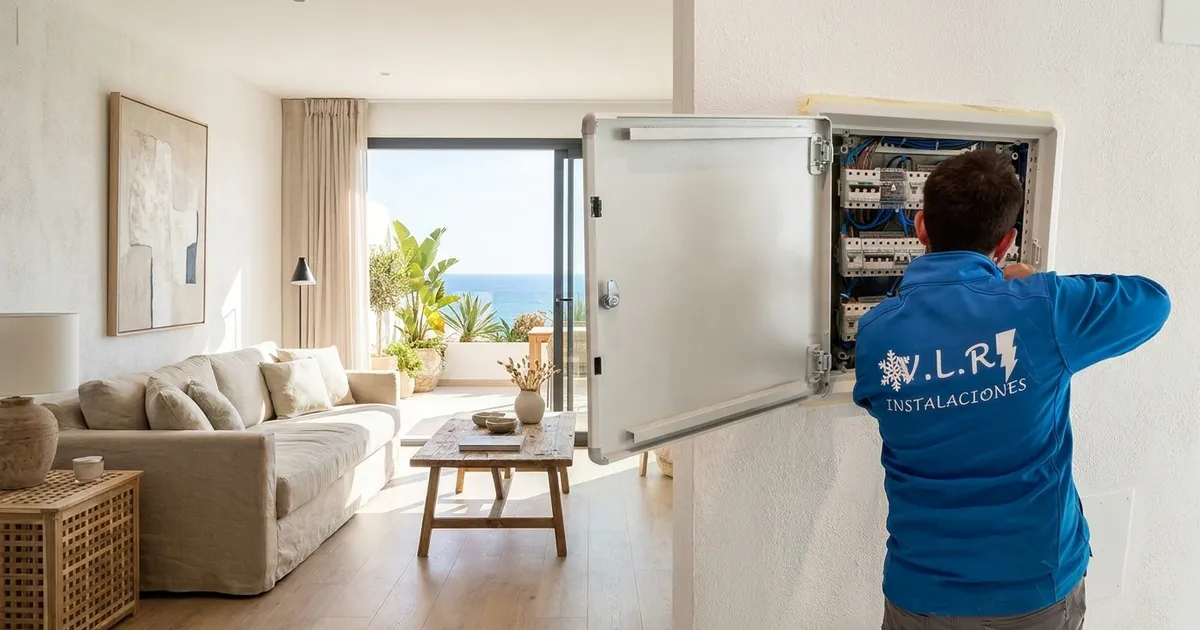
If you are about to put your holiday let on the market in Málaga, the electrical installation is one thing you cannot afford to leave to chance. A holiday home, or vivienda de uso turístico (VUT), gets far heavier use than an ordinary house: guests who switch on the air conditioning, the hob, the water heater and several devices all at once, a constant turnover of people who do not know the installation, and, above all, your legal responsibility if something goes wrong.
In this article we explain, in plain English, the electrical requirements your holiday let needs to meet in Málaga and the Costa del Sol: from the boletín eléctrico (electrical certificate) to the potencia contratada (contracted power) and the protective devices in the consumer unit. The goal is simple: let your property with peace of mind, in line with the regulations, and without the kind of fault that ruins a guest's stay and your reviews.
Why does the electrical installation matter so much in a holiday let?
In a holiday let the installation works much harder, and in worse conditions, than in a normal home. Guests tend to use everything at once and without a second thought: air conditioning on full, the kitchen, a hairdryer, chargers and the television all together. On top of that, they do not know where the consumer unit is or how to reset the diferencial (RCD) if it trips, so any fault quickly turns into a complaint.
Then there is the liability. As the owner, you are responsible for making sure the installation is safe for the people staying in it. A poor installation does not just expose you to penalties or problems with your insurer: it can cause an accident. That is why it is worth getting everything in order before your first guest arrives.
Key electrical requirements for a holiday let
These are the points we check and bring up to standard in a property destined for holiday letting:
1. An up-to-date electrical certificate (CIE)
The boletín eléctrico, officially the Certificado de Instalación Eléctrica (CIE), is the document that proves your installation complies with the Low Voltage Electrotechnical Regulation (REBT). It is valid for 20 years, and you will be asked for it when contracting or changing the supply, increasing the power or after a renovation. It is the standard way to demonstrate that the property is safe to let. We issue it as electricians authorised by the Junta de Andalucía.
2. Enough contracted power
Guests use everything at once, so poorly matched power will trip the electricity again and again, exactly when you are not there to reset it. It is worth calculating the contracted power based on the property's actual appliances (air conditioning, kitchen, electric water heater) and the simultaneous use typical of a holiday rental. We help you size it so you neither fall short nor overpay.
3. Compulsory protection: RCD and MCBs
The consumer unit must have a residual current device, the diferencial (RCD), that cuts the power in the event of a leak (this is what protects people from a shock), plus miniature circuit breakers, the magnetotérmicos (MCBs), that protect each circuit against overloads and short circuits. In a home full of guests who do not know the installation, these devices are your best safety net. If your consumer unit is old or still uses fuses, it should be upgraded.
4. Proper earthing
Earthing (puesta a tierra) is compulsory and essential in bathrooms, the kitchen and any pool area. It sends any current leak safely to earth and, combined with the RCD, stops a faulty appliance from becoming a danger to your guests.
5. Lighting and safety details
Enough sockets, firmly fixed and in good condition, lighting that works, and, in blocks of flats, the emergency lighting and signage the building requires. A smoke detector, while not always compulsory, is strongly recommended in a holiday let, and guests appreciate it.
Before you start letting, it is worth checking the installation if you notice any of these signs:
- The electricity trips when the air conditioning and the kitchen run at the same time.
- The consumer unit has no RCD or still uses old fuses instead of MCBs.
- Loose, burnt or unearthed sockets, particularly in the kitchen and bathrooms.
- The installation is more than 20 years old or you have no certificate.
- You have carried out a renovation (kitchen, bathroom, air conditioning) without updating the certificate.
How does this affect you in Málaga and the Costa del Sol?
Málaga is one of the most active holiday-let markets in Spain, which means more scrutiny. To let legally you must register the property in the Registro de Turismo de Andalucía (the Andalusian tourism register) through a declaración responsable, a signed declaration that you meet the requirements. The Andalusian holiday-home decree (Decreto 28/2016, amended by Decreto 31/2024) requires, among other things, that the property holds a licencia de ocupación (occupancy licence) and that its installations are in good condition and meet current regulations.
On top of that, many town councils have tightened their rules, and the constant turnover of guests multiplies the wear on the installation. In such a competitive market, an unresolved electrical fault does not just risk a penalty: it costs you reviews and bookings. Keeping the electrical side compliant and well maintained is both a legal duty and an advantage for your business.
Practical recommendations
Get an inspection before registering the property. It is far cheaper and easier to sort out problems before you have guests than in the middle of the season. An inspection tells you exactly what is needed to bring the installation up to standard.
Obtain or renew the certificate. If the property is old, you have no CIE, or you have carried out renovations, update the electrical certificate. It is the document that backs up the fact that your installation is safe and meets the REBT.
Adjust the power and modernise the consumer unit. An up-to-date consumer unit, with a properly sized RCD and MCBs, prevents most outages and protects both your guests and your appliances.
Have 24-hour emergency cover in place. A guest left without power at midnight cannot wait until morning. Having a 24-hour emergency electrician on call saves you negative reviews and headaches.
Keep the paperwork. Have the certificate, renovation invoices and any documentation to hand. If you bought the property recently, it is also worth reading up on the electrical check when buying a home.
Frequently asked questions
Do I need an electrical certificate to rent out my property as a holiday let?
The boletín eléctrico (CIE), Spain's electrical installation certificate, is the usual way to prove your installation is safe and meets the REBT regulations. You will be asked for it when contracting or changing the supply, increasing the power or after any renovation, and it is strongly advisable to have it up to date before you start letting, especially in older properties. We issue it as authorised electricians.
How much electrical power does a holiday let need?
It depends on the property's appliances. Guests tend to run the air conditioning, the hob, the water heater and several devices at once, so the contracted power must be sized for that simultaneous use. If it is too low, the electricity will keep tripping. An electrician can size it for your specific case.
How often should a holiday let's electrical installation be checked?
Because of the intensive use and guest turnover, we recommend an inspection at least every 4 to 5 years, and always before you start letting or after a renovation. The certificate is valid for 20 years, but a periodic check catches problems before they cause an outage or an accident.
What do I do if a guest loses power at night?
The best option is to have a 24-hour emergency electrician on hand. An unresolved power cut ruins the stay and costs you bad reviews. At VLR Instalaciones we handle emergencies 24 hours a day across Málaga and the Costa del Sol, usually arriving in under an hour.
Is earthing compulsory in a holiday let?
Yes. Earthing (puesta a tierra) is required under the REBT regulations and is essential in bathrooms, the kitchen and any pool area. Together with the RCD, it protects your guests from electric shock if an appliance develops a fault. It is one of the first things we check.
Preparing your holiday let for the market?
At VLR Instalaciones we have over 20 years of experience as electricians authorised by the Junta de Andalucía across the whole province of Málaga. We inspect your holiday let's installation, issue the certificate, adjust the power, modernise the consumer unit and provide 24-hour emergency cover so you can let with complete peace of mind. Ask us for a no-obligation assessment.