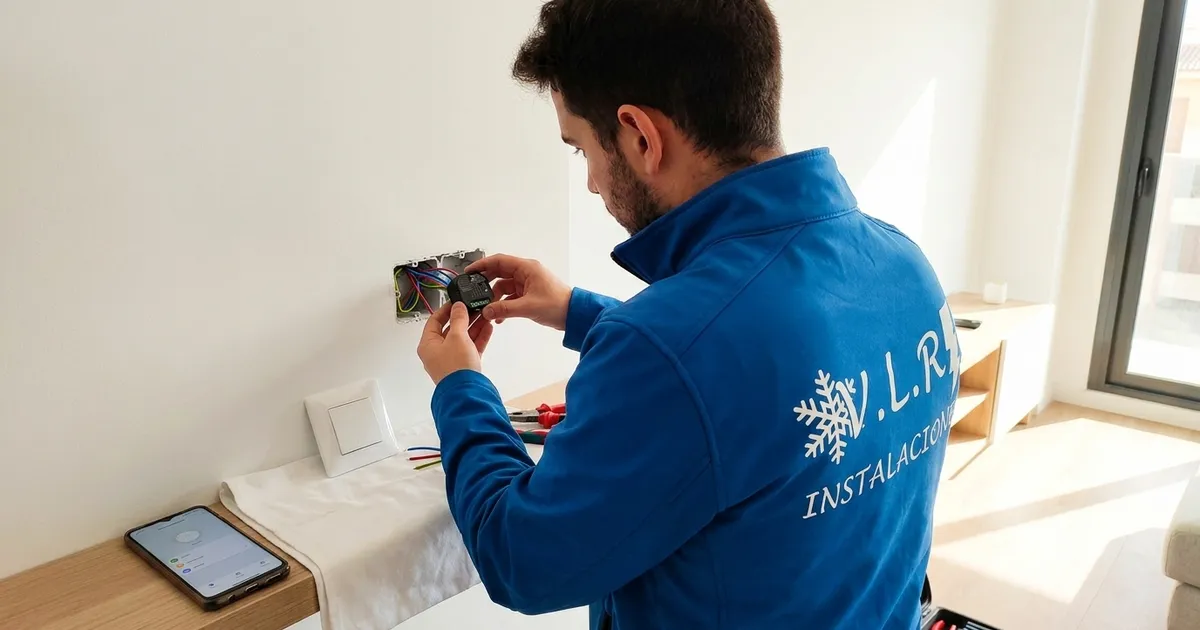
Almost everyone assumes home automation belongs to new build: that having the house under control from your phone means chasing out walls or waiting for the next renovation. In practice it is the opposite: most of what people genuinely want can be done in a property that is already built, without touching the wall.
But there is one technical detail that decides the entire project and that hardly anybody mentions before you buy anything. We will start there, because if you ignore it you will end up with a smart switch that cannot be installed.
The obstacle nobody mentions: the neutral
Most smart switches need a neutral to power themselves: they are small devices that draw a little current even with the light off. And here is the problem: in a good many Spanish installations of a certain age, the only conductor reaching the wall switch is the one going to the lamp. There is no neutral in that box, because none was ever needed.
You cannot tell by looking at the wall. The box has to be opened and checked, and an electrician does that in five minutes. It is the check that determines everything else, and doing it before you buy saves you returns.
The good news is that having no neutral does not close the door. There are three routes: fit the module at the light fitting itself, where both conductors are present; use devices specifically designed to work without a neutral, bearing in mind they can cause flicker with some LED lamps; or use wireless switches, which do not depend on the wiring at all because they run on a battery and radio.
If you would also like to understand what is in your board and how your installation is arranged, we break it down in your consumer unit explained.
What can be done without touching walls
1. Lighting
This is where nearly everyone starts and where there are fewest complications. With modules in the existing boxes or at the light fitting, lighting can be controlled from a phone, by voice or on a schedule, and the wall switch carries on working by hand exactly as before. If you are changing lamps anyway, it is the moment to move to LED lighting and do both at once.
2. Climate control
This is where the real saving is in Málaga. A smart thermostat on a climate system lets you schedule by hour and by room instead of leaving the unit running at will. And for wall-mounted split units there are infrared controllers that do exactly what the handset does, but programmable and from your phone, without touching the unit.
3. Sockets and consumption
Smart plugs are the simplest route of all: they schedule the water heater, the irrigation or the washing machine, and many measure the consumption of whatever is plugged in. That figure is surprisingly useful, because it usually dismantles a few assumptions about what really costs money at home. It is the natural companion to what to unplug when you leave.
4. Shutters, with caveats
If your shutters are already motorised, adding control is straightforward. If they are belt-operated and there is no power at the housing, it has to be run there, and that can mean work in the wall. This is the part of the project to clarify first, because it decides whether we are talking about an afternoon or a small piece of building work.
What does need real work
So as not to oversell it, this is what a device and an app will not solve:
- Shutters with no power at the housing: the most common of the items that genuinely involve building work, however minor.
- A wired system for the whole property: more robust and more independent of the internet, but it makes sense in new build or a full renovation, not as an addition.
- Adding new circuits: if you want to feed something that has no line of its own today, that starts at the board.
- Boxes that are too shallow: some older boxes have no depth to house a module behind the mechanism. It is solvable, but you need to know beforehand.
- Insufficient wifi coverage: not electrical, but it sinks more home automation projects than any wiring problem. If the signal does not reach the far end of the house, nothing else will work properly.
Wireless or wired
The honest comparison is short. Wireless is what makes sense in a property already built: quick to install, no mess, and expandable in stages. Its weakness is dependence on the wifi network and, in some systems, on cloud services a manufacturer can decide to shut down.
Wired is more robust, independent of the internet and lasts decades, but it is only reasonable if you are renovating. Installing it as an addition to a finished house is expensive and disruptive.
And one recommendation worth more than the choice of brand: always ask what happens if the manufacturer disappears. Systems that keep their logic on a local device carry on working without internet and without depending on a company. Those that keep it in the cloud do not. That is the difference between an installation and a subscription.
How this plays out in Málaga
The first factor is the housing stock. Many flats in the old town and the earliest coastal developments are exactly the missing-neutral case. It is not a defect: they were wired that way because at the time it was correct. It simply determines which solution fits, which is why the preliminary check matters so much here.
The second is the climate. In a province where air conditioning runs for hours over months, automating climate control and shutters is not a gadget: closing shutters during the sunniest hours and limiting the unit by time band has a measurable effect on the bill. It is the application of home automation that pays for itself soonest around here.
The third is holiday letting and seasonal properties. Being able to check remotely that the air conditioning has not been left on in an empty house, or to cap the thermostat range, solves a very specific problem in this province. If that is your situation, look at the electrical requirements for a holiday let as well.
Practical recommendations
Start with one room, not the house. Automate the living room or the bedroom, live with it for a month, then decide. Almost everyone discovers they use two automations and that the other eight were surplus.
Check the neutral before buying anything. It is the number one cause of returned equipment. Five minutes of an electrician's time tells you exactly which devices will work for you.
Prioritise what saves money, not what looks impressive. Climate control and shutters have a return in Málaga. Colour-changing lighting is pleasant and saves nothing.
Insist the manual switch keeps working. Any properly executed installation leaves the light usable by hand. If a solution forces you to use a phone to turn on a lamp, it has been badly designed.
And do not accumulate apps. Five different brands means five apps, five accounts and five things that break separately. Better to choose one ecosystem at the outset, even if you start with two devices, and expand it with the installation already planned for it.
Frequently asked questions
Does home automation need building work in an existing property?
In most cases, no. Much of what people actually want (lights from a phone, control of the air conditioning, timed sockets, seeing consumption) is achieved with devices that fit into the boxes and points already there. What can require real work is motorising shutters with no power at the housing, or running a wired system through the whole property.
What is this about a neutral at the switch, and how do I know if I have one?
Most smart switches need a neutral to power themselves, and in a good many older Spanish installations the only conductor reaching the wall switch is the one going to the light, with no neutral. You cannot tell without opening the box and looking, and that is a job for an electrician. If there is no neutral there are alternatives: modules fitted at the light fitting itself, devices designed to work without a neutral, or battery-powered wireless switches that do not depend on the wiring at all.
Does home automation still work if the internet goes down?
It depends how it has been set up, and it is the question fewest people ask before buying. Properly installed switches always still work by hand, because underneath they are switches. What you lose without internet is control from outside the house and, in some cloud-dependent systems, the automations too. Systems that keep their logic on a local device carry on working offline.
Can I automate the shutters I already have?
Often yes, but this is the item that most frequently involves real work. If the shutter is belt-operated and there is no power at the housing, it has to be run there, and that can mean intervention in the wall. If it is already motorised, adding the control module is usually enough. Check this first, because it is the difference between an afternoon's work and a small job of building work.
Is it worth it in a holiday let?
This is where it pays off fastest, and not for comfort but for control. Being able to see that the air conditioning has been left running in an empty property, capping the climate control to a sensible range, or switching everything off between guests has a direct effect on the bill. Keep it simple though: anything a guest cannot understand in ten seconds will end up generating a phone call.
Shall we take a look at your property?
At VLR Instalaciones we have over 20 years of experience as electricians authorised by the Junta de Andalucía, working across the whole province of Málaga. We check what your installation will take (starting with the neutral), tell you plainly what can be done without building work and what cannot, and install the home automation you will actually use, leaving everything working by hand as well. Get in touch and we will take a look at no obligation.