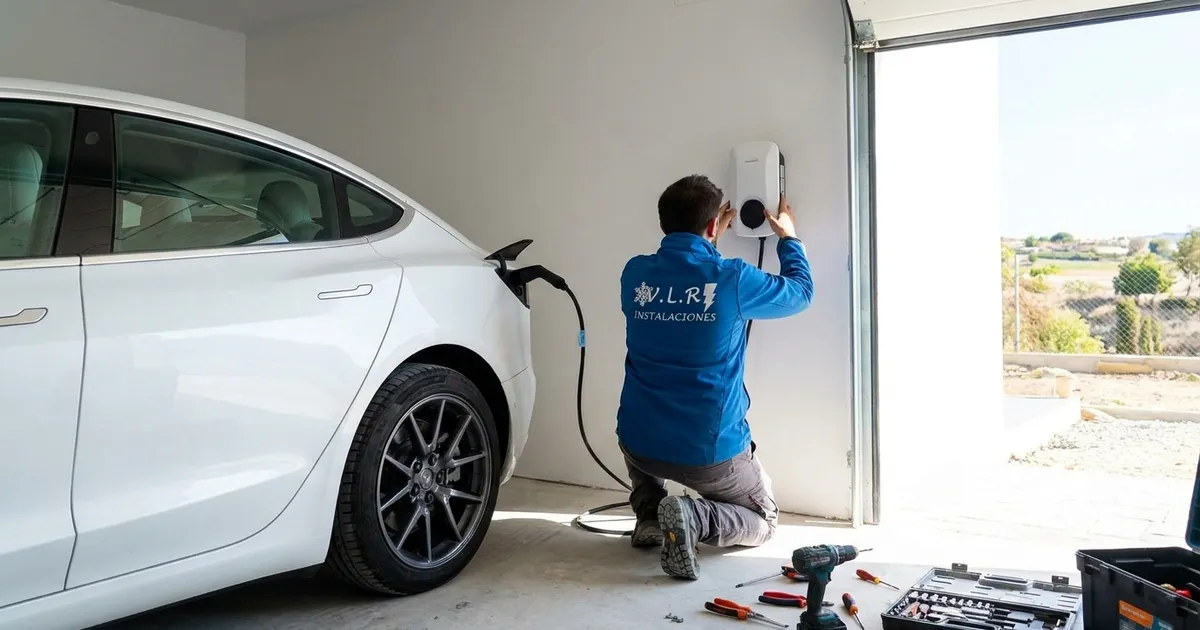
What it costs to charge an electric car at home in Spain has a short answer and a long one. Short: the kWh that go into the battery, times what you pay per kWh. The long answer is the useful one, because it explains why two neighbours with the same car and the same commute can pay noticeably different amounts each month.
The difference is almost never the car or the charger. It is what time you charge, and how your installation is set up. Here is how it works, so you can look at your own bill and tell whether you are doing it the expensive way.
The basic sum: kWh times price per kWh
An electric car uses electricity like anything else in the house, just a lot of it at once. If you know how many kWh go into the battery and what a kWh costs you at that moment, you have your answer. What complicates it is that in Spain the price of a kWh is not the same all day.
Time bands: where the money is won or lost
Most domestic tariffs split the day into bands - punta (peak), llano(standard) and valle (off-peak) - at different prices. The valle band, overnight and at weekends, is the cheapest of the day. It is also exactly when the car is sitting on the drive doing nothing.
That is the real margin: the same charge, in the same car, costs considerably less scheduled for the early hours than plugged in when you get home. Nearly every charger and nearly every car lets you set a start time. It is the cheapest improvement available, because it costs nothing at all.
- Charging on arrival home: the most convenient and the most expensive. It lands in the priciest band and on top of the household's own evening peak.
- Charging scheduled overnight: same result by morning, at off-peak prices, and without competing with the oven or the air conditioning.
- Charging at weekends: Saturdays and Sundays typically sit in the off-peak band all day, so a long charge fits neatly there.
- Charging from solar, if you have panels: surplus you were about to export is worth more in the car's battery.
We deliberately quote no price per kWh here: it varies by supplier, tariff and market. That number is on your own bill, and with it the sum takes you thirty seconds.
The other factor: contracted power
Charging does not only consume energy, it occupies power while it runs. If your supply is already tight and you plug in while the oven, hob and air conditioning are going, you know what happens: the main switch trips and the house goes dark.
The instinctive fix is to raise the contracted power. Sometimes that is right, but it is worth knowing that the standing charge is paid every month of the year, whether you charge or not. If the problem only shows up while the car is charging, there is usually a better answer. We cover it in contracted power in Spain explained.
Load management: adjust before you upgrade
A home charge point does not have to run flat out. Its output can be limited, and more usefully it can be paired with dynamic load management: a small meter in the consumer unit that watches what the house is drawing and automatically throttles the car when the rest of the property wants power.
The car takes a little longer to fill on those nights, which you do not notice because you are asleep. In exchange you avoid upgrading your supply and paying for it twelve months a year. For most Málaga homes that are not generously supplied, this is the sensible route.
Why the wall socket will not do
The emergency cable supplied with the car is for getting out of trouble. It is not for charging every night. A domestic socket and its circuit are not built to deliver current for six or eight hours at a time, and that is where overheating, melted sockets and strange-smelling extension leads come from.
If you ever notice that smell, do not leave it: we cover it in what to do about a burning smell from a socket. A properly installed charge point runs on its own circuit from the board, with its own cable and protective devices, precisely so this cannot happen.
What does change the installation cost
The cost of installing the charge point is a separate question, broken down in EV charger installation cost in Málaga. The heaviest factors are the distance between the board and the parking space, the condition of the cuadro eléctrico (consumer unit), and whether new containment has to be run.
If the car charges in a communal garage the process is different and you have the right to install one - see installing an EV charger in an apartment building.
Send us a WhatsApp with a photo of your consumer unit and your contracted power: we will tell you whether your home can charge with load management instead of an upgrade, and what the charge point would cost.
Solar panels and an electric car
If you already have or are considering solar panels, the car is probably the best load you can own: a lot of energy, and flexible about when it takes it. The condition is that the car is home during daylight. If it is only there overnight, the overlap is much smaller unless a battery is involved, and then it is worth checking the sizing before assuming anything.
Frequently asked questions
How much does it cost to charge an electric car at home in Spain?
The sum is simple: the kWh your battery needs multiplied by what you pay per kWh in the time band you charge in. What changes the answer is not the car, it is the hour. Charging overnight in the valle (off-peak) band costs noticeably less than the same energy into the same car in the late afternoon.
Do I need to increase my contracted power to charge at home?
Not always. A home charger can be configured to limit its output, and many support dynamic load management, which automatically reduces the car's draw when the rest of the house is using power. That is usually the cheaper route: adjust before you upgrade. Raising your potencia contratada (contracted power) increases the standing charge every month of the year, whether you charge or not.
Can I just charge from a normal socket?
Occasionally, using the emergency cable supplied with the car, but it is not a daily solution. A domestic socket and its circuit are not designed to deliver current for many hours at a stretch, which is the usual route to overheating, scorched sockets and, in older installations, real risk. For daily charging you install a proper charge point on its own circuit with its own protective devices.
Is it worth charging the car from solar panels?
Yes, when the car is at home during daylight. Surplus you would export is credited at less than you pay to buy energy, so putting it into the car is worth more than exporting it. If the car is only home at night, the overlap with solar is much smaller unless there is a battery involved.
Does an EV charge point need certification in Spain?
A charge point must be installed by an authorised installer and the work is documented. Beyond the legal side, that paperwork is what protects you with your insurer: a self-installed, undocumented charge point is exactly what a company looks for when declining a claim.
Want to charge at home without surprises on the bill?
VLR Instalaciones has spent more than 20 years on electrical installations across Málaga and the province, as electricians authorised by the Junta de Andalucía. We look at your board, your supply and where you park, then propose the setup that costs least to live with - very often load management rather than a supply upgrade. Get in touch for a no-obligation quote for your charge point. And if you own the home, the 15% IRPF deduction for the charge point only applies to installations completed by 31 December 2026.