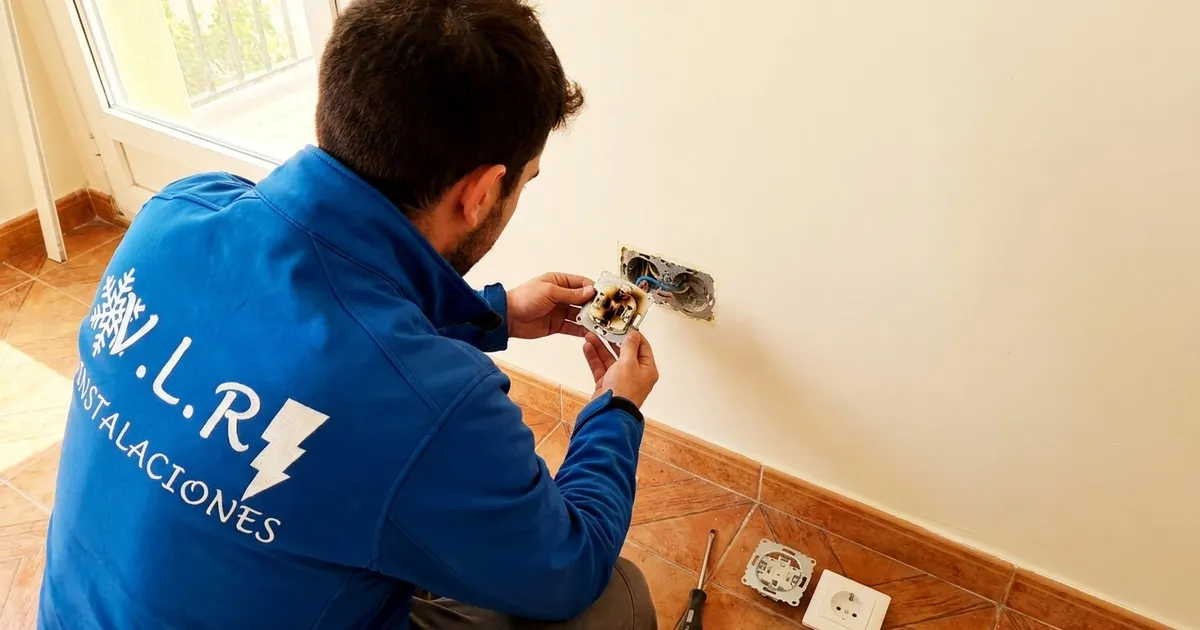
If there is a burning smell coming from a socket or your consumer unit, this is not an annoyance to note down. It is the only warning an electrical installation sometimes gives before it starts a fire. And unlike almost any other fault, it does not survive the usual "I'll look at it at the weekend".
So, in order: what to do right now, then why it happens, and finally why your diferencial (RCD) may not have tripped even though everything looks fine. If you are reading this with the smell still in the room, do the first section before you read any further.
What to do right now
1. Kill the power to that circuit
Go to the consumer unit and switch off the magnetotérmico (MCB) for the affected circuit. If you do not know which one it is, or the smell is coming from the board itself, switch off the main breaker instead. Being without power for a while is inconvenient. Leaving a hot spot energised is not inconvenient, it is dangerous.
2. Do not pull the plug out while it is hot
Isolate first, unplug second. A deformed or hot plug can burn you, and pulling on it while it is live easily makes the contact worse at exactly the point that is failing. With the circuit already dead, remove the appliance calmly.
3. Ventilate, and do not switch it back on "to test it"
The temptation is obvious: reset the breaker and see whether it still smells. Do not. Every time you re-energise a hot spot the material degrades a little further and your remaining margin shrinks. The test tells you nothing an electrician cannot establish without the risk.
4. If you see smoke or a flame, call 112
Leave the property, and if you can do it without going near the source, switch off the main breaker on your way out. Never put water on an electrical fire. A dry powder or CO2 extinguisher is suitable, but do not take risks trying to put it out yourself.
Why it smells of burning
The smell of hot plastic almost always means the same thing: somewhere in the installation, current is meeting more resistance than it should, and that resistance is turning into heat. The usual causes, in the order we find them:
- A loose connection: a terminal screw that was never tightened properly, or that has worked loose over years of expansion and contraction. This is the number one cause and the quietest, because it gives no symptom at all until it starts to heat.
- An overloaded circuit: too much load through one point, almost always via a multi-way adaptor or an extension block with half the room hanging off one socket.
- A high-draw appliance on the wrong socket: the classic is a portable air conditioner, a water heater or a hob plugged into a lighting circuit or an old outlet.
- Aged insulation or damp: decades-old cable with cracked sheathing, or boxes that have taken damp and no longer insulate as they should.
- Old joints inside the wall: twisted and taped, made during some past renovation. They work for years and then one day start to heat.
- A degraded terminal in the board itself: when the smell comes from the consumer unit rather than a socket, this is the first thing to rule out, and it is more urgent because the whole property's load passes through there.
Signs that usually go with the smell
If you have noticed any of these in recent weeks, they fit the same problem and are worth mentioning to the electrician:
- A yellowed socket, or brown marks around the pin holes. That tint is not dirt, it is accumulated heat.
- An appliance plug that gets hot in use, or that has to be wiggled to make contact.
- Crackling or a snapping noise as you plug something in or pull it out.
- A buzz from the consumer unit that was not there before.
- A fishy or hot-plastic smell with no visible source: some materials used in electrical accessories give off that distinctive odour when they overheat. If nobody is cooking, suspect the installation.
- Lights dipping when the air conditioning or the washing machine starts up.
Why the RCD did not trip
This is the part that confuses people most, and it matters: a hot spot caused by a bad connection is not an earth leak. The RCD checks that the current going in equals the current coming out, and here it does. The current follows its normal path, it just heats the place where the contact is poor.
The MCB need not trip either, because the load can be comfortably within what the circuit is rated for. Which leads to the uncomfortable conclusion: a socket can burn out with every protective device present and working correctly. There are devices designed specifically to detect electrical arcing, but not every installation has them.
It is the exact opposite of the situation where the RCD keeps tripping, where the warning arrives as a power cut. Here there is no cut, and the smell is the only warning you get. Which is why it should not be ignored.
What not to do
Do not clean up the socket and carry on using it. An accessory that has got hot enough to darken gets replaced, not rescued. And more importantly: the accessory is rarely the cause, it is the casualty. Swapping it without finding out why it got hot leaves the problem exactly where it was.
Do not keep resetting the breaker. If you are getting power cuts as well as the smell, the protection is doing its job. Insisting overrides the only warning you have.
Do not wrap it in insulating tape. Not a cable, not a box, not a joint you have found. Tape does not fix a hot spot, it hides it and adds flammable material.
And do not put it off over the price of a call-out. Finding a hot spot early is a small repair. The same problem two weeks later can be a whole circuit, a consumer unit, or something considerably worse.
Why it happens more in summer in Málaga
July and August are our busiest months for burning-smell call-outs, and that is no coincidence. Air conditioning runs for hours on end, so connections that coped with intermittent loads are now working at their limit all afternoon. A loose terminal that went unnoticed in January makes itself known in August.
Add ambient temperature. A consumer unit in an internal hallway at 32 degrees sheds heat far less effectively than in winter, and materials run closer to their limits. If the board is in a garage or an enclosed patio, more so again.
And there is a very local factor: much of the housing in the old town and in the first coastal developments has installations dating back decades, sized for a home with no air conditioning, no induction hob and nothing like the number of appliances we now leave plugged in. If it is also a holiday let, with continuous occupancy and appliances nobody switches off, the sustained load is higher still.
What we do when we arrive
The first job is to locate the hot spot, not to swap parts blind. We check the affected socket or accessory, verify the tightness of the terminals on that circuit and in the board, and measure the actual load on the line to establish whether the problem is the connection or the fact that the circuit is carrying more than it should.
From there the repair can be as simple as replacing the accessory and terminating it properly, or it can mean renewing a section of cable, redistributing loads between circuits, or replacing the board. If it turns out the installation is not up to how the house is actually used, we say so and show why: sometimes the real answer is adjusting the contracted power and reorganising the circuits rather than adding another patch.
And if the property has some age to it and has never had a proper inspection, this is the moment to consider a full check with its installation certificate, particularly if you are thinking of letting or selling.
Frequently asked questions
Can I keep using the socket if the smell has gone?
No. The smell goes when the hot spot cools down, not when the problem is fixed. If plastic got hot enough to smell, it reached a temperature it should never reach, and whatever caused that is still there. The moment you reconnect the same load it will heat up again, and every cycle leaves the material a little more degraded.
Shouldn't the RCD have tripped?
Not necessarily, and this is the most dangerous misunderstanding we come across. An RCD watches for current leaking to earth, and a loose connection is not a leak: the current takes its normal path, it just heats the loose point on the way. The MCB need not trip either, because the load can be well within what the circuit is rated for. A socket can burn out with every protective device apparently correct and working.
Is it dangerous to sleep in the house with that smell?
If you have identified the circuit and left it switched off at the board, the risk is gone for as long as it stays dead. If you cannot identify it, if the smell is coming from the board itself, or if it comes back, do not leave it until morning: switch off the main breaker and call an emergency electrician. A hot spot gives no warning before it gets worse.
What do I do if I see smoke or a flame?
Call 112 and get out of the property. If you can do it without going near the source, switch off the main breaker on your way out. Never put water on an electrical fire: water conducts and makes it worse. A dry powder or CO2 extinguisher is suitable, but do not take risks trying to put it out yourself.
Will home insurance cover it?
That depends on the policy, so check with your insurer. What helps in every case is having a report from a licensed installer documenting what failed and what was repaired, and keeping photographs of the condition it was in. Without that documentation it becomes your word against theirs.
If you can smell it now, call us
At VLR Instalaciones we have over 20 years of experience as electricians authorised by the Junta de Andalucía, and we cover electrical emergencies across the whole province of Málaga. We find the hot spot, carry out the repair, and explain why it happened, which is the only way to make sure it does not happen again. If you can smell burning, switch that circuit off at the board and call us.