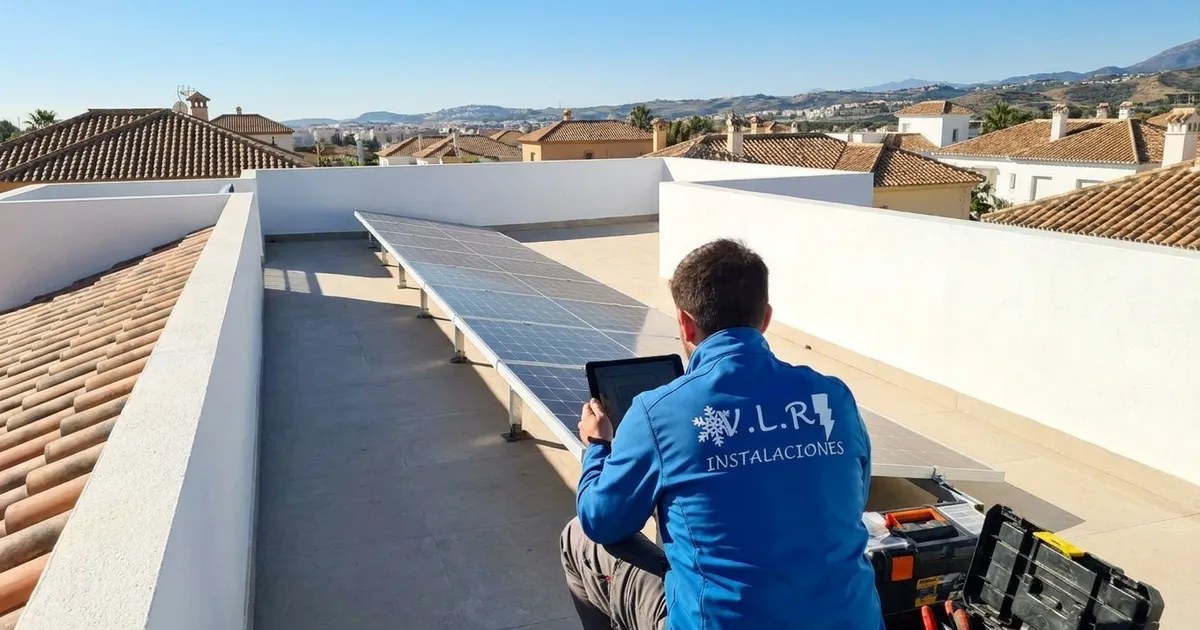
What size solar system do I need? It is the first thing almost everyone asks, and it usually arrives with a figure that cannot answer it: the floor area of the house. How big a property is tells you nothing about how much electricity it uses. Plenty of 300 m² villas use less than a flat running two air conditioning units and a heated pool.
Sizing a solar installation is arithmetic, not instinct, and it rests on three inputs you either already have or that get measured on a site visit. Here is what they are and how they combine, so that when quotes land you can tell whether someone has sized your roof or simply proposed the largest array that fits on it.
The number that drives everything: kWh on your bill
It starts with your electricity bills, and specifically the kWh consumed, not the euro total, which moves with prices. You want a full year, because on the Costa del Sol a July bill looks nothing like an April one. Air conditioning completely reshapes a household's profile.
If you can log in to your supplier's customer area, you can usually download hourly consumption data. That file is gold for sizing, because it tells you not just how much you use but when. The when is what decides whether an installation pays.
Why daytime usage matters more than the annual total
Panels generate when the sun is up. If the house is empty from nine to six and your usage is concentrated in the evening, that generation goes to the grid and is credited on your bill, but it is credited at less than you pay for the electricity you buy. Which is why two homes with identical annual consumption can need quite different systems.
- Daytime-heavy usage: working from home, daytime cooling, pool pump, an aerotermia (air-source heat pump) system. Every generated kWh displaces a purchased one, so a more generous array is justified.
- Evening-heavy usage: house empty on weekdays, cooking and laundry at night. Exports will be high, so size carefully or look at storage.
- Seasonal usage: a holiday home or second residence. The annual figure misleads here; look at the months the property is actually occupied.
- Usage about to change: if an electric car or a heat pump is coming, size for the house you will have, not the one you have now.
From consumption to peak power (kWp)
System size is quoted in kWp (kilowatt peak). Current panels are around 450-500 W each, so a little over two panels makes up each kWp. Converting consumption into kWp depends on local irradiation, and Málaga is about as favourable as Europe gets: the province sits well above what the same array would produce in northern Spain, let alone northern Europe.
What a competent installer does is overlay your consumption curve on estimated month-by-month generation and find the point where extra capacity stops meaningfully increasing savings. That point, not the maximum the roof can hold, is the right size.
What constrains the maths: the roof
1. Usable area, not total area
An 80 m² roof does not take 80 m² of panels. Subtract chimneys, vents, skylights, the row spacing needed to stop panels shading each other, and access for maintenance. Genuinely usable area is usually a good deal smaller than it looks from the ground.
2. Orientation and pitch
South is the annual optimum. East and west produce less overall but spread generation across morning and afternoon, and in a house that uses power at those times that can beat a huge midday peak exported straight to the grid.
3. Shade
The most underestimated factor by some distance. Partial shade on one panel can cost considerably more than the shaded fraction suggests, depending on how the array is wired. A tree casting a small shadow today casts a large one in five years. In central Málaga and in areas of taller blocks, the neighbour's shadow often decides the design.
4. Condition of the roof
If the roof covering needs work, do it first. Dismantling an array to chase a leak is an entirely avoidable cost.
What about the electrics inside the house?
A solar installation does not stand alone. It connects to your board and shares protection with the rest of the property. Before settling on a size it is worth checking the cuadro eléctrico (consumer unit), confirming there is room for the new protective devices, and that the earthing is sound. In older properties this comes up more often than people expect, and it is far better known before a quote is signed than after.
It is also worth reviewing your potencia contratada (contracted power). Self-consumption does not change your contracted power by itself, and the two are frequently confused.
When NOT to go bigger
There are three situations where adding panels is the worst available use of the money, and they are worth saying out loud even though they argue against selling a larger system.
When usage is low and mostly at night. If you are out all day and use little, most of what you generate will be exported. Before growing the array, see whether you can shift loads into daylight: washing machine, dishwasher, water heater, pool pump.
When the house has unaddressed efficiency losses. Switching to LED lighting or tuning the air conditioning usually pays back sooner than the last tranche of panels.
When the roof has run out of good positions. Forcing panels onto poor orientations or shaded areas to reach a round kWp figure adds cost and contributes little energy.
And a battery?
A battery is not what makes an installation worthwhile: sizing decides that. What a battery does is move energy from the afternoon into the evening and provide backup when the power goes out. If your profile is evening-heavy, or cuts worry you, it is worth studying. If your usage is already daytime-heavy, it is often better to start without one and leave the system ready for it. We go into it in is a solar battery worth it in Spain.
The paperwork does not scale with size, but it exists
Whatever the power, the installation is registered and surplus compensation is arranged. Some very cheap quotes leave this out and it surfaces later. The detail is in registering solar panels in Andalucía.
Frequently asked questions
How many solar panels do I need for a house in Málaga?
It depends on how much electricity you use over a year and how much of it you use during daylight. The starting point is not the size of the property or the number of bedrooms, it is the annual kWh figure on your bills. Combine that with the usable roof area and its orientation and you get the peak power (kWp) that actually makes sense.
Is it better to oversize or undersize a solar system?
Slightly under is usually better than substantially over. Energy you generate but do not use is exported to the grid and credited on your bill, but it is credited at less than you pay for the energy you buy. Heavy oversizing stretches the payback without improving real savings.
Does roof orientation matter?
Quite a lot. In the northern hemisphere a south-facing roof produces the most across the year. East and west produce somewhat less overall but spread generation across the morning and afternoon, which can suit a household's actual usage better. Shade from chimneys, trees or neighbouring buildings costs more than most people expect.
Do I need a battery for solar to be worth it?
No. A battery makes sense when you use little during the day and a lot at night, or when you want backup during power cuts. If your usage is already daytime-heavy, such as working from home, air conditioning or a pool pump, it is often better to size the array properly first and consider storage later.
Will I need to change the consumer unit to install solar?
Not always, but it has to be checked. A solar installation needs its own protective devices and somewhere to house them. In properties with an older cuadro eléctrico (consumer unit), inadequate earthing or no free space, upgrading the board is part of the job.
Want to know what size suits your property?
VLR Instalaciones has spent more than 20 years working on electrical installations across Málaga and the province, as electricians authorised by the Junta de Andalucía. We look at your bills, get up on the roof, and tell you what capacity makes sense for your specific case, even when the answer is fewer panels than you expected. Get in touch for a no-obligation solar assessment.