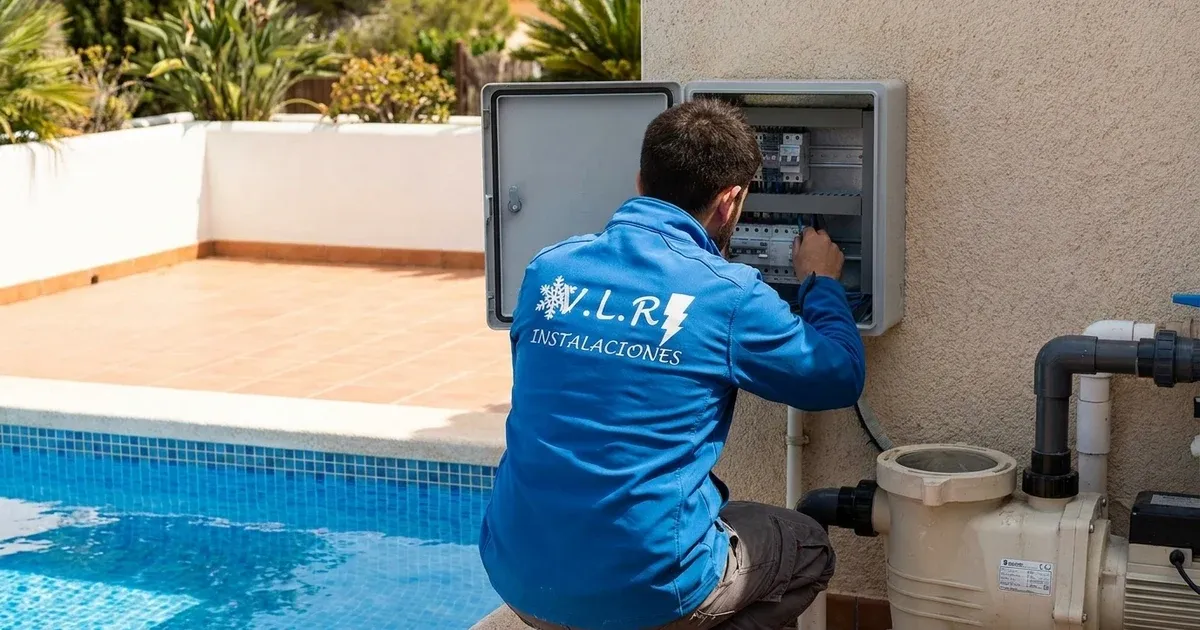
Water, bare feet and electricity in the same place. Pool electrical safety is one of the few areas where Spanish regulations get notably stricter, and for good reason: it is the setting where a fault that would be a nuisance in a living room can be genuinely dangerous.
If you have a pool at your property, or you sit on the committee of a community that has one, this guide explains in plain terms what the regulations ask for, what to check at the start of each season, and the faults we most often find on installations that have been quietly running for years.
Why a pool is a special case
Two reasons stack up. The first is obvious: there is water, and water conducts. The second gets overlooked but matters just as much: a person who is wet and barefoot offers far less resistance to current than the same person dry and in shoes. The same small leak that would barely register elsewhere is hazardous at the edge of a pool.
That is why the REBT (Spain's low-voltage electrical regulation) devotes a dedicated section to pools and fountains, ITC-BT-31, with stricter requirements than an ordinary installation. It is not red tape: it is the difference between a fault being caught by the RCD and being caught by a swimmer.
What the regulations require
1. Zones around the water
The regulation divides the area around a pool into volumes according to proximity to the water, and each one permits different equipment and voltages. The closer to the pool shell, the more restrictive. In practice this means you cannot put a socket, light or enclosure wherever happens to be convenient: the location dictates what may be installed there.
2. A high-sensitivity RCD
Pool circuits are protected by a 30 mA RCD (diferencial), the high-sensitivity type that trips on very small leaks and quickly enough to protect a person. It is also sensible for the pool to have its own circuit in the consumer unit, so a problem at the filtration pump does not leave half the house without power.
3. Equipotential bonding
All the metal parts in the area (ladder, fixings, light housings, metal pipework) are bonded together and connected to the earthing system. The point is that no voltage difference can appear between two items somebody might touch simultaneously. This is the requirement we most often find incomplete, corroded, or simply absent on pools with a few years behind them.
4. Underwater lighting at extra-low voltage
Lights inside the pool shell are not fed at 230 V but at extra-low safety voltage, with the transformer positioned away from the water. If anyone offers you pool lights wired directly to the mains, that is a problem, no matter how waterproof the fitting claims to be.
5. Equipment rated for where it sits
Enclosures, junction boxes and light fittings in the outdoor area need a protection rating that matches their exposure to water and dust, and the requirement rises as you approach the water. An indoor-rated enclosure fitted in the pump housing, or an unsealed junction box, is a common fault and an easy one to spot.
What to check at the start of the season
Without opening anything, these signs mean the installation needs attention before the pool is in full use:
- The RCD trips when the pump starts: this is almost never "just the heat". It usually means damp in the motor or a leak on the circuit.
- You feel a tingle touching the ladder, a handrail or even the water. Get everyone out and call an electrician the same day.
- Lights that flicker or will not come on: could be the lamp, but equally water ingress in the fitting or its connection.
- Rust, limescale or perished seals on the enclosure or boxes: sun, chlorine and salt air wreck gaskets within a few seasons.
- Extension leads or adaptors near the water: these should never form part of a pool installation, even temporarily.
- Nobody has inspected it since the pool was built: if that is several years, it is overdue.
How this plays out in Málaga
The province is full of pools: villas, urbanisations, communities and holiday rentals. Two local factors speed up deterioration. The first is the sun, which through summer works relentlessly on seals, glands and wall fittings. The second is the coastal salt air, which corrodes contacts and metalwork noticeably faster than people expect.
The typical result is an installation that was done properly at the time and, fifteen summers later, no longer complies: the bonding has corroded, a light fitting has damp inside, and the junction box still closes but no longer seals. None of that is visible from the poolside.
If the property is also let to holidaymakers, the bar rises, because the owner answers for people who know nothing about the installation. In that case it is worth reviewing the electrical requirements for a holiday let as well. And if the pool is communal, the installation is a communal element and responsibility sits with the comunidad de propietarios.
Practical recommendations
Inspect at the start of the season, not halfway through. An inspection in May or June costs the same as one in August and avoids closing the pool at the worst possible moment. If it is communal, keep a written record that the inspection was done.
Confirm the equipotential bonding exists and is still sound. It is the most overlooked requirement and the one that most directly protects swimmers. On older pools it needs verifying with instruments rather than by eye.
Never improvise with extension leads. If you need power near the pool for a pump, a robotic cleaner or lighting, have a fixed point installed in the right place with the right equipment.
If you are replacing the lights, take the opportunity to do it properly. Moving to LED pool lighting cuts consumption and is the natural moment to check the transformer, the connections and the sealing of the whole assembly.
And if you are not sure your earthing is sound, start there. The pool's bonding depends on it. We cover how to check in does your home have earthing.
Frequently asked questions
Can I fit any light inside the pool?
No. Underwater lighting runs on extra-low safety voltage rather than the 230 V mains, with the transformer sited away from the water. A fitting sold for gardens or general outdoor use is not suitable for inside the pool shell, however waterproof the manufacturer claims it is. If someone offers you pool lights wired straight to the mains, be very wary.
Do I need a special RCD for the pool?
Yes. Circuits serving the pool are protected by a high-sensitivity 30 mA RCD, which trips on very small leaks and fast enough to protect a person. It is also good practice to give the pool its own circuit in the consumer unit, so a fault at the pump does not take out half the house.
What is equipotential bonding around a pool?
It means linking all the metal parts around the pool (ladder, fixings, light housings, metal pipework, structure) together with a conductor and connecting them to the earthing system. That prevents a voltage difference appearing between two things a person could touch at the same time. It is the requirement we most often find missing or corroded on older pools.
Are communal pools subject to different rules?
The electrical principles are the same, but a communal pool is far more exposed: many people use it, children included, and the installation is a communal element for which the comunidad de propietarios is responsible. In practice it is worth inspecting at the start of every season and keeping a written record of that inspection.
Do I need an electrical certificate for a pool installation?
If you carry out a new installation or alter the existing one, it has to comply with the REBT and a licensed electrician issues the corresponding certificate. You may also be asked for it when arranging or increasing the supply. We handle that paperwork as part of the job.
Shall we check your pool?
At VLR Instalaciones we have over 20 years of experience as electricians authorised by the Junta de Andalucía, covering the whole province of Málaga. We inspect your pool installation, verify the protective devices and the bonding, replace lighting and wiring that does not comply, and issue the electrical certificate where needed. We work for private owners and for communities alike. Ask us for a no-obligation assessment before the pool is in full use.