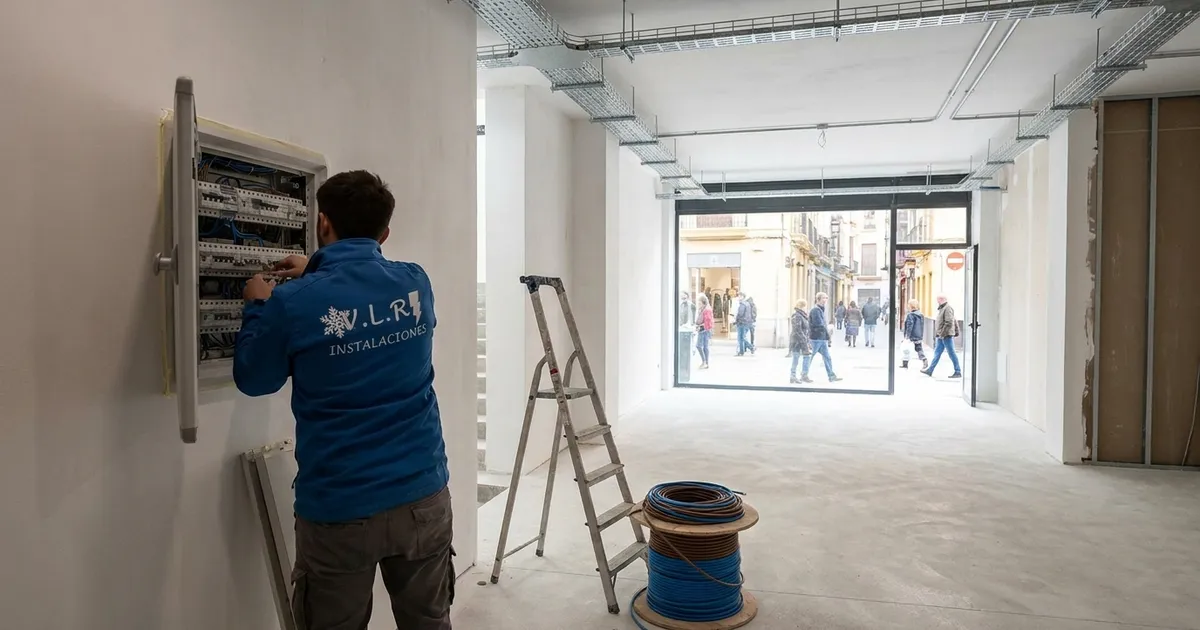
The electrical installation in commercial premises is the item that delays more openings than any other, and nearly always for the same reason: it gets left until last, once the fit-out is finished and the rent has been running for two months. By then any problem costs double, because you have to open up what has just been closed.
If you are thinking of opening a business in Spain, or taking over an existing one, this is what will be asked of you, how it differs from a home, and what to check before you sign the lease. It is the part nobody explains when you are shown the unit.
Why commercial premises are not a house
A commercial unit is not simply a home with more floor area. The underlying difference is that it involves the public, a business activity and the liability of the operator, and the regulations treat it accordingly: higher requirements, more documentation and far more frequent inspections.
The comparison that sums it up: a domestic installation is reviewed every 20 years. A commercial one is subject to periodic inspection every 5 to 10 years, depending on the activity and the type of installation. Four times as often, because the risk and the usage are greater too.
Then there is the factor people most underestimate: the load profile. A home has short peaks. A unit with refrigeration, an oven, a coffee machine and air conditioning running twelve hours a day subjects the installation to sustained work that a domestic installation will not tolerate.
What will be asked of you
1. The electrical installation certificate
To arrange the supply to the unit, or to increase it, you need the electrical installation certificate, the boletín, issued by an installer licensed and registered with the Junta de Andalucía. Without it there is no electricity contract, and without electricity there is no opening.
2. A technical project or a design memorandum, depending on the case
Depending on the type of premises and the power involved, the regulations require a project signed by a qualified engineer in addition to the installer's certificate, or the matter is resolved with a technical design memorandum. Premises with public access, such as hospitality or shops with a defined capacity, most often need a project. Clarify this at the start, because it changes the timescale and the budget.
3. Emergency lighting and exit signage
This is the requirement we most often find incomplete in premises that were already trading. Units with public access must have emergency lighting and signed exit routes, with their own battery autonomy so that they work precisely when the power fails. It is not a decorative extra: it is one of the first things checked.
4. A board and circuits sized for the actual activity
The distribution board has to correspond to what you will actually do in the unit, with circuits separated and protected according to their function, and with room for whatever comes next. Inheriting the previous business's board and hanging everything new off it is the origin of half the faults we attend in commercial premises.
5. Verified earthing
The earthing system has to exist and, above all, has to be measured. In units in older city-centre buildings it is common to find an earth that is present but no longer compliant, and that is not visible to the eye.
Signs that a unit will cause you problems
If you are viewing premises, these are the signs that the electrical item will be far bigger than the listing suggests:
- Nobody has the documentation: no certificate, no project, no inspection records. If nothing turns up, assume it all has to be done again.
- The board is full with no spare ways: not one more circuit will fit, so anything you add forces a replacement.
- There is no emergency lighting, or there are units that have not lit up in years. If the previous business had public access and lacks it, that tells you how the installation has been managed.
- The contracted power is low for your activity: increasing it depends on the distribution company and on the building's supply, and that timescale is not within your electrician's control.
- Extension blocks, leads and cables across the floor: the signature of an installation that fell short and got patched.
- Inherited air conditioning with no service history: equipment left by the previous tenant is usually a cost disguised as a benefit.
- A change of use: going from retail to hospitality, or from storage to a unit with public access, moves the requirements into a different category and the previous installation is no guide at all.
The mistake that delays openings most
It is always the same one: signing the lease and commissioning the fit-out before anyone has looked at the installation. Electrical work gets planned first because it governs everything else: where the containment runs, where the board sits, how much power you need and what documentation you will have to produce.
The second mistake, more expensive still, is leaving it until after the tiling and painting. A circuit that was overlooked goes from an hour's work to minor building work with finishes to repair.
The third is assuming that increasing the supply is a quick formality. It can be, or it can depend on the building's incoming supply and the distribution company's timescales. It is worth checking the available power before you commit to the unit, as we explain in choosing and changing your contracted power.
How this plays out in Málaga
A large share of the city's commercial units sit in older buildings in the centre, with installations that have been adapted to one activity after another over decades. When we open a board in the old town it is normal to find three generations of work layered on top of each other, none of it documented.
The other very local pattern is the change of use towards hospitality, especially in the busiest tourist areas. That jump is the one people most underestimate: the load multiplies with a kitchen, chillers and air conditioning, and the unit also becomes a public-access premises, which moves the requirements up a category.
There is a calendar element too. In Málaga many openings are planned to land in time for Semana Santa or the summer, and whoever starts the fit-out with no slack is the one who ends up paying a premium for haste. If your target is a spring opening, the site visit is not a January job, it is a now job.
One caution about licences: the municipal side, whether a licence or a declaración responsable (responsible declaration), depends on each town hall and on the specific activity. Requirements and timescales are not the same in Málaga city as in Marbella or Vélez. Confirm it with your ayuntamiento or with whoever is handling the application. What we can tell you with certainty is which electrical documentation any of them will ask for.
Practical recommendations
Get the site visit done before you sign. This is the advice in this guide that saves the most money. Knowing whether the unit needs an inspection or a whole new installation changes what you are willing to pay in rent, and it is a genuine argument in the negotiation.
Ask the landlord for every document that exists. Installation certificate, project, last inspection. If it exists, it saves you work. If it does not, at least you know your starting point.
Size it for the business you want, not the one you open with. Leaving spare ways in the board and provision for extra circuits costs very little during the fit-out and a great deal two years later when you want to add a chiller or new equipment.
Use the fit-out for whatever cannot be touched afterwards. With the containment open, LED lighting and air conditioning are best resolved in one go. Afterwards, every change means opening things up again.
Diary the next inspection on the day you open. Five to ten years feels remote on day one and then arrives without warning. Having it in the calendar avoids discovering it when it has already become a problem.
Frequently asked questions
Do I need an electrical certificate to open commercial premises?
Yes. To arrange the supply for a commercial unit, or to increase it, you need the electrical installation certificate issued by an installer licensed and registered with the Junta de Andalucía. This is what everyone calls the boletín. And unless the installation is intact and documented, a change of activity almost always means modifying it, so the certificate will be a new one.
Can I use the previous business's electrical installation?
Almost never as it stands. It was sized for a different activity, with different equipment and a different circuit layout. A clothes shop becoming a café multiplies the load with chillers, a coffee machine and air conditioning. Typically some of it is usable and some has to be redone, and the only way to know which is to inspect the unit rather than look at photographs in the listing.
Do I need a technical project or just the installation certificate?
It depends on the type of premises and the power involved. For some activities and power levels the regulations require a project signed by a qualified engineer in addition to the installer's certificate; for others a technical design memorandum is enough. Premises with public access, such as hospitality or shops with a set capacity, most often fall into the first group. Establish this at the outset, because it changes both the timescale and the cost.
How often must commercial premises be inspected?
Unlike a home, which is reviewed every 20 years, a commercial installation is subject to periodic inspection at intervals that generally fall between 5 and 10 years depending on the activity and the type of installation. Note the date from the day you open, because it arrives sooner than you expect and it is an easy requirement to overlook.
How long does the electrical work take?
It depends on the scope of the fit-out and on whether the supply has to be increased, because the distribution company's timescales are not within the installer's control. What we can say is that the electrical work is rarely the bottleneck when it starts early, and almost always is when it is left until last. The first thing to do is the site visit, ideally before you sign the lease.
Shall we see the unit before you sign?
At VLR Instalaciones we have over 20 years of experience as electricians authorised by the Junta de Andalucía, and we work in commercial premises across the whole province of Málaga. We carry out the site visit, tell you plainly what is usable and what has to be redone, execute the installation and issue the certificate you need to arrange the supply. If you are considering a unit, call us before you sign: that is while the information can still help you negotiate.