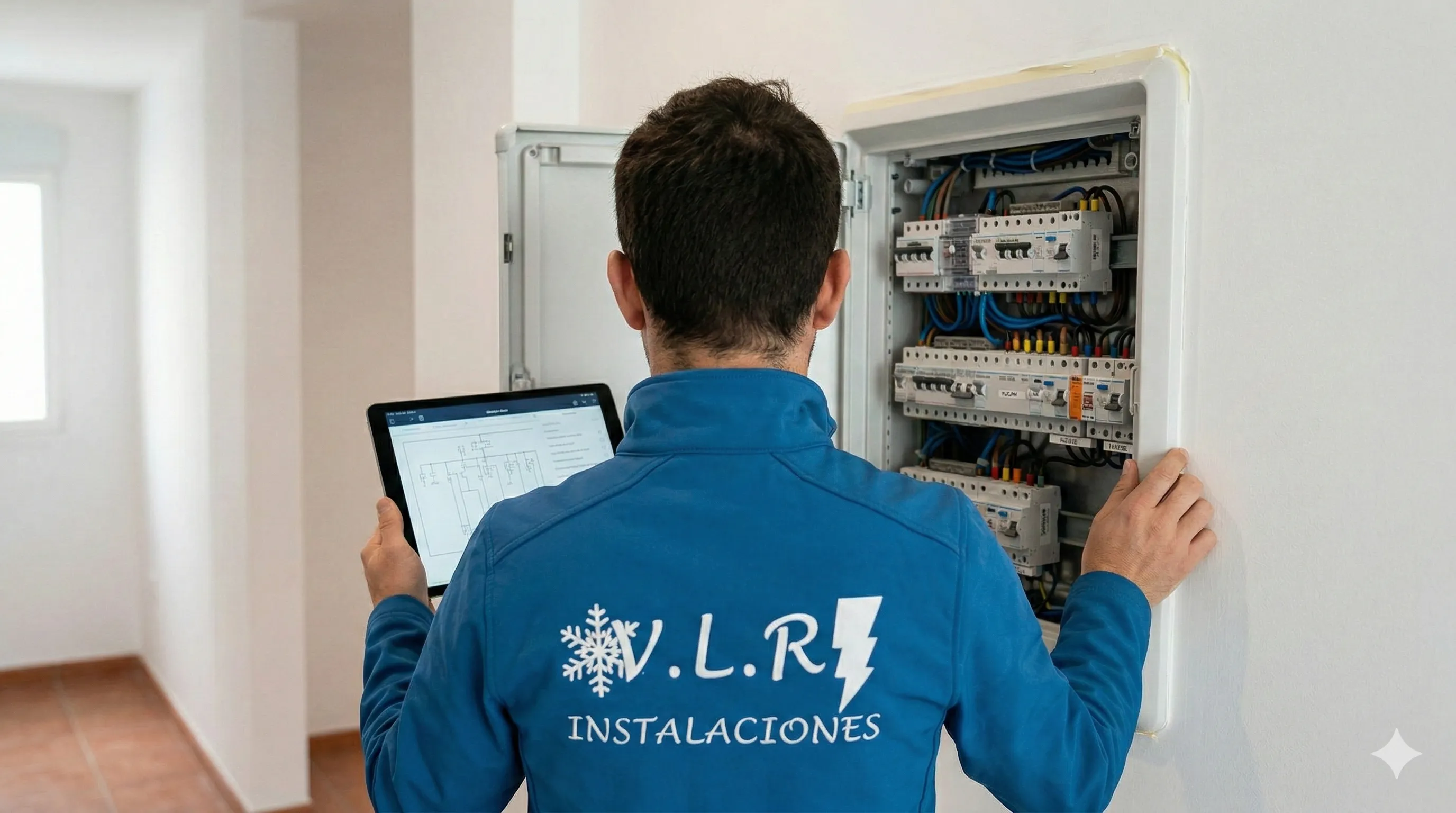
Spain's Low Voltage Electrical Regulations (REBT) are preparing for their first major update since 2002. The same electrical rules have been in place for over 20 years, and that's about to change. The new REBT 2026 brings significant changes that directly affect homes, businesses, and communities of owners across Málaga.
Don't worry, you won't have to rip out your installation and start from scratch. But there are things worth knowing now to avoid surprises later. We'll explain it clearly, without unnecessary jargon.
Is the new REBT 2026 published in the BOE yet?
As of today (October 2026), the new REBT has not yet been published in the BOE (Spain's Official Gazette). The regulation still in force is Royal Decree 842/2002. The updated text is at an advanced stage: since July 2025 it has been under European public consultation, a mandatory step to ensure compatibility with EU legislation.
It is worth being straight about the timetable. In April 2026, a technical session run by COGITI (Spain's council of industrial engineering professionals) on the changes still placed publication in the first half of 2026 and described the process as having started in 2022. That estimate has now passed without publication. A useful reminder that the dates in circulation are estimates, not an official schedule: what we explain here comes from the draft text and industry briefings, and may change before final approval.
Until it's published in the BOE, no new requirement is mandatory. Even so, the direction of travel is clear, and many new installations are already being carried out to these criteria ahead of the rules. We'll keep this article updated as soon as there's official news.
Where can I find the text of the new REBT?
Because it hasn't been published yet, there is no official PDF of the new REBT in the BOE. The text that is legally in force is still Royal Decree 842/2002, which you can download from the BOE website. The draft of the new regulation (the proyecto de real decreto and its new technical instructions, such as ITC-BT-53) has been made public during the Ministry of Industry's public-consultation process, but it is a provisional text that may change before final approval. Be wary of any website offering you "the definitive REBT 2026": as things stand, it does not exist.
Summary of the changes coming
- Type A RCDs (ITC-BT-17): a ban on installing new type AC RCDs in domestic, residential and tertiary installations, with a two-year moratorium. The ones already in your consumer unit do not have to be replaced.
- Mandatory surge protection (ITC-BT-17, with characteristics per ITC-BT-23): in all new installations, with no prior risk assessment.
- Technical conditions for self-consumption (ITC-BT-40): a thorough revision covering generating-installation types and RCD protection on the generator circuit.
- DC and batteries (new ITC-BT-53): a specific framework for solar and storage, including DC arc-fault detection and where batteries may be sited.
- Mandatory maintenance for certain installations (commercial premises, communities, above a power threshold).
- Broader scope: also repairs and existing installations that present a serious risk.
What is the REBT and why does it matter?
The REBT (Reglamento Electrotécnico de Baja Tensión) is the regulation that governs how all low-voltage electrical installations in Spain must be designed, installed, and maintained. In other words, the electricity in your home, shop, or office. Every socket, every RCD, every cable must comply with this regulation.
The problem is that the current REBT dates from 2002. Back then, there were no rooftop solar panels, no EV chargers in garages, and many of the electronic devices we use daily simply didn't exist. Technology has moved on significantly, and the regulations needed to catch up.
The most important changes in the new REBT 2026
The update is being applied in phases. The first phase is well advanced and contains the most relevant day-to-day changes. Here are the ones most likely to affect you:
1. Installing type AC RCDs is being banned
This is probably the change with the biggest impact on homes. The revision of ITC-BT-17 is set to prohibit the installation of type AC RCDs (residual current devices), the kind fitted in most electrical panels across Spain, in domestic, residential and tertiary installations. Instead, type A RCDs will be the minimum, or whichever type each ITC specifically prescribes.
Why? Because type AC RCDs only detect pure alternating current leakage. But today, with phone chargers, induction hobs, variable frequency drives, and electric vehicle chargers, many appliances generate DC components that a type AC RCD simply cannot detect. A type A RCD responds to both: pure AC leakage and pulsating leakage with a DC component of up to 6 mA.
Let us clear up a widespread misunderstanding. You will read a lot of "you have two years to change your RCDs". That is not what this says. There are two separate things:
- Type AC RCDs already installed do not have to be replaced. They stay where they are.
- The two-year moratorium is a window in which type AC RCDs may still be installed, so existing stock can be used up and manufacturers can adapt production. It is not a countdown for your consumer unit.
That said, if your consumer unit is old and you are having work done anyway, moving to type A is a real and inexpensive safety improvement. Just be clear that it is your decision, not a legal requirement imposed on what is already fitted. Be sceptical of anyone selling it to you as a deadline.
One further nuance: type AC remains permitted in other applications, essentially industrial installations where maintenance exists and the choice of protection has been made on the basis of the defined use of the installation.
Type A, type F or type B? Not every circuit needs the same thing
Type A is the new minimum, but depending on what sits on the circuit you may need more:
- Type A: general-purpose sockets, lighting (including LED and dimmers), class I appliances such as induction hobs, water heaters, and EV charging circuits with a DC component below 6 mA.
- Type F: designed for single-phase variable-speed drives. That means inverter air conditioning, heat pumps and aerotermia, or a washing machine with a variable-speed drive.
- Type B: for three-phase drives, photovoltaic systems, batteries, UPS units and EV chargers exceeding 6 mA of DC.
There are also "super-immunised" versions (A-SI, F-SI, B-SI) designed to avoid nuisance tripping from electromagnetic disturbance, harmonics or electrical storms. In a Málaga home with autumn storms and plenty of connected electronics, that reinforced immunity is usually worth having.
No need to wait for the new regulation: for a charge point, ITC-BT-52 already requires its own 30 mA class A RCD and surge protection today. It is the circuit in the house where getting the protection right matters most. We settle all of it as part of our EV charger installation in Málaga, with a fixed price before any work starts.
2. Mandatory surge protection
Until now, installing surge protectors in a home was a recommendation, not a requirement. Under the revision of ITC-BT-17, with the technical characteristics set out in ITC-BT-23, protection against transient and temporary overvoltages will be mandatory in all new installations, without needing a prior risk assessment.
Two distinct phenomena are covered, and each has its place in the installation:
- Type 1 transient surges (coarse protection): at the origin of the installation, upstream of the meter.
- Type 2 transient surges (medium/high protection): inside the main distribution board. Combined type 1 + type 2 devices are permitted.
- Temporary or permanent overvoltages: also inside the main distribution board.
What if your installation already exists? This is the most misread point. If you carry out a modification or extension, surge protection does not automatically become mandatory. It is triggered only if you add a new circuit for generation (solar, for example) or for EV charging, as set out in their respective technical instructions. Adding an air-conditioning circuit or home automation does not on its own trigger the requirement.
This is particularly relevant in parts of Málaga where electrical storms can cause voltage spikes that damage appliances, IT equipment, or even your solar panel installation. A surge protector in the consumer unit prevents those nasty surprises. We cover this in detail in our guide to surge protection and the REBT.
3. Solar self-consumption: the revision of ITC-BT-40
Here is a detail almost nobody reports correctly. The technical conditions for self-consumption are not only in the new DC instruction: the most relevant part sits in the thorough revision of ITC-BT-40, "low-voltage generating installations".
ITC-BT-40 classifies generating installations as isolated (type a), assisted (type b) and interconnected (type c), and within the last it separates self-consumption without export, or with export up to 100 kW (type c1), from self-consumption exporting above 100 kW connected at high voltage (type c2). To run in island mode, islanding detection plus prior physical and electrical separation from the grid is required.
If you already have solar panels or are considering them, what affects you most is the protection of the generator circuit:
- Generators connected to the internal installation do so through a dedicated circuit, with a type A, B or F RCD according to the specification of the inverter manufacturer.
- In dwellings, residential areas and installations accessible to the public, that RCD will be 30 mA.
- It may go up to 300 mA only if two conditions are met together: the inverter provides permanent residual-current monitoring in accordance with UNE-EN 62109-2, and the earth resistance of the installation, measured with an earth tester or loop impedance meter, is below 30 ohms.
A word of caution: in the documentation circulating so far, this provision is explicitly marked as under discussion, so it may change before final approval. What will not change is the underlying idea: your earthing becomes a measurable value that determines which protection you are allowed to fit. If nobody has ever measured your earth resistance, now is a good time.
4. The new ITC-BT-53: DC, arc faults and where batteries go
The new REBT introduces for the first time a specific technical instruction, ITC-BT-53, dedicated to DC (direct current) system installations. It is heavily focused on photovoltaics and battery storage. These are the points with practical consequences:
- Protection against indirect contact is achieved by double or reinforced insulation, or by SELV.
- Obstacles, placing out of reach, non-conducting locations, equipotential bonding and electrical separation are no longer accepted as protection against direct contact.
- Insulation faults must be detected and cleared, and that function may be integrated into the inverter.
- Photovoltaic modules must be protected against overcurrent by fuses or circuit breakers.
- The installation needs its own isolation and switching means: electronic devices integrated into inverters are not accepted for this purpose.
- DC arc-fault detection and protection equipment is required. This is one of the most significant and least discussed changes: DC arcing is a genuine cause of rooftop solar fires.
And the point most people will miss if they install battery storage. Non-gassing storage systems for residential, commercial and light-industrial use must:
- Be installed only in garages or in dedicated technical rooms intended specifically for that purpose. In other words: not on any convenient living-room wall or in a hallway cupboard.
- Be protected by enclosures that prevent fire or explosion spreading both from the inside out and from the outside in. Those enclosures must be metallic or have a minimum fire resistance of 90 minutes in both directions.
If you are collecting battery quotes for your home in Málaga, this is a very concrete question you can put to any installer: where will the battery go, and in what enclosure? The answer will tell you a lot about who you are dealing with.
5. Mandatory maintenance for certain installations
Another important change: certain electrical installations will need a mandatory maintenance contract. This mainly affects installations that require a technical project (such as commercial premises, communities of owners, or installations above a certain power threshold).
Periodic inspections will include checks on the earthing system, verification of protective devices, and general condition of the installation. The aim is for installations to remain safe throughout their entire service life, not just on the day they're installed.
6. Broader scope: repairs and at-risk installations
The current REBT mainly applies to new installations and their extensions. The new regulation goes further: it will also cover repairs and any existing installation considered to present a serious risk.
This means that if you have a very old installation (for example, a property from the 1970s or 80s in central Málaga with deteriorated wiring), it could fall within the scope of the new regulation and require upgrading.
How does this affect you in Málaga?
Across Málaga province there are thousands of homes with electrical installations that are 30, 40, or even 50 years old. Many still operate with type AC RCDs, without surge protection, and with inadequate earthing.
Here are the most common scenarios where the new REBT could directly affect you:
- Buying or selling a property: you'll need a boletín eléctrico (CIE) certifying that the installation complies with current regulations. Under the new REBT, the requirements will be more demanding.
- You have or want solar panels: the new ITC-BT-53 will specifically regulate your self-consumption installation.
- You have or are installing an EV charger: protection requirements for charging points are being updated with safer RCDs.
- Your installation is old and showing problems: if there are signs of serious risk, the new REBT allows intervention even on existing installations.
- You own commercial premises: you'll likely need a mandatory electrical maintenance contract.
What can you do now?
You don't need to wait for the new REBT to be published to take action. In fact, getting ahead of it is the smart move. Here are our recommendations:
Check your consumer unit. Are your RCDs type AC? If so, plan to replace them with type A. It's not complicated or especially expensive, and it significantly improves safety.
Consider installing surge protection. Even though it's not yet mandatory for existing installations, a surge protector is relatively inexpensive and can save you thousands of euros in damage to electronic equipment.
If your installation is over 20 years old, get it inspected. An authorised electrician can assess your installation and tell you if it needs updating to comply with the new regulations. Better to find out now than when you need the electrical certificate.
If you have or plan to install solar panels, make sure everything is in order. The new DC regulations will be demanding. A properly done installation from the start will save you problems down the line.
Installing an EV charger? You do not need to wait for the new regulation. A charge point is a new circuit and already needs its own protection today. Ask us for a quote for your charge point.
Frequently asked questions about the new REBT 2026
Is the REBT 2026 published yet?
No. As of October 2026, the new REBT has not yet been published in the BOE, and Royal Decree 842/2002 remains in force. The text has been under European public consultation since July 2025. Industry briefings pointed to the first half of 2026, a window that has now passed.
When does the new REBT come into effect?
Once it is published in the BOE, there will be transition periods for some requirements, such as the two-year moratorium allowing type AC RCDs to continue being installed while stock is used up. Note that this moratorium is about installing them, not a deadline to replace the ones you already have. Until it is published, no new requirement is mandatory.
Where can I download the REBT 2026 as a PDF?
There is no official PDF of the new REBT yet, because it hasn't been published in the BOE. The text in force is still Royal Decree 842/2002, available on the BOE website. The draft of the new regulation circulated during the Ministry of Industry's public-consultation process, but it is provisional and may change before it is approved.
Will I have to change my entire electrical installation?
Not necessarily. The new REBT mainly applies to new installations, extensions, and repairs. However, if your installation poses a serious risk, it could fall within the scope of the new regulations. We recommend getting a professional inspection.
Do I have to replace my existing type AC RCD?
No. Type AC RCDs already installed do not have to be replaced. What the new REBT prohibits is installing new type AC RCDs in domestic, residential and tertiary installations, and even that comes with a two-year moratorium intended to use up existing stock and let manufacturers adapt production. Swapping to a type A is a recommended safety improvement, but a voluntary one.
How much does it cost to replace a type AC RCD with a type A?
Roughly €150 to €300 (parts and labour), depending on the state of your consumer unit. Worth remembering that replacing RCDs already fitted is not compulsory: it is a voluntary safety improvement, particularly worthwhile if you have an induction hob, inverter air conditioning, solar or an EV charger.
Does it affect me if I already have solar panels?
If your solar installation was done correctly and complies with current regulations, you shouldn't have problems. It is worth checking the RCD on the generator circuit: the revision of ITC-BT-40 envisages a type A, B or F RCD at 30 mA in dwellings, extendable to 300 mA only where the inverter monitors residual current per UNE-EN 62109-2 and earth resistance is below 30 ohms.
Is mandatory maintenance required for my home?
Mandatory maintenance contracts are mainly expected for installations that require a technical project, such as commercial premises or larger installations. A standard home won't require one, although regular inspections are still highly recommended.
Need your installation checked?
At VLR Instalaciones, we've been working with electrical installations across Málaga province for over 20 years. We're authorised by the Junta de Andalucía and know both the current regulations and the upcoming REBT changes inside out.
If you want to know whether your installation is ready for the new regulations, or you need to upgrade your consumer unit, get in touch for a no-obligation assessment. We'll tell you exactly what you need and what it will cost, with no surprises.