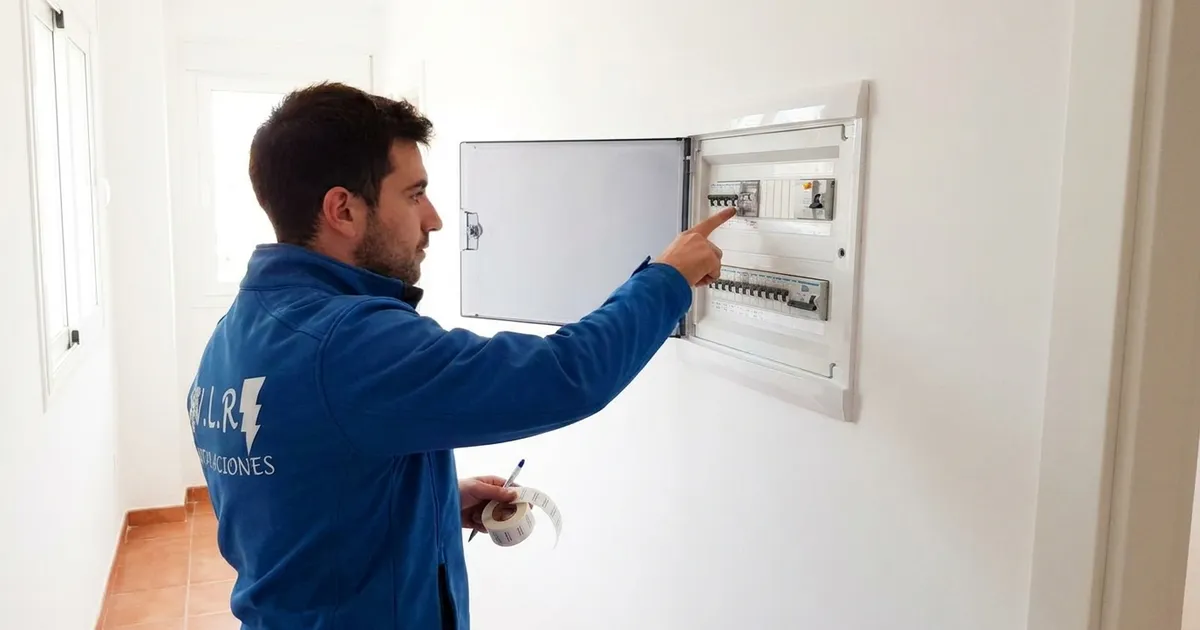
Almost nobody opens their consumer unit out of curiosity. You open it when something has happened: the power has gone, you need to find the guilty switch, and you are usually doing it in the dark with a phone torch and no real idea what any of it is.
This article is for the day before that. In ten minutes you will know what each switch in your board does, which one to look at depending on what has stopped working, what an older board is missing, and how to label yours so you never have to guess again.
What you will find inside
1. The main switch (and the ICP, if you have one)
The main switch is the largest and usually sits on the left: it isolates the whole property at once. It is the one you pull if you smell burning, if there is water, or if you simply do not know what is going on. Find it today, not on the day you need it.
Next to it, in older properties, there may be an ICP (interruptor de control de potencia, power control switch) inside a sealed box: this is what tripped if you exceeded your contracted power, and it belongs to the supply company. With today's digital meters that function is built into the meter, so many homes no longer have a physical ICP in the board. If you cannot find one, that is probably why.
2. The RCD (diferencial)
This is the one that protects people. It checks that all the current going in comes back out, and if it detects some escaping (through someone touching what they should not, or through damp in the installation) it cuts within thousandths of a second. You can recognise it because as well as a lever it has a test button.
The key point: the RCD does not protect your appliances, it protects your life. And it does not replace earthing, it works alongside it.
3. The MCBs (magnetotérmicos)
These are the small ones in a row, one per circuit: lights, sockets, kitchen, washing machine, air conditioning. They protect the installation rather than you, tripping when a circuit draws more current than its cable can carry (overload) or when there is a short circuit. One tripping while the rest of the house carries on is precisely what should happen.
4. The surge protection device
Not every board has one, and it is the element that has changed most in recent years. Its job is to divert voltage spikes (a storm, a switching event on the network) before they reach the television, the computer or the air conditioning. If your board has a module with a small green window, that is probably it. We cover it fully under surge protection.
Which one to check when the power goes
The logic is straightforward once you look at how much has stopped working:
- The whole house is out and so are the neighbours: it is not your board, it is a network outage. Do not touch anything. We have a guide on what to do in a power cut.
- The whole house, but the neighbours have power: check the main switch and the RCD. If the RCD is down, something is leaking in the installation.
- Several areas at once, lights and sockets mixed: that is the RCD for that group of circuits. Usually a faulty appliance or damp.
- Just one area or one appliance: that is its MCB. Almost always overload, too much drawn through one circuit.
- It trips exactly when you switch on one particular appliance: the appliance is the suspect, not the board. Leave it unplugged and check.
- It trips with nobody switching anything on: damp, or an intermittent fault. This is the hardest to find and the one most worth leaving to an electrician.
And one rule that never fails: if it trips twice in a row, stop resetting it. The protection is telling you about something real. We go into this for the RCD in why your RCD keeps tripping.
What an older board is missing
You do not need to be an electrician to spot a board that has fallen behind. These signs tell you most of it:
- Ceramic or screw-in fuses: if you still have these, the installation is from another era and there is no RCD protection at all.
- A single RCD for the whole property: it works, but any fault blacks out the entire house and finding it takes far longer.
- Only two or three MCBs for everything: that means there are no separated circuits, so the washing machine, the oven and the lights share protection.
- Not one spare way: a full board cannot take anything new, no air conditioning, no EV charger, no solar.
- Nothing labelled: not a technical defect, but it turns every fault into a blind search.
- Cables entering where they should not, connector blocks on display or covers that will not close: that is no longer age, that is an overdue inspection.
If you recognise several of these, the conversation stops being about the board and becomes about the installation. What it costs to replace a consumer unit sets out what renewing it involves.
Label your board: ten well-spent minutes
This is the best effort-to-benefit maintenance task in the house, and it needs no tools. Do it in daylight and, if you can, with someone to help.
Switch off one MCB, walk round the property and note what has stopped working. Switch it back on and repeat with the next. By the end you will have the full map, and a label on each switch settles it permanently. One practical warning: do it when nothing critical is running, and mind the freezer circuit and any computer that is switched on.
If the property is a holiday let, this moves from advisable to necessary. Guests do not know the property, and a labelled board with a note on what to do if the power trips saves you half your night-time calls.
How this plays out in Málaga
August is the month an old board announces itself. The air conditioning runs for hours, the house is full and everything goes on at once, so boards with few circuits and a single RCD trip exactly when it is least welcome.
And there is a calendar point worth knowing: 15 August is a public holiday in Spain, with much of the retail and service sector closed or running at half pace. If the power goes that day, knowing which switch to check and having a labelled board is the difference between two minutes and an afternoon in the dark.
The other local feature is the housing stock: many flats in the old town and in the first coastal developments have boards designed for a home with no air conditioning, no induction hob and nothing like the number of appliances we now take for granted. They were not installed badly, they were designed for a different life.
Practical recommendations
Find your main switch today. Not on the day of the problem. It is the one thing that turns an emergency into a controlled incident, and learning it takes thirty seconds.
Press the RCD test button now and then. Manufacturers typically suggest monthly or every few months. It should drop instantly. If it does not, it is decoration rather than protection: call an electrician.
Label the circuits. Ten minutes, no cost, and you will be grateful for it at the worst possible moment.
Photograph the open board and keep it on your phone. It lets you describe what you have over the phone when you call an electrician, and it saves time on diagnosis.
And if you are adding anything substantial, check the board first. Air conditioning, an EV charger, solar or an induction hob all start at the board. Confirming there is space and capacity before buying the appliance avoids the most common surprise in this trade.
Frequently asked questions
How many RCDs should my consumer unit have?
It depends how many circuits the property has, but the principle is that there should not be just one covering the whole home. The sensible arrangement splits the circuits into groups, each with its own RCD, so that a fault in the kitchen does not black out the rest of the property. If your board has a single RCD for everything it will work, but any fault takes the whole house out and tracing the cause is far slower.
Can I touch anything inside the consumer unit myself?
You can operate the switches by hand, up and down: that is what they are for and it is safe. What you must not do is remove the cover over the wiring, loosen screws or touch terminals. Behind that cover there is live voltage even with the switches off, because the incoming supply is still live. Operating them, yes. Opening it up, no.
What is the ICP and why doesn't my board have one?
The ICP is the power control switch, the one that cut your supply if you exceeded your contracted power. It sat in a sealed box because it belongs to the supply company. With today's digital meters that function is usually built into the meter itself, so many homes no longer have a physical ICP in the board. If you cannot find one, that is probably why rather than something missing.
What is the RCD test button for?
It checks that the RCD is still capable of tripping. Pressing it simulates a leak and the switch should drop instantly; you then push it back up. Manufacturers typically recommend doing this monthly or every few months. It is the only part of your installation you can verify yourself in ten seconds, and if it does not trip when you press it, call an electrician: it is sitting there without protecting you.
How do I know if my board meets current regulations?
There are visible clues: ceramic or screw-in fuses, a single RCD for the whole house, no separated circuits, or a board with no spare ways all point to an installation that has fallen behind. But compliance is not determined by looking: it is established with instrument testing and documented in the installation certificate. If it has never been checked and the property is decades old, it is worth doing.
Shall we check it for you?
At VLR Instalaciones we have over 20 years of experience as electricians authorised by the Junta de Andalucía, working across the whole province of Málaga. We inspect your consumer unit, test the protective devices with instruments, leave the circuits properly identified, and issue the installation certificate where it is needed. If you recognised your own board in the section on older ones, get in touch and we will take a look at no obligation.