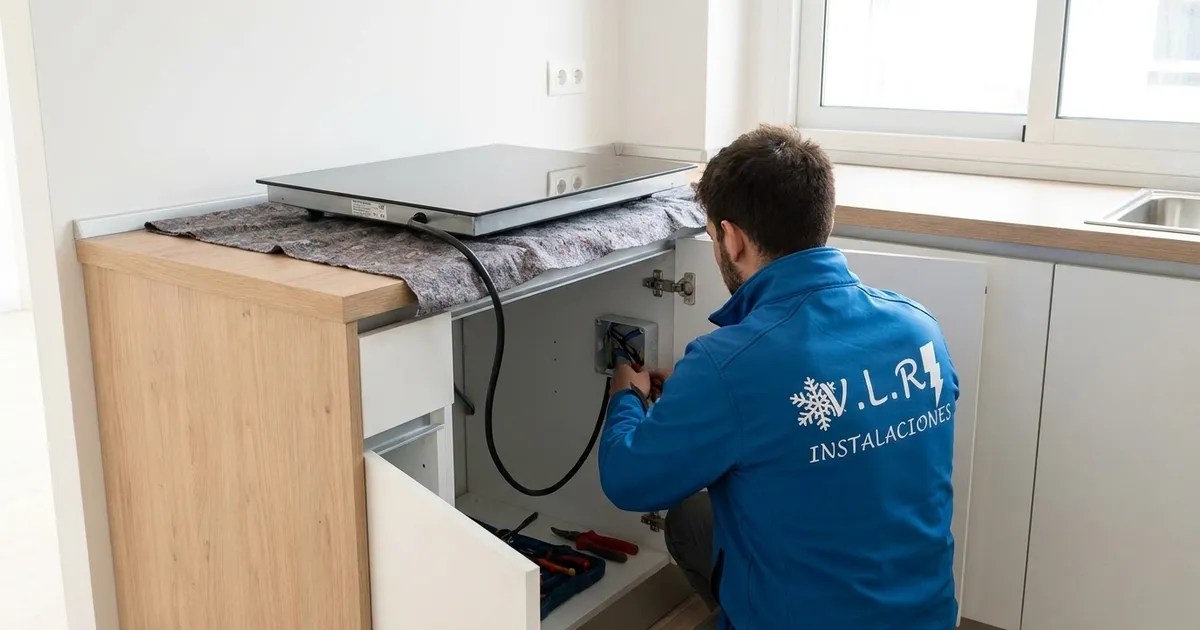
You buy the induction hob, it arrives, and then somebody asks whether the installation will take it. That is the usual order of events, and it is the wrong way round: the answer might be yes and be settled in a morning, or it might mean a new circuit from the board and an increase in contracted power.
This guide is for the moment before you buy. What an induction hob actually needs, how to tell whether your kitchen is already set up for it, and what changes depending on where you are coming from: a ceramic hob, gas, or a kitchen untouched for thirty years.
Why induction is a special case
An induction hob is comfortably one of the highest-draw appliances in the house. And it does not merely draw a lot, it draws it suddenly. It heats very fast because it moves a lot of power in a short time, and if you use several zones or the rapid-boost function the demand climbs further still.
That sets it apart from almost everything else. A television or a computer is irrelevant to your installation. An induction hob is one of the three or four things that genuinely make it work hard, alongside air conditioning, the oven and, if you have one, the car charger.
This is why the regulations provide for the kitchen to have its own circuit, with a larger cable size and a different protective device than an ordinary socket circuit. It is not a luxury: it is what stops the cable running at its limit every time you cook.
What it actually needs
1. A dedicated circuit
The hob does not share a circuit with the kitchen sockets or the fridge. It goes on the kitchen circuit with its own protection in the board. If everything in your kitchen hangs off the same place, that is the first thing to resolve.
2. A fixed connection, not any old socket
Normally the hob is hard-wired to its own connection point inside the cabinet rather than plugged into a socket. Some lower-powered models can use a suitable outlet, but the manufacturer states that on the appliance's data sheet. Check it before buying: it is the cheapest check in this entire guide.
3. Cable of the right size
The cable feeding the hob has to be sized for its load. A cable running above what it is rated for gets warm, and that heat is what degrades the insulation and the connections over the years. It is a problem you cannot see and that gives no symptoms until it does.
4. Space and protection in the board
If a circuit has to be added, it has to fit. A board with no spare ways means extending or replacing it, and that changes the budget. If you are not sure what state yours is in, your consumer unit explained sets out what to look for.
5. Enough contracted power
The hob at full load adds to whatever else is already running. In homes on the lowest power levels it is common to fall short and trip the supply when hob, oven and air conditioning coincide. One useful detail: many hobs let you cap their maximum power during initial setup, which sometimes avoids an increase altogether. The criteria for deciding are in choosing your contracted power.
It depends where you are coming from
The actual work changes completely according to how your kitchen stands today:
- From a ceramic hob in a reasonably modern kitchen: the best case. The circuit and connection probably already exist, and it is a matter of checking and connecting.
- From a ceramic hob but the kitchen is decades old: a circuit exists, but the cable size, protection and condition of the connection all need verifying before anything is assumed.
- From gas: most likely there is no circuit in place at all, because none was ever needed. A new one has to be run from the board. Routine work, but worth knowing before you buy.
- A full kitchen refit: the ideal moment. With the units out, doing the circuit properly costs a fraction of what it costs afterwards.
- You are renting: the electrical connection is an alteration to the property, so speak to the landlord first. And if the hob is yours and you plan to take it, get that in writing.
- It is a holiday let: add it to the general review, because usage is far heavier and the people using it do not know the property.
How this plays out in Málaga
Two things converge here. The first is that a large share of flats in the old town and the first coastal developments are on the lowest contracted power with a kitchen never designed for induction. The second is that switching from gas to induction has been one of the most common renovations of recent years, especially when buying an older property to do up.
That is exactly the combination that produces the surprise: hob bought, kitchen fitted, and then it turns out a new circuit and a power increase are needed. None of it is difficult; it is simply cheaper and faster when you know in advance.
And a summer factor worth bearing in mind: add the hob at full load to air conditioning running all afternoon, and August is when marginal contracted power stops being enough. If you are weighing up induction and you have already noticed the supply tripping when several appliances coincide, that is your warning.
Practical recommendations
Check before you buy, not after. That is the whole guide in one sentence. With a photograph of the board and knowing what is in the kitchen now, the scenario you are in can be established in advance.
Read the data sheet of the hob you like. Its maximum power and how it connects are both on there. Two hobs that look similar can ask different things of your installation.
Ask whether the hob allows power limiting. It is a feature that resolves plenty of cases without touching your electricity contract, and hardly anyone knows about it when buying.
If there is a kitchen refit, commission the electrical work first. With the units out everything is straightforward. With the kitchen fitted, any new circuit means opening things up again. The logic is the same one we set out in rewiring a property.
And do not improvise the connection. It is a high-draw connection and a loose terminal there is the classic origin of a hot spot. If the work is being done, have it documented with its certificate where applicable.
Frequently asked questions
Can I plug an induction hob into a normal socket?
Usually not. A full-size induction hob is hard-wired to its own connection point rather than plugged into a kitchen socket, because it draws far more than a normal socket is designed for. Some lower-powered models can be connected to a suitable outlet, but the manufacturer states that on the appliance's data sheet, and it needs checking before you buy rather than afterwards.
Will my old ceramic hob's circuit do?
Often yes, because a conventional ceramic hob is also a high-draw appliance and usually has its own kitchen circuit. But it cannot be assumed: the cable size, the protective device in the board and the condition of the connection all have to be checked. If the kitchen was done decades ago, or has been modified piecemeal, that check is precisely what prevents the problem.
What if I am coming from a gas cooker?
That is the case involving the most work, because there is probably no circuit in place for a hob: where there was gas, none was needed. A new circuit has to be run from the board to the kitchen with its own protection. It is still an entirely routine job, but it is worth knowing before you buy the hob rather than on installation day.
Do I have to increase my contracted power for induction?
It depends what you have now and what you run at the same time. In homes on the lowest power levels an increase is often needed, because the hob at full load adds to everything else. Many hobs let you cap their maximum power during setup, which can make them fit without an increase. It is worked out for your specific case before deciding.
Can I install the hob myself?
Fitting the hob into the worktop cut-out is joinery and you can do that. The electrical connection is another matter: it is a high-draw circuit, and a poorly tightened connection there is exactly what creates the hot spots that end up burning. If a new circuit is needed, or the board has to be altered, it has to be done by a licensed installer.
Shall we check it before you buy?
At VLR Instalaciones we have over 20 years of experience as electricians authorised by the Junta de Andalucía, working across the whole province of Málaga. We check the kitchen and the board, tell you which scenario you are in before you spend money on the hob, run the circuit if one is needed, and make the connection as it should be. Get in touch and we will take a look at no obligation.