The single-phase or three-phase question almost never comes up on its own. It comes up when you want to add something substantial: a fast car charger, a heat pump, a pool with its pump, or a kitchen that no longer fits the installation you have. And it usually arrives with a recommendation from somebody who has heard that three-phase is better.
Here is the version without the myths: what the difference actually is, how to tell in two minutes which one you have, when changing is genuinely worth it, and when there is a considerably faster and cheaper answer that nobody has offered you.
What the difference actually is
On a single-phase supply, one live conductor and a neutral arrive: a single path through which all the current for the house comes in. It is what the vast majority of Spanish homes have, and for an ordinary home it is perfectly sufficient.
On a three-phase supply, three lives and a neutral arrive. The idea is not that "more electricity comes in" but that demand is spread across three paths rather than concentrated in one. That allows higher power levels with more headroom, and it feeds appliances designed to run on three phases, such as certain motors and the faster car chargers.
The nuance that gets lost in the pub version: three-phase is not a tariff and is not automatically more power. You still contract a power figure, and that power is distributed across the three phases. If the distribution is done badly and all the load hangs off one phase, you will have a three-phase supply behaving like a marginal single-phase one. Balancing the load is half the job.
How to tell which you have
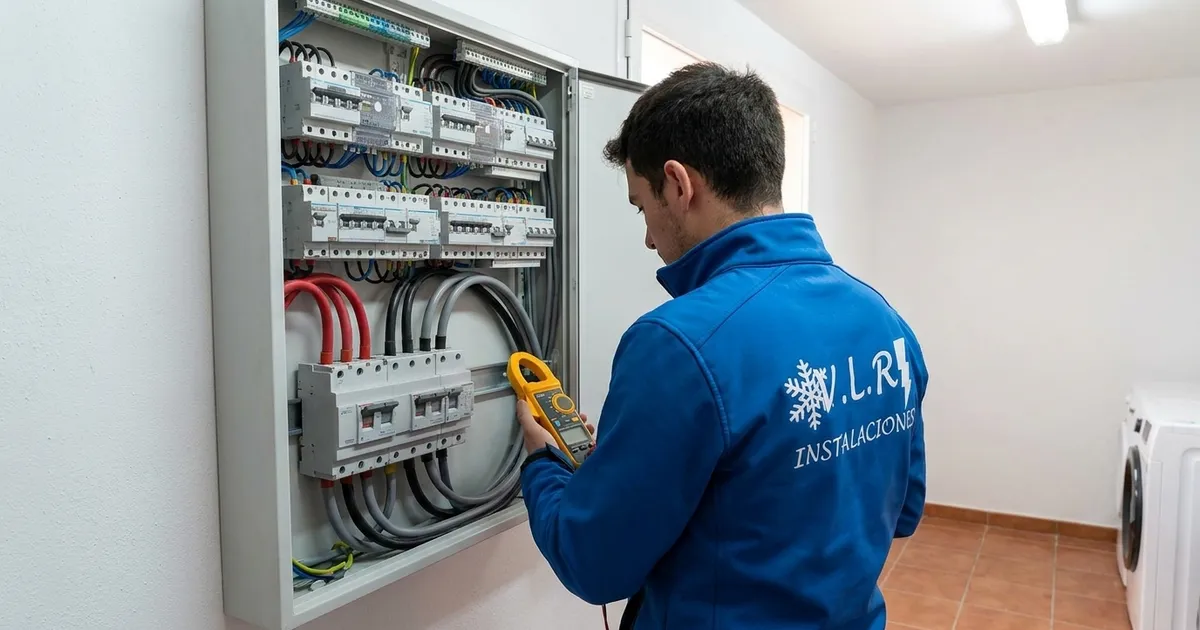
You need no tools and you do not have to open anything. Look at the main switch in your board: single-phase normally has two poles and three-phase has four, making it visibly wider than the rest. The number of thick cables entering the board usually gives it away too.
If you want certainty, your contract and bill state it, and any electrician can tell you in a minute. If it helps to know what everything in the board does, we break it down in your consumer unit explained.
When changing is worth it
1. You want to charge the car fast
A domestic charger up to around 7.4 kW runs on single-phase and covers overnight charging comfortably for most drivers. Three-phase comes in if you want charging in the order of 11 or 22 kW. The criteria for choosing are in what an EV charger costs to install, and the useful question is not which is more powerful but how many kilometres you drive a day.
2. Heat pump or whole-house climate control
In larger properties, a climate system serving the whole house, on top of everything else, is one of the scenarios where three-phase stops being an indulgence. Some units above a certain output require it outright.
3. You have an appliance or motor that demands it
Pool pumps above a certain size, machinery, a workshop at home, or irrigation with large motors. There is no debate here: if the equipment is three-phase, you need three-phase.
4. You already have high power on single-phase and you are running tight
When a detached house accumulates a pool, air conditioning, an induction hob and an electric car, there comes a point where concentrating all of that on one phase stops making sense. If your supply trips regularly when appliances coincide, that is the signal.
What to know before requesting it
- It depends what is in your street: three-phase has to be available on the local network. It is not solely your decision, and it is the first thing to check.
- It can mean altering the incoming supply: and that means distribution company timescales, which no installer controls. It is the part most likely to stretch the project.
- The board gets rebuilt, not adapted: moving to three-phase is not swapping one component. The internal distribution changes and the board is built again.
- The load has to be balanced: circuits get shared across the three phases. A poor distribution cancels out the benefit of having changed at all.
- It is not automatically cheaper: above a certain power the supply moves to a different access tariff, which can work for or against you depending on consumption.
- It needs its paperwork: the modification is carried out by a licensed installer and documented with the installation certificate.
And when it is not worth it
This is the part rarely explained, and in our experience it is the right answer on most visits: most homes do not need three-phase. They need what they already have to be done properly.
Before considering a change of supply there are three cheaper things that resolve almost every case. The first is redistributing the circuits: often the problem is not total power but that too much shares one line. The second is adjusting the contracted power, which is frequently wrong in one direction or the other; the criteria are in choosing your contracted power.
The third is the least known: capping the power of the problem appliance. Many induction hobs and many chargers let you configure a maximum, and that alone makes them fit without touching anything else. We cover it applied to the kitchen in fitting an induction hob.
Be wary of anyone proposing a move to three-phase without first looking at how your circuits are distributed. It is the most expensive solution to a problem that sometimes takes a morning.
How this plays out in Málaga
There is a very clear profile in the province where three-phase does make sense: the coastal detached house with a pool, air conditioning in several rooms, an irrigation pump and, increasingly, an electric car. Added together, that is exactly the case three-phase distribution exists for.
At the opposite end are the flats in the old town and the earliest developments, where three-phase is rare, depends on the building's meter arrangement, and is almost never the best answer. What is usually missing there is not a different kind of supply but an updated internal installation.
And a category of its own: commercial premises, where three-phase is fairly common because the machinery requires it. If you are considering opening a business, that check forms part of the site visit we describe in opening commercial premises in Spain.
Practical recommendations
Start by checking what is available. Before designing anything, you need to know whether three-phase exists in your street and on what terms. Everything else depends on that answer.
Ask them to justify why you need it. A good quote explains which specific load forces the change. If nobody shows you that number, you probably do not need it.
Have the alternatives assessed first. Redistributing circuits, adjusting power, or capping the appliance. If none of the three works, then three-phase is the answer, and it will be the answer with reasons behind it.
If you do it, do it for the next ten years. This is the moment to leave provision for the electric car, the solar or the climate system you have not installed yet. Rebuilding the board twice makes no sense at all.
And group the work. If the board is being rebuilt, take the opportunity to review the rest of the installation and get it documented. With the board open, everything else costs less.
Frequently asked questions
How do I know whether I have single-phase or three-phase?
The quickest clue is the main switch in your board: single-phase normally has two poles and three-phase has four, which makes it visibly wider than everything else. The number of thick cables entering the board usually shows it too. If you are unsure, your contract and your bill state it, and any electrician can confirm it in a minute.
Is electricity cheaper on three-phase?
Not in itself. Three-phase is not a tariff, it is a way of bringing the current in. What can change the bill is that above a certain power level the supply moves onto a different access tariff, and that can work for or against you depending on your consumption. It is a calculation to run on your actual figures rather than a general rule.
Can I switch to three-phase in a flat?
It is uncommon and not always possible. It depends how the building's meter installation is arranged and what is available on the network. In a flat there is nearly always a better option: redistributing the circuits, adjusting the contracted power, or capping the power of whatever appliance is causing the trouble. In a detached house three-phase is far more common.
Do I need three-phase for an EV charger?
For a domestic charger up to around 7.4 kW, no: it runs on single-phase and covers overnight charging comfortably for most drivers. Three-phase becomes relevant if you want faster charging in the order of 11 or 22 kW. The useful question is not which charger is more powerful but how many kilometres you drive a day and how many hours the car has to charge.
How long does switching to three-phase take?
The part we do, the board and the internal installation, is predictable. What we do not control is the distribution company's timescales and, if it is needed, alteration of the incoming supply, which is what can stretch things out most. That is why it is worth starting by checking what is available in your street before committing to a date or to an appliance.
Shall we look at it before you decide?
At VLR Instalaciones we have over 20 years of experience as electricians authorised by the Junta de Andalucía, working across the whole province of Málaga. We measure your actual consumption, check how your circuits are distributed, and tell you with figures whether you need three-phase or whether there is a simpler answer. If the change is needed, we carry it out and document it. Get in touch and we will take a look at no obligation.