The panels have been running a couple of years, you check the app, and something looks off: output is down on what it used to be. The natural assumption is that something has broken. It rarely is, and the real causes range from something you can sort out in a morning to a component that genuinely needs replacing.
Let us take them in order of likelihood, with one principle first: always compare against the same month last year, never against last month. That single mistake is why so many people think they have a fault every October.
First: rule out the calendar
A solar system produces far less in winter than in summer, and that is not a fault: the sun is lower, days are shorter, and there is more cloud. A drop from June to December can be dramatic and completely normal.
The comparison that means something is this November against last November. If that number holds, your system is fine and what changed was the season. If it has genuinely fallen, read on.
Cause 1: dirt, and here that means calima
The first suspect, and it matters more here than in most of Europe. Calima (Saharan dust) settles as a very fine film that rain does not always remove, and spring pollen, sea salt near the coast and bird droppings all add to it.
An even layer of dust costs you some output. What does real damage is localised dirt: a gull dropping or a stuck leaf covers one area, and because of how a panel is wired internally that costs considerably more than the covered fraction suggests.
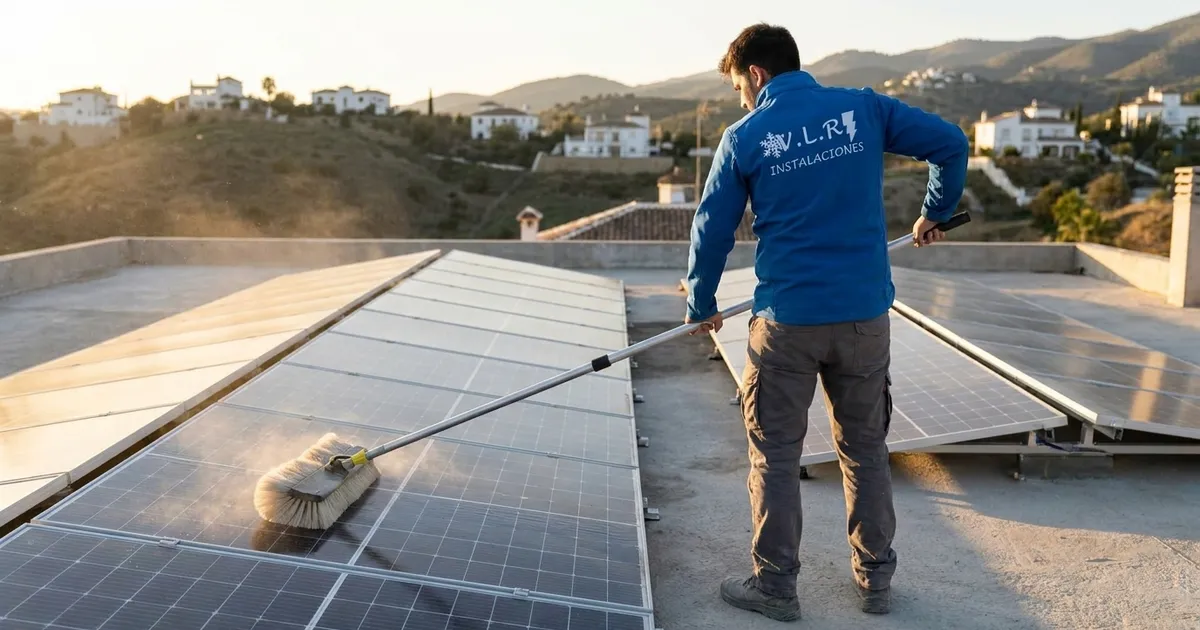
Water and a soft brush usually do it. Do not clean at midday in high summer: cold water onto very hot glass is an unnecessary way to find trouble. Early morning is the moment.
Cause 2: shade that was not there before
Shade grows. The neighbour's tree, a new antenna, an air conditioning unit fitted on the roof next door, an extension across the street. None of it existed when the system was designed.
The giveaway: the drop happens at the same time every day and gets worse in winter, when the sun sits lower and shadows stretch. If output collapses every afternoon from a particular hour, look at what stands in that direction.
Cause 3: the inverter
The inverter converts what the panels generate into the electricity your house uses. It works harder than anything else in the system and, in practice, it is normally the first thing that needs replacing, well before the panels.
It rarely dies without warning. Look for error codes in the app, intermittent stops, irregular output with no weather explanation, or a noticeably louder fan. It is worth budgeting for as a future cost rather than discovering it the day it stops.
Cause 4: a string that has stopped contributing
If the system has several strings of panels and one drops out - a degraded connection, a damaged panel, a fuse - output does not fall to zero, it falls in a step. In the app it looks like a lower ceiling than before, consistently.
This is not diagnosable from the sofa. It needs measurement at the installation, and that is installer's work.
Cause 5: normal degradation
Panels lose a little performance every year. It is a known effect, covered by the manufacturer's production warranty, and it is slow and gradual: a fraction of a percent annually, not a step change.
Which means degradation never explains a sharp month-to-month drop. If the change was sudden, the cause is somewhere else on this list.
What is worth checking periodically
Look at the app with some regularity. No need to obsess, but a monthly glance means you spot a drop when it happens rather than six months later, having lost output you cannot recover.
Check visually after a storm. Strong wind and hail can shift or damage modules. In Málaga's gota fría season that matters - we cover it in protecting your installation from storms.
Check the protective devices. The electrical side of the system lives in your consumer unit and ages like everything else. A periodic review of the whole installation is sensible, particularly once it has some years on it.
Do not stand on panels or improvise on the roof. The DC side stays live even with the inverter off, and a pitched roof is a dangerous place. Accessible cleaning, yes; the rest, no.
What if it never produced what was promised?
That is a different problem and worth separating. If output has not matched the projections since the very first summer, there is nothing to maintain: the system was most likely undersized, badly oriented, or oversold. We cover that in how to size a solar system.
And if you are considering a battery to make better use of what you already generate, the reasoning is in is a solar battery worth it.
Frequently asked questions
Why are my solar panels producing less than they used to?
Before assuming a fault, check the obvious: the time of year. In December the sun is low and the days are short, so producing far less than in June is entirely normal. The valid comparison is against the same month last year. If that comparison has also dropped, the usual causes are accumulated dirt, new shading, an inverter problem, or a string of panels that has stopped contributing.
Do solar panels need cleaning?
On the Costa del Sol, yes, more than in northern Europe. Calima (Saharan dust) leaves a fine film that rain does not always wash off, and pollen, sea salt and bird droppings add to it. Water and a soft brush are usually enough. What you should not do is clean at midday in summer: cold water on very hot glass is a bad idea.
How much output do panels lose over the years?
Panels lose a small amount of performance each year, and manufacturers cover this in their production warranty. It is slow and gradual, a fraction of a percent annually. If your output has dropped sharply from one month to the next, that is not degradation: it is a fault or something covering the panels.
How long does an inverter last?
The inverter works hardest of anything in the system and is normally the first component to need replacing, well before the panels. It is worth budgeting for as a future cost rather than meeting it as a surprise. It usually gives warning before failing outright: error codes in the app, intermittent stops, or irregular output.
Can I go up on the roof and check them myself?
Cleaning from a safe, accessible position is reasonable. Climbing onto a pitched roof, standing on the panels or handling the DC wiring is not: there is a fall risk, and the DC side remains live even with the inverter switched off. Do the visual check from somewhere you can stand safely and leave the rest to an installer.
Want to know why your output has dropped?
VLR Instalaciones has spent more than 20 years on electrical installations across Málaga and the province, as electricians authorised by the Junta de Andalucía. We check the whole system (panels, inverter, protective devices and wiring) and tell you whether what you have is dirt, shade, a component reaching the end of its life, or simply winter. Get in touch for a no-obligation solar system check.