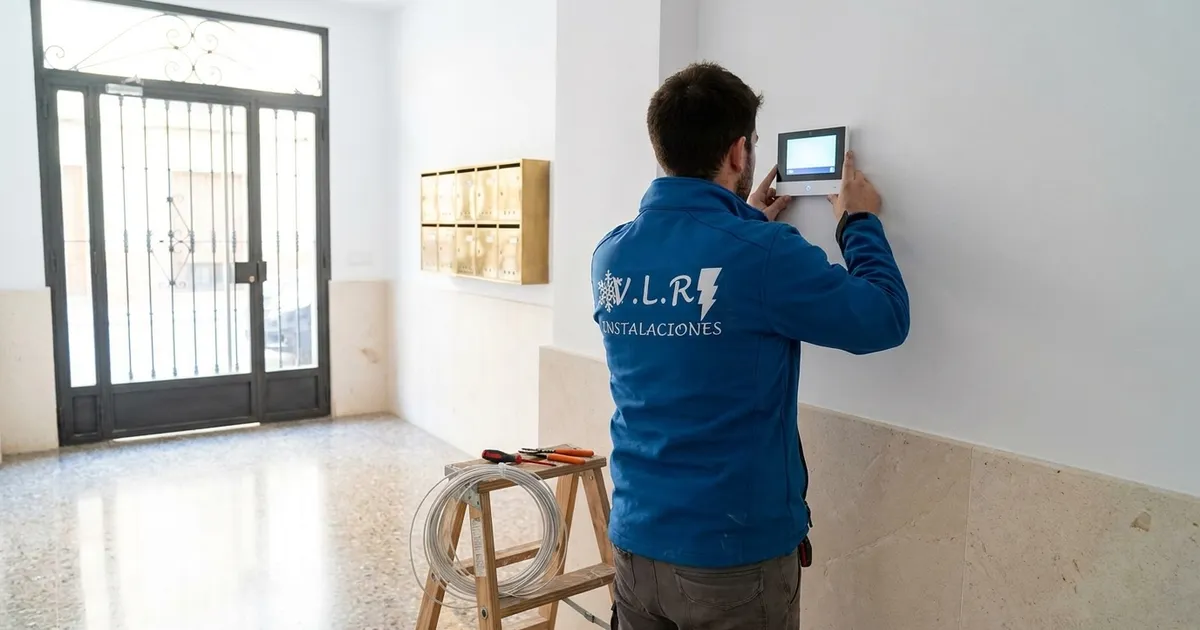
Replacing a communal door entry system is one of those jobs that gets postponed indefinitely. As long as you can hear something and the door opens, nobody puts it on the agenda. Then one handset goes silent, then another, and eventually half the building is walking down to open the door by hand.
If you sit on the committee, you are the presidente of your community, or you simply have to live with it, this guide covers when replacement is worth it, what really separates an audio portero automático (door entry phone) from a videoportero (video intercom), whether walls have to come up, and how the decision normally gets taken.
When it is time to replace
A properly installed door entry system lasts a long time, and that is exactly the problem: by the time it starts failing it has usually been in place for two or three decades and spares no longer exist. These are the signs a system has reached the end of its life:
- Handsets are failing one by one: the fault is not in one flat, it is the system ageing. Replacing individual handsets turns into a slow drip of spending.
- Spares are no longer available: if your electrician is sourcing handsets from second-hand listings, the building is living on borrowed time.
- Poor audio or crosstalk: hiss, whistling or conversations bleeding between flats usually points to degraded cable or a control unit at its limit.
- The street panel is corroded: sunken buttons, unreadable name plates, damp inside. Near the coast, salt air destroys entrance panels sooner than people expect.
- The door release is slow or intermittent: it can be just the electric strike, but often it is the power supply asking to be retired.
- Nobody knows who holds keys: after years of copies being cut, access control is theoretical at best.
Audio or video: what actually changes
1. Audio door entry
The classic setup: you speak, you release the door. It is still a perfectly sound choice if the community wants the simplest and cheapest option, and in a small block it is often the sensible one. What it does not give you is any way of knowing who is really at the door.
2. Video intercom
This adds a camera at the street panel and a monitor in each flat, so you see who is calling before you open. In a building with a lot of coming and going, or with elderly residents living alone, that difference matters more than it sounds. It is what most communities choose when they renew.
3. Systems with phone app entry
Some equipment diverts the door call to an app: you see the caller and open the door wherever you are. This makes sense if the building has holiday lets with arrivals at all hours, or owners who are out all day. It needs internet at the entrance, and somebody has to manage adding and removing users.
4. Keyless entry
Proximity fobs let you cancel a lost fob instead of rekeying the whole entrance. For a large community that is probably the single most practical improvement of the lot, though it is almost never the one people ask for first.
Do walls have to come up?
This is the first question at every meeting, and fairly so: nobody wants a stairwell in pieces for weeks. The good news is that current digital systems run on very few conductors, so in many buildings part of the existing wiring can be reused and the work kept to the ducts and boxes already there.
The necessary caution: that has to be verified on site, not assumed. If the conductors are degraded, if the route passes through inaccessible places, or if joints were made mid-run years ago, reuse may not be viable. A serious installer checks this before quoting and tells you which scenario you are in. Be wary of anyone who promises over the phone that there will be no building work without having seen the entrance.
If the building has other shortcomings in the communal areas, this is the moment to group the work together. Renewing the door entry while access is already open, and taking the opportunity to look at the communal services board or change the stairwell lighting, works out better than three separate visits over three years.
How the decision gets made
This is where renewals stall, and it is rarely for technical reasons. As a general rule, repairing or replacing a system that no longer works is treated as necessary maintenance of a communal element: the system belongs to the community and keeping it in service is not optional.
Going from audio to video, or adding app entry, is normally classed as an improvement, and for improvements the Ley de Propiedad Horizontal (Spain's horizontal property law) requires a larger majority. The practical consequence is significant: the same job can need different majorities depending on how the agenda item is worded. Talk to the administrador de fincas (managing agent) before the meeting is called, because getting the wording right first time saves a second convocation.
One piece of advice that applies to any work in communal areas: bring comparable quotes. Three quotes covering the same scope can be voted on. Three quotes measuring different things only produce argument and postponement.
How this plays out in Málaga
Much of the housing stock in the city and along the coast went up between the 1960s and the 1980s, and plenty of those buildings still have the original door entry installation, or a single renewal carried out twenty years ago. That is precisely the profile where spares have run out.
Two local factors compound it. Salt air in buildings near the sea attacks the contacts and buttons of the street panel far sooner than it would inland. And direct sun on a south-facing panel degrades the name plates and the seals within a few summers, with damp then getting in wherever the panel no longer closes properly.
The other characteristic of the province is turnover: buildings with holiday lets, seasonal workers and owners who only appear in summer. In that setting access control stops being a comfort feature and becomes the system that decides who gets into the building.
Practical recommendations
Stop replacing handsets one at a time once you are on your third. Past the third fault in quick succession, the community is paying for a renewal in instalments without having decided on one. It is worth doing the arithmetic before patching again.
Get the wiring position in writing. The quote should state whether existing cable is being reused or new cable is allowed for, and what happens if something different turns up once the work starts. That one line prevents most mid-job disputes.
Settle the scope before asking for prices. Audio or video, app or no app, fobs or traditional keys. If each company quotes a different scope, the meeting is not comparing anything.
Think about the next ten years, not this year's budget. The difference between audio and video is paid once. The nuisance of a system that does not match how the building actually lives is paid every day.
And if the entrance is generally dated, put it forward as a single piece of work. In some buildings it makes sense to integrate it with other entrance systems as part of a home automation or communal electrical installation upgrade.
Frequently asked questions
Can a video intercom reuse the old system's wiring?
Often, yes. Current digital systems run on very few conductors, so in many buildings part of the existing wiring can be reused instead of chasing out the whole stairwell. It depends on the actual condition of the cable and where it runs, which has to be checked on site rather than assumed. Where the wiring is degraded or insufficient, the alternative is usually surface trunking or an existing duct.
What does it cost to replace a communal door entry system?
Three things drive it: the number of flats, whether it is audio or video, and whether the existing wiring can be reused or a new run is needed. An eight-flat block with usable cable and a forty-flat building with several entrances are not remotely comparable. We look at the installation and give a fixed quote at no obligation, itemised so the owners' meeting can compare it properly.
Does the owners' meeting have to approve it?
It depends how it is put forward. Repairing or replacing a system that no longer works is generally treated as necessary maintenance of a communal element. Going from audio to video, or adding phone app entry, is normally an improvement, and the Ley de Propiedad Horizontal requires a larger majority for improvements. Speak to the administrador de fincas before the meeting is called, because how the agenda item is worded determines the majority you need.
Can the street door be opened from a phone?
Yes. Some systems divert the door call to an app so you can see who is calling and let them in from anywhere. That is genuinely useful for holiday lets with arrivals at all hours, and for anyone out during the day. It needs an internet connection at the entrance, and it is worth deciding who will manage adding and removing users.
What if only one handset has failed?
If the rest of the building works properly, replacing that one handset is often the whole job. The problem arises when the system is old enough that compatible handsets are no longer made: every fault then becomes a hunt for spares, and at some point replacing the system costs less than continuing to patch it.
Shall we take a look?
At VLR Instalaciones we have over 20 years of experience as electricians authorised by the Junta de Andalucía, working across the whole province of Málaga. We install and repair door entry systems and video intercoms, check the wiring before quoting, and provide a fixed itemised quote of the kind an owners' meeting needs in order to vote. We work with communities and with managing agents alike. Get in touch and we will take a look at no obligation.