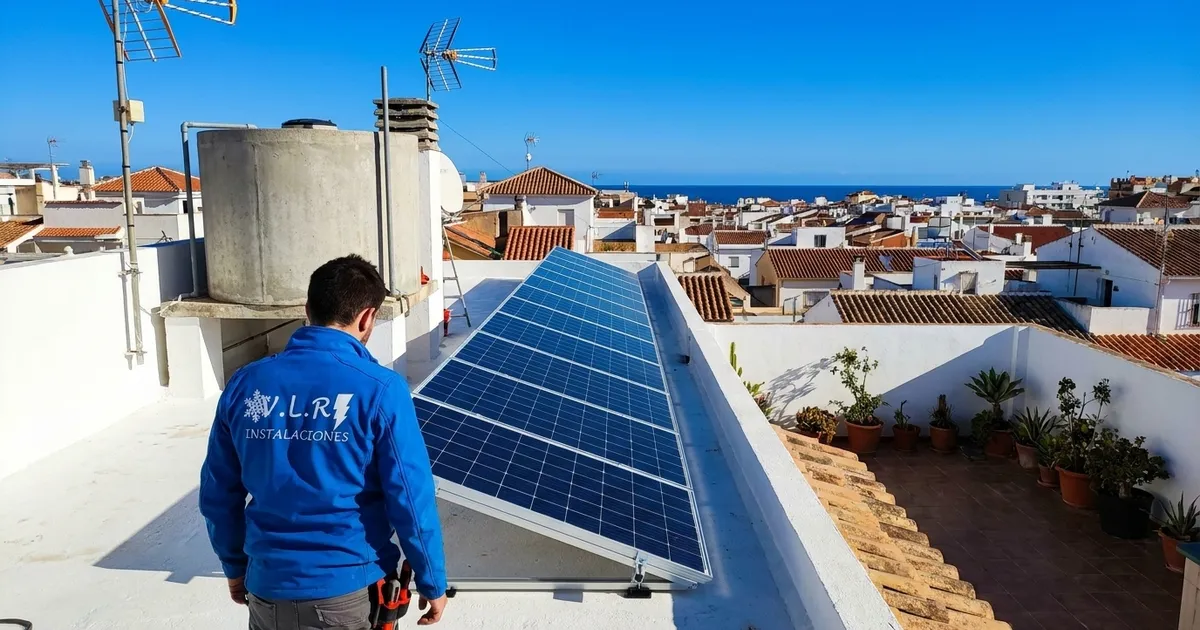
Fitting solar panels to an apartment building is one of the decisions that shows up fastest on the bill, and also one that stalls most often at the owners' meeting. The reason is almost never technical. It is that nobody has explained clearly what is possible, who pays, and what majority the law actually requires.
If you sit on your community's committee, or you are an administrador de fincas (managing agent), this is the full picture: the ways of structuring it, how the output gets shared, the majority the law demands, and what to check on the building before you start collecting quotes.
What shared self-consumption means
Individual self-consumption is what most people picture: panels on a villa roof feeding that one house. Shared self-consumption (autoconsumo colectivo) is the same idea, but with a single installation splitting its output between several supply points at once: the lift, the garage and, if you want, the flats themselves.
That is precisely the situation in a block of flats: one large unused roof above, many meters below. Spanish regulations have permitted it for years, and in 2022 the permitted distance between the installation and its associated consumers was widened substantially, which made viable a lot of projects that previously fell outside the rules by a matter of metres.
Three ways to structure it
1. Communal services only
The installation connects to the communal services board and feeds the lift, stairwell and garage lighting, pumping, and the filtration plant if there is a communal pool. This is the option with the least paperwork, because there is a single associated supply and no distribution coefficients are needed.
It also fits better than people expect: those loads are daytime and fairly constant, exactly when the panels produce. In many communities this is where direct usage is highest, with the added advantage that the saving reaches everyone's service charge without anyone having to do anything inside their own flat.
2. Shared self-consumption across the flats
Here the output is divided between the participating flats through distribution coefficients: a signed agreement fixing what percentage goes to each supply point. The saving lands on each owner's own bill rather than on the communal charge. It offers the most saving and demands the most coordination, since the percentages have to be agreed and notified to the distribution company.
3. Start with the communal part and extend later
The middle route, and in practice the one that unblocks most meetings: size the roof for the whole scheme, install the communal-services part first, and leave the extension ready for the flats that want to join later. It is far easier to get a meeting behind a first step with a visible return than behind a complete project all at once.
Can it go ahead if not everyone wants it?
Yes, and this is the part that surprises most meetings. The Ley de Propiedad Horizontal (Spain's horizontal property law) treats renewable energy installations far more favourably than an ordinary improvement: a third of the owners representing a third of the participation quotas is enough. It is one of the lowest thresholds anywhere in the law, and it exists precisely so that a small minority cannot block the installation.
How the cost is shared, and how owners who vote against are treated, is a separate matter that depends on how the works are classified and how the resolution is drafted. That is the part to prepare with the managing agent before the meeting is called, not to improvise on the night. The same was true of EV charging points in apartment buildings: the obstacle is rarely the law, it is how the agenda item is put.
What to check on the building before requesting quotes
Before you sit down to compare offers, six things decide whether the project is straightforward or expensive:
- The condition of the roof: if the waterproofing is near the end of its life, deal with that first. Nobody wants to lift panels two years later to repair a roof terrace.
- Actual shading: lift housings, water tanks, chimneys, aerials and the building next door. A roof that looks clear at midday can be half in shadow by five.
- The cable route: how the run gets from the roof to the communal services board, and whether there is a usable riser or duct. This is typically the item that varies most between quotes.
- The communal services board: many older buildings have a communal board that cannot take anything more without being replaced. Better to know beforehand.
- The communal contracted power: worth reviewing, because adjusting the contracted power sometimes delivers an immediate saving before any panels go up.
- Real consumption, with the bills in front of you: twelve months of communal bills tell you more than any estimate. Sizing on intuition is the quickest route to oversizing.
How this plays out in Málaga
The province works in your favour on almost every count. Irradiation is among the best in Europe, and much of the housing stock has a flat roof terrace, which lets you orient and tilt the modules as you please instead of accepting whatever the pitched roof gives you.
One local characteristic makes the communal-services option particularly worthwhile: many coastal communities have a lift, garage, pool and irrigation, meaning high communal consumption concentrated in daylight hours. That is the profile that gets the most out of a system without needing storage at all.
The two factors to watch are local as well. Salt air means the quality of the mounting structures and fixings matters more in buildings near the sea. And heat in July and August slightly reduces module output just when there is most light, so production estimates should be built on real temperatures here rather than a national average.
There is also a timing point worth using: the August bill is the highest of the year and it arrives just before the autumn season of owners' meetings. That makes it the best moment to get the item on the agenda, because the numbers that justify it have just landed in everybody's inbox.
Practical recommendations
Start with the communal services. It is the fastest to approve, carries the least paperwork and produces a visible result in the service charge. With that precedent set, extending to the flats is a much easier conversation.
Take quotes with identical scope to the meeting. All three should price the same capacity, the same mounting system and the same cable route, and should expressly include the registration work. If each measures something different, the meeting is not comparing, it is guessing.
Insist that the estimated output is justified. A serious estimate says where its figures come from and accounts for shading from the building itself. Be wary of a round number with no explanation behind it.
Do not leave the paperwork until last. The installation needs its technical documentation and its installation certificate, and compensating surplus involves further filings. We cover it in detail in registering solar panels in Andalucía.
Leave the battery for a second phase. Unless output is being shared with the flats, storage contributes less than people assume in a community with daytime consumption. Decide it with the building's own consumption data, as we discuss in is a solar battery worth it.
Frequently asked questions
Does every owner have to agree?
No. The Ley de Propiedad Horizontal treats renewable energy installations far more favourably than an ordinary improvement: a third of the owners representing a third of the participation quotas is enough. It is one of the lowest thresholds in the whole law, designed precisely so that a small minority cannot block the installation. How the cost is shared is a separate question and is best drafted by the managing agent.
Can it power only the lift and communal lighting?
Yes, and it is usually the simplest way to start. The installation connects to the communal services board and covers the lift, stairwell and garage lighting, pumping and pool filtration. It involves the least paperwork because there is a single associated supply, and it fits well because those loads run during the day, exactly when the panels are producing.
How is the output shared between flats?
Through distribution coefficients: an agreement signed by all participants setting out what percentage of the output is allocated to each supply point. It is notified to the distribution company and can be changed later through the prescribed procedure. It does not have to match the flat's participation quota in the community.
Does a communal installation have to be registered?
Yes. Like any self-consumption installation it needs the technical documentation, the installation certificate issued by a licensed installer, and the filings with the Junta de Andalucía and the distribution company, plus the surplus compensation contract if you want it. In a community there is the additional agreement on how output is shared between participants.
Is a battery worth it for a community?
It depends what is being supplied. If the installation covers only communal services, consumption is mostly daytime and nearly all the output is used directly, so a battery adds less. Once output is shared with the flats, consumption shifts to the evening and night and storage starts to make sense. Decide it against the building's actual consumption data rather than by default.
Shall we look at it with your community?
At VLR Instalaciones we have over 20 years of experience as electricians authorised by the Junta de Andalucía, working across the whole province of Málaga. We assess the roof and the building's real consumption, size the solar installation, prepare the documentation the owners' meeting needs in order to vote, and handle the registration from start to finish. We work with communities of owners and with managing agents alike. Get in touch and we will take a look at no obligation.