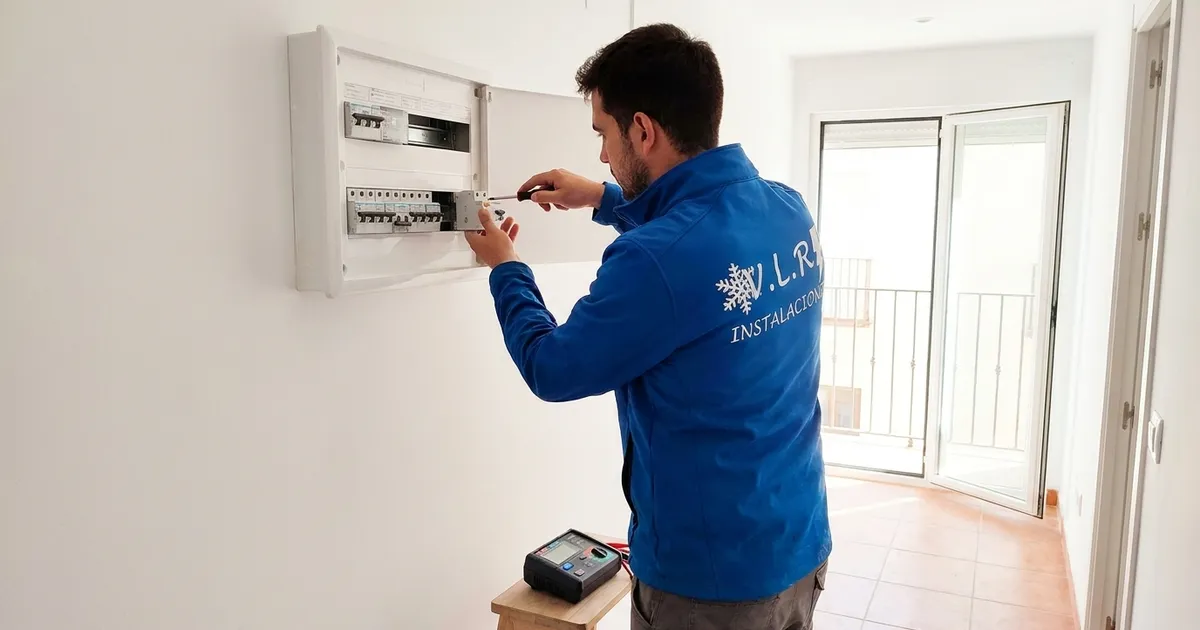
If you have read that the type AC RCD is being banned in Spain and that the type A RCD is the new standard, you have probably wondered three things: whether the one in your consumer unit (cuadro eléctrico) is the kind being banned, whether you will have to replace it, and what that would cost. Most of what you will find online is in Spanish, written for installers, or written to sell you a new device.
The short answer: you do not have to replace the RCD you already have. What Spain's new wiring regulations are expected to ban is fitting new type AC RCDs, and even that is not in force yet. Still, knowing the difference between the two types helps you decide when an upgrade is worth it, which in some homes is right now.
Type A vs type AC RCDs: what each one detects
An RCD (residual current device, the diferencial in a Spanish consumer unit) checks that all the current going out along a circuit comes back along it. If some of it leaks to earth, through a faulty appliance or through you, it cuts the power in a fraction of a second. If yours keeps tripping and you want to know why, that is a separate guide: why your RCD keeps tripping.
The types differ in which shapes of leakage they recognise:
| Type | What it detects | Typical circuits |
|---|---|---|
| AC | Sinusoidal alternating current only | Simple loads: heaters, traditional heating, incandescent bulbs |
| A | Everything type AC does, plus pulsating leakage with a DC component of up to 6 mA | Sockets, LED lighting, induction hobs, water heaters, electronics in general. The minimum under the new REBT |
| F | Everything type A does, plus the mixed-frequency leakage of single-phase variable-speed drives | Inverter air conditioning, heat pumps (aerotermia), washing machines with variable-speed motors |
| B | All of the above, plus smooth DC | EV chargers with more than 6 mA of DC, solar and batteries where the manufacturer specifies it, three-phase drives |
Why it matters: the electronics in a modern home, from LED drivers and induction hobs to chargers, washing machines and inverter air conditioning, rectify the current in order to work. When one of them develops a fault, the leakage can carry a DC component, and a type AC RCD is designed for pure AC only. Faced with that leakage it may not trip as it should, which is exactly when you need it.
That does not make your type AC RCD useless. It still protects you against AC leakage, which is most of it. It simply belongs to an era of incandescent bulbs and ceramic hobs rather than to what we plug in today.
If you have had electrical work done in the UK recently, this will sound familiar. Since the 2022 amendment to the UK wiring regulations (BS 7671), a type AC RCD may only serve fixed equipment known to draw no DC component, so type A has become the normal choice there. Spain is now heading the same way.
Is Spain banning type AC RCDs?
Not yet. When we published this guide in November 2026, the new REBT (Spain's low-voltage electrical regulations) had still not been published in the BOE (Spain's Official Gazette). Until it is, the 2002 regulations apply, and they allow type AC. What exists is a draft with a very clear direction. For everything else it changes, see our guide to the new REBT and what it means for your home. On RCDs, the revision of ITC-BT-17, the technical instruction that covers protective devices, provides for:
- A ban on fitting new type AC RCDs in domestic, residential and tertiary installations. In plain terms: homes, shops and offices.
- Type A as the minimum, or whatever the technical instruction for a particular case requires, such as type F or B for certain equipment.
- Type AC RCDs already installed can stay. There is no obligation to replace them.
- A two-year moratorium from publication and entry into force, during which type AC can still be fitted, so that existing stock can be used up and manufacturers can adapt production.
- Type AC remaining permitted elsewhere, essentially industrial installations with maintenance, where protection is chosen for the defined use of the installation.
Some readings of the draft in the Spanish trade press add a condition to that moratorium: during those two years, fitting a type AC would require written justification that nothing downstream of it produces pulsating or DC leakage. In a modern home, with LEDs, an induction hob and electronics on almost every circuit, that would be hard to justify, so the sensible assumption is that anything new will be type A at least.
Watch out for the headlines. The moratorium is a window in which type AC may still be fitted, not a countdown for the one in your consumer unit. If someone tells you that you "have two years to change your RCDs", that is not what the draft says.
Do I have to replace my type AC RCD?
Not by law. On the day the new REBT comes into force, your type AC RCD can stay where it is, like the countless consumer units from the 1990s that still work perfectly well.
What would change is replacement. If your RCD fails, or you carry out a renovation or extension once the new rules apply and the moratorium has ended, whatever is fitted in its place would have to be type A at least. Swapping like for like with another type AC would no longer be an option.
And there are cases where it is worth acting now, rules or no rules:
- Your RCD trips for no obvious reason: if you never find a faulty appliance, it is the classic case for a super-immunised RCD, covered below. Rule out a genuine fault first, with the steps in why your RCD keeps tripping.
- You are installing an EV charger: no need to wait for anything. ITC-BT-52 already requires every charge point to have its own 30 mA class A RCD, and it is part of every EV charger installation we carry out.
- You have, or are adding, a heat pump or inverter air conditioning: those circuits, with variable-speed drives, call for a type F. If you are still choosing between the two, see heat pump or air conditioning.
- You are going solar: the RCD on the inverter circuit is whatever the inverter manufacturer specifies (A, B or F). Ask before you sign the quote for your solar panels.
- Your RCD is old, or the test button does nothing: a typical service life is around 10 to 15 years. If it does not trip when you press the test button, it needs replacing now, and if it is being replaced, make it a type A.
- You are renovating or replacing the consumer unit: if the board is being opened anyway, fitting type A costs almost the same and leaves the installation ready for what is coming.
If your type AC RCD works, trips when you test it and you have not added anything new, there is no rush. It is an upgrade, not an emergency.
Super-immunised type A RCDs: what they are and when they are worth it
A super-immunised RCD, sold in Spain as superinmunizado and marked A-SI or simply SI, is not a separate type in the standard. It is a type A with reinforced immunity: it detects exactly the same leakage as a type A, and it is also designed not to trip falsely on disturbances that are not dangerous, such as harmonics and high frequencies from electronics, storm transients or the current spike when some appliances start up.
That matters because a home's electronics produce small, harmless leakage that can add up and trip a standard RCD. The result is the classic "it trips now and then and we never know why", sometimes with the house empty and the fridge off for days.
Because it is still a type A, it meets the minimum the new regulations are expected to set. It is most worthwhile in three situations:
- Homes with lots of electronics: LEDs throughout, computers, televisions, inverter units.
- Storm-prone areas: transients from a nearby lightning strike are a common cause of false trips.
- Holiday homes: a false trip while you are away means days without the fridge, the alarm or the pool pump.
Super-immunised versions of types F and B (F-SI and B-SI) also exist for the circuits that need those types. The word to use with a Spanish electrician is superinmunizado.
How to tell whether your RCD is type A or AC
Open the door of the consumer unit, only the door and never the cover over the wiring, and find the RCD: usually the widest switch, with a test button marked "T" and "30 mA" printed on it. Many homes have more than one. If you are not sure which switch is which, our guide to the Spanish consumer unit explained walks you through it.
The type is printed on the front of the device, as letters or as a symbol:
A single wave symbol, or the letters "AC": it is type AC. The wave with two half-waves beneath it, like two humps, or the letter "A": it is type A. If "SI" or "superinmunizado" appears next to the A, it is a type A with reinforced immunity.
If you cannot find any marking, assume it is type AC, which is what most consumer units in Spain have. And while you are there, press the test button: the RCD should trip instantly. It will cut the power to the circuits it protects, so switch the computer off first. If it does not trip, replace it, whatever its type.
What does it cost to go from type AC to type A?
Less than most people expect, because the device is the small part of the bill. These figures are Spanish market references, not our prices, and they are here to help you judge whether a quote is reasonable:
- The device: in Spanish electrical suppliers and DIY stores, a 40 A, 30 mA type A RCD, the usual size for a home, costs around €30 to €50 in mainstream ranges, even super-immunised. Not much more than the equivalent type AC.
- The whole job: Spanish quote-comparison portals put replacing an RCD, device and labour included, at roughly €50 to €200, and a super-immunised one at around €150. A call-out charge is sometimes added on top.
What pushes the figure up is everything other than the device: two RCDs instead of one, a circuit that needs a type F, or an old consumer unit with no spare space or wiring that is worth reorganising. If the board needs more than a device swap, it makes sense to bring it up to date in one go; there are guide figures in what a consumer unit replacement costs in Málaga.
This is not a DIY job. Even with the main switch off, the cables feeding the consumer unit stay live, and afterwards the RCD has to be tested with a meter to confirm it trips when it should. Use an authorised installer (empresa instaladora autorizada); here is how to check an electrician is registered in Spain.
How does this affect you in Málaga?
Across the province there are countless homes whose consumer units date from the 1980s, 1990s and 2000s and still have type AC RCDs, among them plenty of Costa del Sol apartments that were bought furnished and whose consumer unit nobody has touched since. They are not illegal, and the new REBT will not make them so, but they were designed for a different kind of home.
On the coast you also get the combination that causes the most false trips: inverter air conditioning in every room, LEDs everywhere and autumn storms. A well-chosen super-immunised RCD often fixes what years of "just flip it back up" never did.
If you are also thinking about an EV charger or solar panels on the roof, it is more practical to plan the consumer unit once: the right RCD for each circuit, plus surge protection, which the new REBT is also set to make mandatory in new installations and which we cover in surge protection in Spain: is it mandatory yet?
What we recommend you do now
Check which type you have. Ten seconds with the consumer unit door open settles it.
If it is type AC and gives you no trouble, do not rush. There is no deadline for what is already installed. When it is due for replacement, through age, a fault or a renovation, make the new one type A.
If it trips for no reason, or you are adding an induction hob, a heat pump, an EV charger or solar, act now. In those cases the upgrade makes sense today, new regulations or not.
Get the type in writing. On any quote that includes RCDs, make sure the type is stated (A, F, B, superinmunizado) and not just "diferencial 40 A 30 mA". It is the only way to compare two quotes properly.
Frequently asked questions about type A and AC RCDs
Are type AC RCDs banned in Spain?
Not yet. The draft of the new REBT would ban fitting new type AC RCDs in homes, shops and offices, with a two-year moratorium from its publication and entry into force so that existing stock can be used up. Until it is published in the BOE, Spain's 2002 regulations remain in force, and they allow them.
Will I have to replace my type AC RCD when the new REBT comes into force?
No. Type AC RCDs already installed do not have to be replaced. What would change is replacement: once the moratorium has ended, if yours fails or you renovate, the new one would have to be type A at least. Upgrading early is a voluntary safety improvement.
What is the difference between a type A and a type AC RCD?
A type AC RCD only detects sinusoidal AC leakage. A type A detects that too, plus pulsating leakage with a DC component of up to 6 mA, the kind modern electronics can produce: LED lighting, induction hobs, chargers or washing machines with electronic controls. Faced with that kind of leakage, a type AC may not trip as it should.
Is a super-immunised RCD a type A?
A super-immunised A-SI is, yes: it is a type A with reinforced immunity. It detects the same leakage as a type A and also filters out the disturbances that cause false trips, such as harmonics, high frequencies or storm transients. That is why it meets the minimum the new REBT is expected to set. Super-immunised versions of types F and B also exist.
How much does it cost to replace a type AC RCD with a type A?
As a market reference, Spanish quote-comparison portals put replacing a super-immunised RCD at around €150, device and labour included, and the device alone costs around €30 to €50 in shops. It costs more if several need replacing or the consumer unit needs reorganising. For what is already installed, it is a voluntary upgrade, not an obligation.
Want your consumer unit upgraded to type A?
At VLR Instalaciones we have been working on consumer units across Málaga province for over 20 years, as an installer authorised by the Junta de Andalucía, the regional government. We will tell you which RCD each circuit in your home needs without overselling: if yours can stay, we will say so, and we are happy to talk it all through in English.
If you want your RCDs replaced or your consumer unit brought up to date, get in touch for a no-obligation quote. We work to a fixed quote, so you will know the price before we start.